
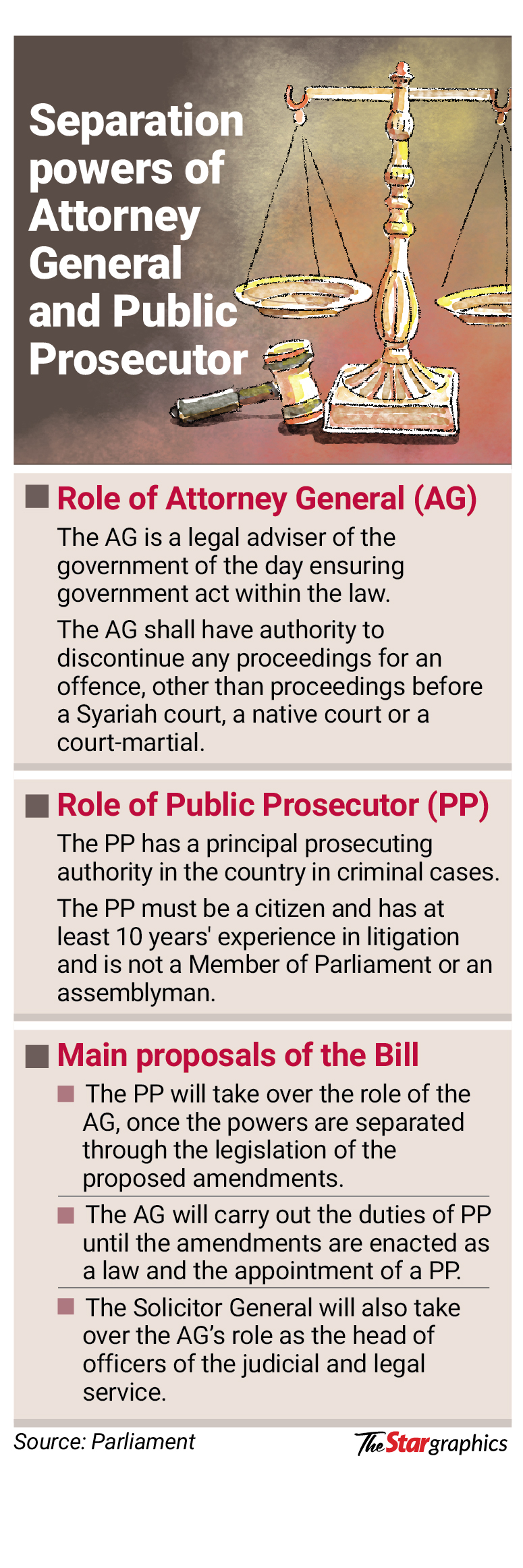
PETALING JAYA: The separation of powers between Attorney General (AG) and Public Prosecutor (PP) is a necessary structural reform to address unnecessary suspicion and enhance neutrality, legal experts say.
While supporting the reform, Malaysian Bar president Datuk Mohamad Ezri Abdul Wahab said the current constitutional framework which consolidates both powers in a single office gives rise to structural tension and public perception of conflict.
“Even when exercised with integrity, the dual role creates unnecessary suspicion.
“These functions (of both AG and PP) are conceptually distinct. One advises the Executive while the other determines whether to prosecute, including in cases involving members of the Executive or those connected to it,” he said when commenting on the tabling of the Bill to separate the powers of the AG and the PP at the Dewan Rakyat for first reading yesterday.
“Separation would clarify institutional boundaries, strengthen prosecutorial neutrality and align Malaysia with established practices in several Commonwealth jurisdictions. Ultimately, it is about strengthening public confidence in the rule of law,” he said.
“An independent PP, distinct from the government’s legal adviser, reduces the perception that prosecutorial decisions are influenced by political considerations.
“Independence must be both actual and perceived. In high profile or politically sensitive cases, public confidence depends on the assurance that decisions are based solely on evidence and law.
“If properly structured, the separation would enhance both the operational and perceived independence of the prosecutorial function,” he added.
Additionally, Mohamad Ezri emphasised that structural reform must be accompanied by clear safeguards.
This includes security of tenure, a transparent appointment process, an independent budgetary allocation and clear statutory delineation of powers.
“If accountability to Parliament is introduced, it must relate to reporting and institutional transparency, not interference in specific prosecutorial decisions.
“Independence does not mean the absence of accountability. It means accountability structured through law, not political influence,” he said, adding that the reform if implemented properly can help increase public trust in the justice system.
Constitutional law expert Assoc Prof Datuk Dr Shamrahayu A. Aziz said the reform was good as the PP could only be removed by a tribunal process similar to that applied to superior court judges, ensuring security of tenure.
“As the PP office is free from any interference, dissatisfaction or any conflict of interest, this will then be seen as a more trustworthy position,” she said.
“The appointment and dismissal of the PP is also supported by legal provisions which gives security of tenure to the position,” she added.