
PETALING JAYA: Parliamentary seats in Malaysia have remained at 222 since 2008 when the country had a population of around 27 million with over 10.9 million registered voters.
Going by data from the Department of Statistics, there are about 34.3 million people in Malaysia now.
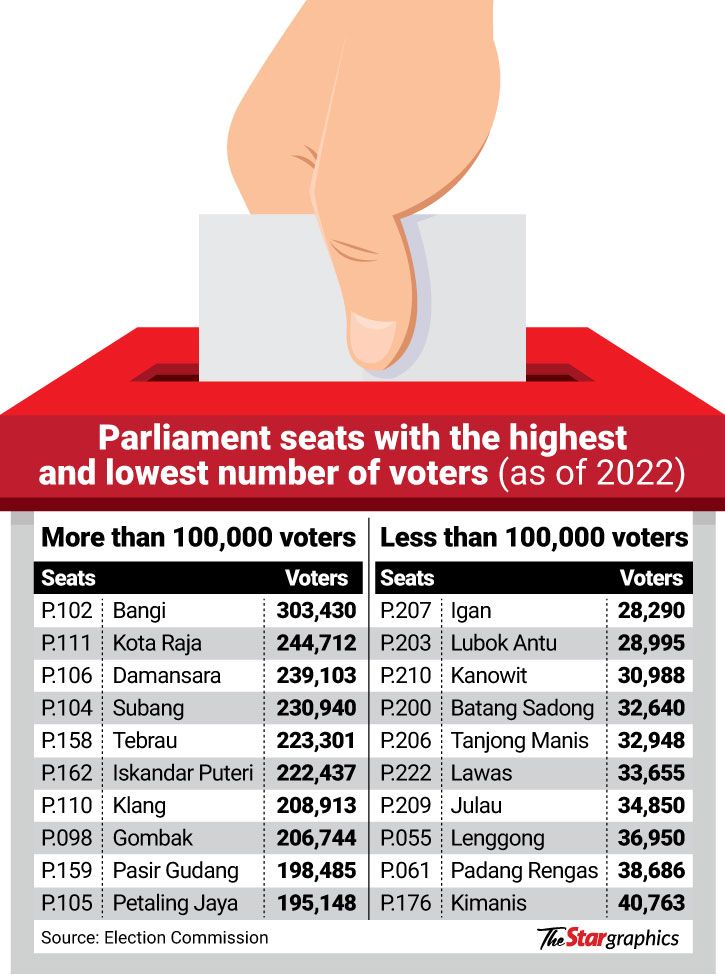
The Star’s analysis of the 222 parliamentary seats for the 2022 election data showed that 86 seats had over 100,000 voters.
That being the case, especially with 22.06 million voters registered with the Election Commission (EC) as of December 2025, should more seats be created through a redelineation exercise?
ALSO READ: EC can review electoral boundaries every eight years
From these seats with over 100,000 voters, seven had more than 200,000 voters, with Bangi in Selangor having the largest number at over 300,000.
Election analyst G. Manimaran said ideally a constituency should have between 60,000 and 100,000 voters as this number will ensure a reasonably fair representation.
“The EC should increase the number of seats by at least 15-20% of the current number, if we go by the size of the population and also by the formula that was used during the second, third, fourth and fifth redelineation exercises,” he said.
“Currently, we have about 50 constituencies with fewer than 60,000 voters, and most of them are below 50,000 voters. At the same time, Bangi, is estimated to have over 300,000 voters.”
He said the difference in voters in a seat also varies due to population density and the size of the area.
“For example, the number of voters in the Kinabatangan, Gua Musang and Lembah Pantai seats vary based on facilities due to the level of development, their sizes and the existing population,” he said.
“Another example is the Tuaran seat in Sabah, the area is said to be five times larger than the state of Perlis, which has three parliamentary seats.
“Perlis is 819sq km while Tuaran is 1,166sq km.
“The EC needs to take into account the aspect of area size, population density and existing facilities when considering the process of redelineation of constituencies.”
ALSO READ: Large constituency limits MP’s reach
Coalition for Clean and Fair Election (Bersih) chairman Muhammad Faisal Abdul Aziz said the number of parliamentary seats had remained unchanged despite the country seeing significant population growth.
“In contrast, the redelineation exercise conducted in 2018 focused largely on the readjustment of electoral boundary lines rather than increasing the number of constituencies.”
He said a review of electoral boundaries is crucial due to the substantial disparities in the number of voters between different constituencies.
“For example, the number of voters in the Bangi seat during the 2022 general election was 303,430.
“In contrast, Sabak Bernam recorded only 51,609 voters,” said Muhammad Faisal.
“This raises the question of whether such disparity is constitutional, given that the Thirteenth Schedule, Part I, Section 2(c) of the Federal Constitution provides that the number of electors within each constituency in a state ought to be approximately equal, except where greater difficulty is faced in reaching voters in rural areas and other hardships encountered by rural constituencies, which may justify a measure of weightage.”
However, in light of developments in rural infrastructure, including improved road networks and modern communication systems, the challenges of access and communication for rural voters have been significantly reduced, he added.
“As such, it may no longer be reasonable to justify a disparity as wide as that between Sabak Bernam and Bangi, which stands at roughly a 1:6 ratio.”
He said following the implementation of Automatic Voter Registration and Undi18, there is a 40% increase in the electorate, therefore the projections indicate a growing imbalance in the voter-to-constituency ratio across different areas.
ALSO READ: Remap seats to resolve voter imbalances, say MPs
“The unequal voter ratio is expected to worsen in the states of Kedah, Kelantan, Terengganu, Penang, Perak, Selangor, Kuala Lumpur, Negri Sembilan, Johor and Sabah.”
Muhammad Faisal said constituencies require redelineation due to their size.
“There are constituencies that cover two municipal councils. This makes it difficult for the MP to handle administrative issues, especially when it comes to complaints by voters on basic amenities,” he said.
Come March 9, it would be eight years since the last redelineation of electoral boundaries for Peninsular Malaysia. (For Sabah, it was February 2025 and Sarawak on Aug 21, 2023).
The EC has yet to make an official decision on redrawing the electoral boundaries.
When contacted, EC deputy chairman Dr Azmi Sharom said that while an eight-year period establishes the earliest start date for the exercise, it does not mandate that the exercise must commence then.
“That will be determined by the EC when we meet. But if you look at 13th Schedule of the Federal Constitution, it basically lays down the criteria. It’s very broad.”