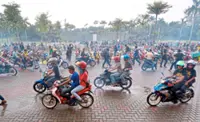
PETALING JAYA: The kapchai, a humble, lightweight motorcycle commonly found on Malaysian roads, is the nation’s deadliest vehicle, accounting for nearly 70% of annual road fatalities.
Data from the Road Safety Council of Malaysia found that these small-capacity motorcycles, particularly those below 150cc, are often lethal because their delicate structure offers almost no protection during mishaps.
“This leaves riders highly vulnerable to serious injury or fatality,” said Datuk Suret Singh, who is an executive member of the council.
He said that between 85% and 90% of the almost 16.8 million registered motorcycles in the country are kapchai, or small-capacity, models.
ALSO READ : Road safety experts: Smart lanes a double-edged sword
Despite it being a “lightweight”, he said the kapchai is often capable of speeds beyond 110kmph.
In an interview, Suret called for drastic measures to prevent more tragedies.
“Road safety interventions, which focus on commercial and passenger vehicles, should no longer continue ignoring the elephant in the room.
“Since small-capacity motorcycle riders constitute 70% of deaths, we must consider measures that control their usage and exposure,” he said.
He suggested a temporary six-day ban on motorcycles during the festive periods when roads are heavily used.
“Restricting the use of kapchai two days before, during and after a festive season could address this issue. This might seem extreme and unpopular, but lives matter.”
As an alternative during the temporary ban, he said that riders could carpool or use public transport.
Suret said statistics show that 34% of fatalities involving smaller bikes occur on federal roads, 32% on state roads, 22% on municipal roads and 12% on expressways.
Travellers could opt to travel by air, train, or bus, as these modes of transportation are known to be safer, he said.
As for bus operators, he said they must ensure speed limiter devices are functioning properly and that drivers do not exceed eight hours on the road without compulsory rest stops.
On another safety concern, Suret stressed that the use of rear seat belts can reduce the risk of serious injury by up to 50% in a crash and called for stricter enforcement to ensure backseat passengers buckle up.
Universiti Putra Malaysia Road Safety Research Centre head Assoc Prof Law Teik Hua noted that many Malaysians perceive the use of rear seat belts as “optional”.
“But in a collision, rear passengers can be flung forward with great force, endangering themselves and those in front,” he said.
“Wearing a rear seat belt is not about avoiding a fine but about protecting lives.”
Prof Law also reminded parents to ensure children are properly secured at all times.
“A few seconds spent buckling up could save a life,” he said.
He added motorists travelling long distances should ensure that their vehicles are in a roadworthy condition.
They should also take breaks every two hours and maintain patience and discipline while on the road.