KOTA KINABALU: Sabah’s fight against plastic pollution took a step forward after a four-month zero waste community project at a village in Tuaran wrapped up, providing villagers with recycling skills and a massive community clean-up.
The project in Kampung Gerinsing, Mengkabong in Tuaran, which began in September 2025 as a grassroots experiment, has now become a model for how villagers can turn waste into resources, discipline into leadership, and awareness into lasting change.
Driven by non-governmental organisation Zero Waste Sabah with support from All-Party Parliamentary Group Malaysia on UN Sustainable Development Goals (APPGM-SDG), the project equipped residents with hands-on skills in waste segregation, composting, and recycling.
Over four months, villagers attended workshops on zero waste practices, learned to make compost and fruit enzymes, as well as establish a community compost site to manage organic waste right at home.
“This pilot project proves that zero waste solutions, already successful in countries like the Philippines, India, and Vietnam, are replicable in Sabah,” said Zero Waste Sabah’s founder Ruth Yap following the end of the project on Sunday (Jan 25).
She said the project also proves that community-driven zero waste models can succeed where waste-to-energy (WTE) incineration falls short.
“By applying the 5R principles – Refuse, Reduce, Reuse, Recycle, Rot – the initiative fostered environmental responsibility, built local leadership, and recovered valuable resources.
“The government must look beyond incineration and invest in community-based alternatives to address Malaysia’s escalating waste crisis,” Yap said.
She explained that a waste audit was conducted involving 60 households, with rubbish categorised as 41% recyclables, 32% kitchen waste, 21% general waste, 5% special waste such as disposable nappies, sanitary pads and tissues, and 1% hazardous waste including bulbs and electronics.
She said 30% of the villagers committed to segregating waste and paying a monthly fee to sustain the programme while the waste collection system continued with scheduled pick-ups three times a week.
“We managed to create a waste collection system that not only collects waste but educates the community in the process to increase the awareness of the locals on plastic pollution, recycling and sustainable waste management,” she added.
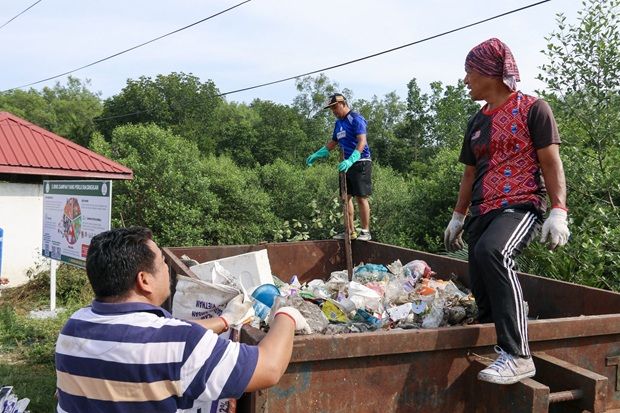
For the closing ceremony, a total of 80 participants including Tuaran MP Datuk Seri Wilfred Madius Tangau and APPGM-SDG advisor Dr Jain Yassin as well as Tuaran district officers, NGOs (Trash Hero Kota Kinabalu and Tuaran), Universiti Malaysia Sabah (UMS) Marine Science students and state government agencies, Institute of Development Studies (IDS Sabah) picked up 1,434.3kg of waste from mangrove areas in the village with 10.8kg of recyclables collected.