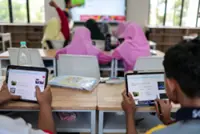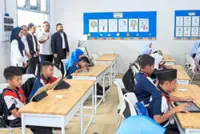
JOHOR BARU: Sekolah Rintis Bangsa Johor (SRBJ), or Bangsa Johor Pilot School, which adopts a digital-based learning approach, not only supports the national education digitisation policy but also solves the issue of heavy school bags among pupils.
A total of 2,500 iPads have been supplied to Year Four, Five and Six pupils at four SRBJ schools, complete with high-speed Internet access, in addition to modern facilities including the use of smart boards in every classroom.
Parents have shared positive feedback, noting that the use of tablets offers a more practical learning alternative while significantly reducing the physical burden on their children when attending school.
Danial Rahmat, 38, said the use of such devices has made the learning process more organised for his children, Damian Mikhael, 12, and Diandra Marsya, 10, who attend SK Tasek Utara without having to carry numerous textbooks and exercise books daily.
“Notes and homework can be completed directly on the tablet.
“I also see this as a step that could help reduce costs in the future, particularly in terms of book purchases, if it is implemented comprehensively,” he told Bernama.
Another parent, Fateha Novianti Azani, 37, said she sees the effectiveness of the devices as having the potential to bring changes to the national education ecosystem.
“Pupils no longer need to carry thick books every day because one tablet can replace many textbooks and exercise books. This device can also serve as a reference book that can be accessed anywhere,” she said.
The approach, according to her, fosters a more interactive learning environment by enabling quick access to technological facilities, aligning with the demands of 21st-century learning.
English teacher Nabihah Razali said that with the use of iPads, the Digital Educational Learning Initiative Malaysia (Delima) can be used optimally in classrooms, thereby reducing dependence on textbooks.
Delima is a digital learning platform designed to create an inclusive and dynamic learning environment for both teachers and students. It offers access to digital textbooks and various learning applications, enhancing the educational experience for all users.
However, Nabihah, who has served at SK Tasek Utara for 18 years, said the use of technology at SRBJ is implemented in a balanced manner alongside conventional learning methods, as textbooks and exercise books are still used depending on the tasks given.
“This is because subjects such as English still require writing skills, and we do not want pupils to lose those skills,” she said.
Science and Mathematics teacher Nur Hidayah Jamil noted that the approach emphasised at the school has enhanced the pupils’ proficiency in using technology.
“About 80% of pupils in my class are able to handle the devices with guidance from us as facilitators. Therefore, besides addressing the issue of heavy school bags, we are able to strengthen efforts to cultivate digital education,” said the teacher, who has served at the school for 16 years.