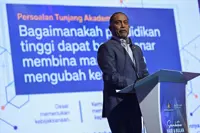
PUTRAJAYA: The Higher Education Ministry will take over the entire pre-university education system, including Form Six and matriculation programmes, starting next year, says Prime Minister Datuk Seri Anwar Ibrahim.
Anwar said the move would reclassify Form Six and matriculation students under the higher education framework rather than the school system, similar to how the Education Ministry oversees the pre-school sector.
"Just as the Education Ministry has taken over the entire pre-school system, the Higher Education Ministry will take over the whole pre-university system - Form Six and matriculation.
"This means Form Six and matriculation students will no longer be considered school students, but will fall under the category of higher education," he said when speaking at the launch of the National Education Plan 2026-2035 on Tuesday (Jan 20).
He said the decision was partly aimed at addressing long-standing concerns over limited course options and university placements, which have often affected high-performing students, including those from minority backgrounds.
To understand this problem, he has asked universities to increase the number of places in selected courses.
Following consultations with universities, Anwar said an additional 1,500 places would be created this year in high-demand fields, bringing the total increase to 3,000 places.
"These include law, accounting, finance and banking, Islamic finance, artificial intelligence, economics, Bahasa Melayu, English, communication, media studies, data science, data analytics and computer science," he said.
Anwar added that while matriculation and foundation students would continue to receive priority, the government has also given assurances that high-performing Form Six (STPM) students would not be sidelined.
For students with a CGPA of 4.0, universities will, to the best of their ability, offer them places, although course availability may still depend on the capacity of the university.
He said the broader reform agenda under the Higher Education Ministry would emphasise flexibility in learning pathways, moving away from rigid structures tied strictly to departments and faculties.
"This reform approach provides more flexible options. The education system should not be overly bound by rigid departmental or faculty structures. The details of this flexibility will be further explained by the relevant minister," he said.
Anwar also highlighted plans to strengthen polytechnics and community colleges, with a strong focus on digitalisation and artificial intelligence, adding that the ministry is in the process of drafting a Polytechnics and Community Colleges Act.
As part of this reform, 10 polytechnics will be upgraded progressively throughout the education planning period.
He further announced that the Technical and Vocational Education and Training (TVET) pathway would be introduced earlier in schools, beginning at Form One instead of Form Three.
"This is a precursor initiative. The Education Ministry will ensure that TVET pathways, whether in STEM or digital fields, are embedded within a more comprehensive and advanced TVET framework, allowing students to choose their specialisations earlier," he said.
Acknowledging that the expanded pathways would increase teachers' workload, Anwar said the government would step up efforts to reduce administrative burdens on educators and improve teachers' facilities.
After the salary increase, it is only appropriate that the government also improves teachers' facilities, not just school infrastructure.
"We are allocating an additional RM100mil now to improve teachers' rooms and related facilities," he said.
Anwar also raised concerns over declining reading habits among students, describing it as a global issue that Malaysia must actively address.
Interest in reading has significantly declined. He said the country must do something to sharpen talent within the teaching system by training children to read more, and to compel them to read, whether textbooks, selected reading materials or novels.
He added that education experts worldwide agree the culture of reading has weakened and must be revived as part of broader education reforms.