
‘Suku-suku separuh’ still best fit for Malaysians, say experts
PETALING JAYA: The United States has inverted the food pyramid with latest dietary guidelines for Americans to eat “real food” instead of ultra-processed fare with added sugars and refined carbohydrates, but feedback here is that it may not be the best for Malaysians.
The US dietary guidelines introduced this month feature an upside-down pyramid prioritising protein, dairy and healthy fats along with vegetables and fruits.
It also recommends the intake of refined carbohydrates such as white bread, ready-to-eat or packaged breakfast options, flour tortillas and crackers.
Experts here said that although Malaysians can take a cue from this approach, the previous food pyramid and “suku-suku separuh” (quarter and half) portion control method still worked best for Malaysians.
Nutrition Society of Malaysia president Prof Dr Mahenderan Appukutty said the emphasis on whole foods, fruits and vegetables, lean protein sources, whole grains and limiting added sugars and highly processed food was a sound recommendation which aligned with international nutrition science.
However, he said one must consider that dietary guidelines were developed based on specific cultural, food system and lifestyle contexts.
As such, Prof Mahenderan said what worked well in the United States and other countries might not be directly applicable to Malaysians as it required careful adaptation.
“Malaysians have distinct eating patterns, staple foods, culinary traditions and nutritional challenges that must be considered,” he said.
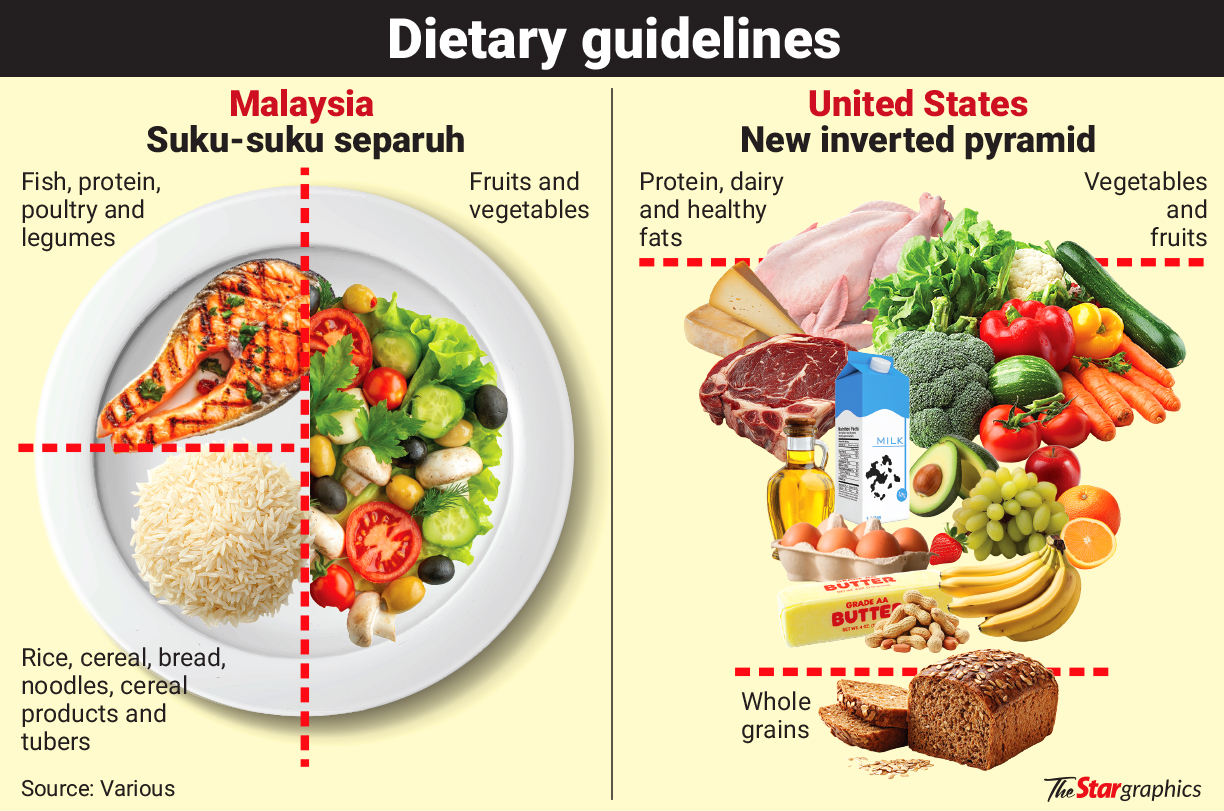
He added that the Malaysian Food Pyramid 2020 was still relevant, along with the estimation that 50% to 65% of daily energy comes from carbohydrates, 25% to 30% from fat and 10% to 20% from protein.
“The key message is not to avoid staple foods such as rice but to consume them in appropriate portions and balance them with adequate protein, vegetables and healthy fats,” he said.
From a public health perspective, he said the main issue was portion control and food quality, not the elimination of carbohydrates.
In practical daily settings, the simple suku-suku separuh model is an effective public health strategy, with half the plate filled with fruits and vegetables, a quarter with carbohydrates and the other quarter with protein.
“It is accessible, culturally appropriate and flexible across Malaysia’s multi-ethnic cuisines.
“This approach promotes moderation, portion control and dietary diversity, making it especially effective for the general population, including lower-income groups and individuals with limited nutrition literacy,” he said.
That said, Prof Mahenderan pointed out that the Malaysian Healthy Plate model did not explicitly distinguish between whole grains and refined carbohydrates, nor did it directly address processed foods, added sugars or sugar-sweetened beverages.
“This is where nutrition education and professional guidance are essential.
“Registered nutritionists continue to recommend reducing refined carbohydrate intake and increasing whole grains due to their higher fibre content and beneficial nutrients, including phytonutrients and antioxidants,” he added.
Reiterating that international dietary models could offer useful scientific insights, he advised Malaysians to continue relying on the Malaysian Dietary Guidelines and suku-suku separuh concept.
“The goal is not to replace local recommendations but to strengthen them using global scientific evidence while respecting local food culture and lifestyle.
“Continuous engagement with registered nutritionists for nutrition education, alongside active lifestyles and healthy eating, remain key to building a healthier Malaysia,” he said.
Malaysian Association for the Study of Obesity honorary secretary Dr Jasmine Chia Siew Min said the core message of shifting towards real food and reducing refined carbohydrates and added sugars was relevant to Malaysians with a high consumption of white rice, sweetened condensed milk and flour-based snacks.
“The Malaysian challenge is tied to our rich cultural heritage of communal eating, where refined carbs and hidden sugars have become the invisible baseline of every meal.
“The new US recommendations to embrace red meat and animal fats might be more controversial, especially in Malaysia where heart disease is the leading cause of death,” said the Monash University Malaysia’s School of Pharmacy lecturer.
She said the key was to understand that the type of processing mattered more than the type of food, with a piece of fresh beef being preferable to a low-fat vegan cookie loaded with preservatives, emulsifiers and sugar.
She said the suku-suku separuh model remained the most effective “anchor” for Malaysians as it directly addressed the local struggle with portion control and rice-heavy meals.
Dietitian Ng Kar Foo upheld the Malaysian Dietary Guidelines, saying it was developed primarily using Malaysian data and not outdated.
“While the new US dietary guidelines carry some positive and familiar messages such as emphasising whole foods and reducing highly processed foods and may sound more up-to-date or attractive in their presentation, this does not make our local recommendations obsolete,” he said.
Instead of relying on social media influencers without formal nutrition training, he said Malaysians should verify information through credible sources such as the Health Ministry, Nutrition Society of Malaysia and Malaysian Dietitians’ Association, or seek personalised advice from registered professionals.
The Malaysian Food Pyramid emphasises generous portions of fruits and vegetables as the base, followed by grains, rice and tubers as the second level. Then, protein-based foods and limited amounts of fats, oils, sugar and salt.