GEORGE TOWN: With their eyes, ears and other features dotted with red, the lions are ready to leap into the Chinese New Year and welcome the Year of the Horse.
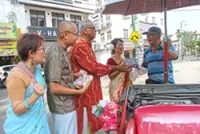
The traditional eye-dotting ceremony, known as “dian jing”, marks the ritual awakening of a new lion dance costume before its first performance.
Ching Xing Cultural and Sports Centre chairman Calvin Kwan said the ceremony symbolises the act of bringing the lion to life and empowering it to spread blessings.
“The ritual includes prayers and the sprinkling of holy water, followed by the use of a brush dipped in red ink to dot the eyes, ears, nose, tongue and spine, among others.
“This allows the lion to ‘see’, ‘hear’, ‘smell’ and ‘taste’, transforming it from a costume into an auspicious symbol believed to bring good fortune, health, prosperity and protection,” he said after leading the ceremony at the association’s centre in Air Itam yesterday.
Thirteen lions were “awakened”, with Kwan saying that more would undergo the ritual as the Chinese New Year draws closer.
“Lion dance performances take place throughout the year, but the demand for them surges sharply during the festive season, resulting in heavy use of the costumes.
“About 80% of lion dance costumes are now imported, largely due to a shortage of local masters skilled in crafting them by hand.
“Prices typically range from RM1,800 to RM2,500 per set, with some exceeding RM3,000 each,” he said.
Kwan, whose association is celebrating its 43rd anniversary this year, said the production method and materials used in lion dance costumes have largely remained unchanged over the years, with only minor adaptations and improvements.
“Modern lion heads use aluminium rods for the core structure of the head, weighing between 2kg and 4kg to improve durability while reducing strain on performers.
“However, bamboo and rattan are still used to shape it because their flexibility creates more lifelike and expressive movements.”
He said that traditional lion costumes were about 3m long, but the newer designs are shorter to allow greater agility, especially for performances on stilts.
Penang tourism and creative economy committee chairman Wong Hon Wai, who participated in the dotting ceremony, expressed hope that the lion dance can be listed as an Intangible Cultural Heritage by Unesco next year.
“Malaysia and China have jointly submitted a nomination to have the lion dance recognised as a Unesco Intangible Cultural Heritage.
“The joint nomination was submitted to Unesco in March 2025. It may take about two to three years, or even longer, before the committee convenes to assess the nomination due to the large number of applications received from countries worldwide,” he said.
While the lion dance originated from China, Wong said Malaysia had contributed significantly to its evolution and promotion, particularly through innovations such as the lion dance on stilts.
“We have preserved the tradition, elevated it to new heights, and brought it back to the international stage, a fact that has been recognised by China.
“That is why both countries are working hand in hand on this joint nomination,” he said.