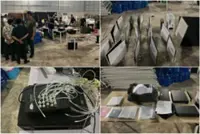
KOTA TINGGI: What began as an overseas job opportunity turned into a year-long nightmare for a 26-year-old Malaysian who was forced to work for an online scam syndicate in Myawaddy, Myanmar.
The victim, who wanted to be known only as Chew, said he was among 31 Malaysians safely repatriated on Dec 20 after being rescued from a scam compound during a security raid by Myanmar authorities.
Chew, who works as a ground staff member for an airline company at Singapore’s Changi Airport, said his ordeal began on Oct 1, 2024, when he came across a Facebook advertisement by a Thai-based e-commerce company offering trading opportunities for Malaysians.
“After expressing interest, I was told to fly to Bangkok, where I would be taken to the company’s warehouse,” he told a press conference organised by Stulang assemblyman Andrew Chen held at a food court here on Wednesday (Dec 31).
Chew said he booked a flight to Bangkok via Changi Airport and arrived on Oct 4, where a Thai man at the airport picked him up.
However, he was later told that the warehouse in Bangkok had flooded due to flash floods and that he would instead be taken to another warehouse in Tak, a town between Bangkok and Chiang Mai.
“I felt something was wrong when we arrived in Tak. It was a rural area, and I saw several armed men wearing army uniforms,” he said.
Chew said the armed men surrounded him before being forcibly taken across the border into Myanmar, where he was confined in a double-storey house in Myawaddy.
Inside the house, Chew said he found about 60 other Malaysians, both men and women, who were also victims of the same syndicate.
“We were forced to work as scammers. They took my mobile phone, Malaysian passport and MyKad,” he said.
Chew said the syndicate gave him a list and ordered him to recruit 30 victims from Hong Kong, regardless of age or gender.
“If I failed, I would be beaten, electrocuted or starved for more than a week,” he said.
He added that his role involved initiating contact with victims via Facebook before passing their details to other scammers, and he was unsure how many people eventually fell victim to the scams.
As most of the targets were from Hong Kong, Chew said he had to rely on Google Translate to communicate, as he did not speak Cantonese.
“The syndicate also created an app that made scammers sound like they were from the same place as the victims, making it more believable,” he said.
Chew said the syndicate offered various fraudulent schemes, including bogus investment opportunities, love scams and the sale of non-existent items.
He said he was forced to work under the syndicate for about a year, but was later told he would be handed over to another group due to poor performance.
“Before that could happen, Myanmar security authorities raided the base and rescued us,” he said.
Chew said he and other Malaysians were then taken to Thailand, where they were handed over to Malaysian Embassy officials.
“All of us returned home via the Immigration, Customs, Quarantine and Security Complex (ICQS) in Bukit Kayu Hitam, Kedah, on Dec 20,” he added.
On Dec 20, Sinar Harian reported that 31 Malaysians who fell victim to an online job scam syndicate in Myawaddy had been safely repatriated.
Wisma Putra said the Foreign Ministry, through its embassies in Bangkok and Yangon, successfully facilitated the repatriation of 31 Malaysian nationals.
The group arrived safely at the Immigration, ICQS in Bukit Kayu Hitam, Kedah, at 6.50pm on Dec 20 and were handed over to the Royal Malaysia Police for further investigation.
"Their identities were confirmed earlier by officials from the Malaysian embassy in Bangkok during a previous repatriation operation in early December.
"Their return could not be immediately arranged due to local immigration laws concerning illegal entry. However, thanks to the efforts and negotiations by the Malaysian embassy in Bangkok and the assistance of the Tak Immigration authorities, the group was released under Thailand's National Referral Mechanism (NRM) on Dec 19,” said Wisma Putra.