
PETALING JAYA: With days left before the year closes, taxpayers should be pressing the panic button now if they want to secure any remaining tax reliefs, tax experts warn.
The experts cautioned that only expenses actually paid by Dec 31, not planned or promised, will qualify for tax relief for the 2025 assessment year.
KPMG Malaysia senior tax policy adviser Dr Veerinderjeet Singh urged Malaysians to adopt a more proactive mindset by placing Dec 31 as the real deadline for action instead of waiting when the tax filing season arrives next year.
“Start the panic before the year is over. That’s what pushes you to get your receipts and documents in order.
“Once everything is in place, you are prepared to substantiate your eligibility for tax reliefs when you file early next year,” he said.
Veerinderjeet also highlighted that the scope for last-minute tax planning is limited considering there is less than two weeks left for the year, but pointed to several remaining fundamental reliefs which are doable if action is taken immediately.
Among them, he said, is the private retirement scheme (PRS), which offers up to RM3,000 in tax relief for individuals who invest before Dec 31.
“If you still invest before the end of the year into a unit trust or approved private retirement schemes, you can still claim the RM3,000 relief,” he said.
Another area where taxpayers may benefit from is medical-related reliefs – medical expenses or check-up costs of up to RM1,000, as well as vaccination expenses.
Veerinderjeet added that lifestyle reliefs should not be overlooked as those cover purchases such as books, electronic gadgets, tablets and computers, with claims capped at RM2,500.
Tax consultant Datin Christine Koh said many taxpayers mistakenly assume that commitments made before year-end, such as signing up for services or intending to make purchases, are sufficient for relief claims, when in fact only expenses incurred by midnight on Dec 31 are recognised.
“Tax reliefs must be incurred to be claimable. Mere intention or commitment does not qualify,” she said, urging individuals to rely on the Inland Revenue Board (LHDN) website for accurate and complete information.
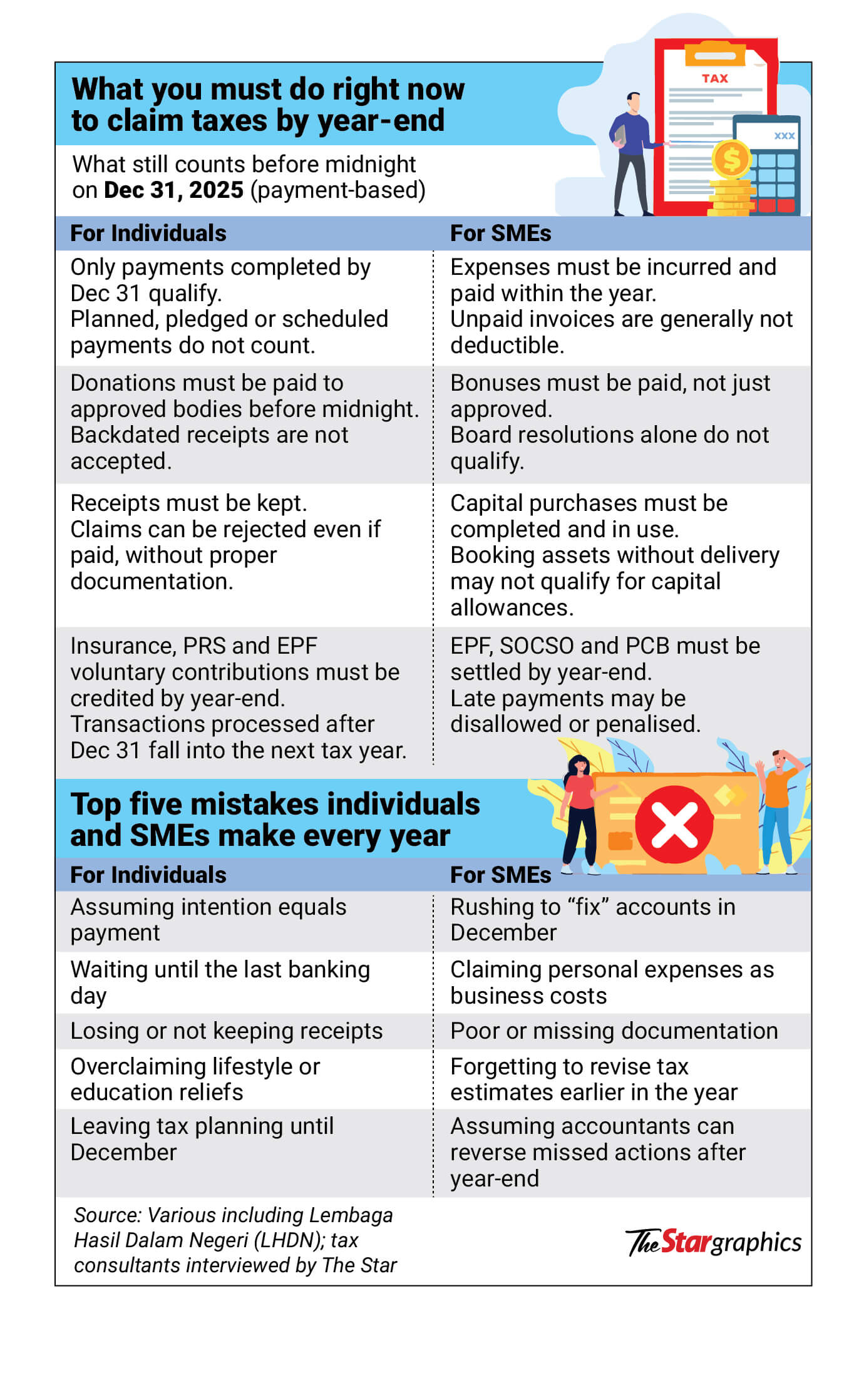
Koh advised taxpayers to review the official list of reliefs and identify those they have yet to incur, adding that payments must be made by year-end if they intend to claim.
She highlighted several new or expanded reliefs for 2025, including medical treatment relief that now covers grandparents, sports equipment purchases for parents, and a tax relief of up to RM2,500 for food waste composting machines.
Koh also flagged common pitfalls for married couples, particularly for National Education Savings Scheme (SSPN) and childcare reliefs, which can only be claimed by one parent even if both contributed.
Meanwhile, tax expert Renganathan Kannan said self-employed taxpayers making voluntary Employees Provident Fund contributions may claim relief of up to RM4,000, separate from the RM7,000 relief cap for mandatory EPF and life insurance, while net deposits into SSPN accounts are eligible for relief of up to RM8,000.
He added that lifestyle reliefs, including newspaper subscriptions, fall under a single RM2,500 cap and should be planned carefully to maximise tax benefits.
Small and Medium Enterprises Association of Malaysia national president Datuk William Ng said SMEs should focus on optimising the tax system rather than taking purely defensive steps as the year draws to a close.
Ng said many SME owners rush to bring forward expenses such as maintenance work, software subscriptions, professional fees or staff-related costs so they can be booked within the current financial year.
Others finalise bonus payments or settle outstanding liabilities at the last minute.
“At this stage, what is still possible are timing-related decisions. The bigger opportunities, such as capital allowances, automation incentives or restructuring remuneration, require planning months earlier,” he said.
Ng added that weak documentation and late awareness of tax exposure remain common problems, highlighting the need for regular financial reviews rather than treating accounts as a once-a-year compliance exercise.
He said SMEs that tracked their numbers earlier had time to plan reinvestments, upgrade equipment, automate processes or restructure costs in ways that also improved productivity and not just reduced tax.