
PETALING JAYA: The glow of cryptocurrency’s promise has cast a long shadow across Malaysia, not in the form of digital wealth, but in the electricity meters that never tick.
From Melaka to Sarawak, crypto mining activities are leaving behind multimillion-ringgit losses, fire risks and strained infrastructure.
In Melaka, police have intensified their campaign against illicit miners through an operation named Ops Elektrik Kripto.
Between 2023 and June this year, 52 raids were carried out, leading to the seizure of 634 pieces of equipment worth more than RM380,000.
Just this year alone, 18 raids uncovered 392 units of mining hardware, although only one arrest was made.
“These operations reflect our commitment to addressing the unauthorised use of electricity infrastructure for illicit purposes,” said state police chief Deputy Comm Datuk Dzulkhairi Mukhtar, stressing that syndicates often exploit technology at the expense of public resources.
Information released by the Melaka police revealed a steady increase in enforcement activity over the past two-and-a-half years.
While the identities of the masterminds remain under investigation, Melaka police noted a rise in covert mining operations, with many of the setups discovered in rented premises or vacant buildings designed to evade detection.
Melaka police also cited ongoing collaboration with utility providers and regulatory bodies in efforts to prevent electricity theft and other hazards linked to illegal mining operations.
The problem, however, is far from confined to one state.
In Sarawak, Syarikat Sesco Bhd, the operations and retail arm of Sarawak Energy Bhd (SEB), reported nearly RM31mil in losses since last year due to power theft linked to crypto mining.
There were 56 such cases last year with losses estimated at RM20.3mil while this year, there have been 29 cases involving estimated losses of RM10.6mil as of July 29.
However, SEB said existing laws and regulatory provisions were sufficient to govern and enforce action against power theft cases, including those involving cryptocurrency operations.
Under the state’s Electricity Ordinance, offenders face fines of up to RM200,000 and/or jail terms of up to five years.
SEB has urged property owners to exercise due diligence when renting out their premises, including having proper tenancy agreements and registering the electricity account under the tenant’s name.
“Landlords should also actively monitor their properties and report any suspicious activities that might indicate electricity misuse,” the company added.
Beyond the financial toll, Assoc Prof Dr Jasrul Jamani Jamian warns of systemic risks.
The Universiti Teknologi Malaysia Faculty of Electrical Engineering lecturer said, “While crypto mining does not destabilise the national grid as a whole, it wreaks havoc on local infrastructure.
“The real issue is localised planning.
“If Tenaga Nasional Bhd assumes an area has low power demand and designs new connections accordingly, hidden electricity theft from crypto mining could mean the actual load is much higher than recorded.
“When this unaccounted load is added to the grid, it can cause overloading of transmission lines, triggering protection system trips,” he explained.
Jasrul likened the situation to developing a new housing area based on inaccurate demand data.
“If the existing network is already carrying high loads due to theft, adding new consumers without realising the true capacity can lead to overloaded lines and even fires,” he noted.
There is also an environmental cost.
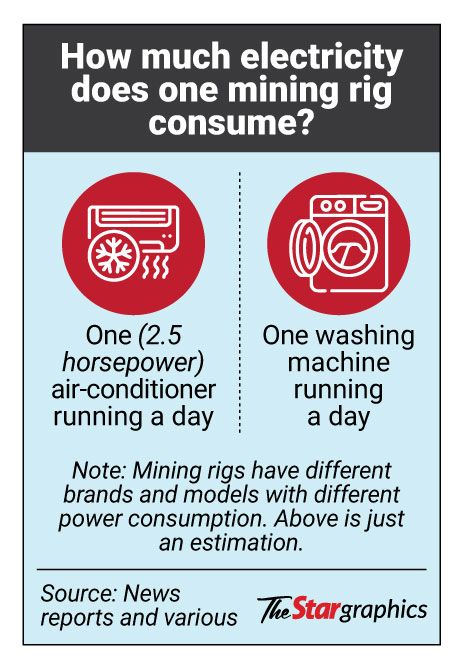
Crypto rigs run 24 hours a day, guzzling electricity largely generated from coal and natural gas.
“In Malaysia, 80% to 85% of our electricity is generated from coal or natural gas, so the greenhouse gas emissions are significant compared to normal consumption,” said Jasrul.
He added that tackling electricity theft was not just about stopping financial losses but also about ensuring a safe, reliable and sustainable power supply.