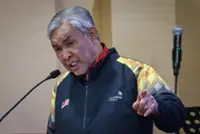
KUALA KUBU BHARU: The country's agricultural industry needs to be strengthened through Technical and Vocational Education and Training (TVET) to reduce dependence on food imports, says Deputy Prime Minister Datuk Seri Dr Ahmad Zahid Hamidi.
He stated that the move was crucial to ensuring food security, including in the dairy sector, to meet the domestic market's needs.
Ahmad Zahid, who is also the Rural and Regional Development Minister, said that the National TVET Council was prepared to channel assistance and collaborate with agricultural training institutions nationwide to implement the initiative, particularly through high-tech courses aimed at attracting the interest of young people.
"The existing modules are good, but in my view, integrating the Internet of Things (IoT) and modern teaching pedagogy into TVET is essential.
“Learning should comprise only 30% classroom sessions, with the remaining 70% conducted in the field to give students real-world exposure to agriculture," said Ahmad Zahid, who is also National TVET Council chairman.
He said this at a press conference after opening the groundbreaking ceremony of the Selangor Agricultural Development Corporation's (PKPS) "Ehsan Dairy Farm" Dairy Cattle Complex here on Sunday (Aug 10).
Also present were Selangor Menteri Besar Datuk Seri Amirudin Shari and PKPS Group Chief Executive Officer Datuk Dr Mohamad Khairil Mohamad Razi.
Ahmad Zahid also said that premium salaries should be offered to TVET graduates in the agricultural sector, rather than being tied to a minimum wage of RM1,700, to attract more young people to join the industry.
He said TVET graduates holding the Malaysian Skills Certificate (SKM) Level Three are eligible to receive a minimum salary of RM3,000, while those with SKM Level Five qualifications can earn up to RM5,000 per month.
"SKM Level Five is equivalent to a diploma, and due to strong market demand and high employability, it can command a premium salary of around RM5,000. This will certainly encourage young people to venture into this field," he said.
On "Ehsan Dairy Farm", Ahmad Zahid described it as a “game-changer” for PKPS in its efforts to boost local dairy production, thereby helping to reduce the country's reliance on imports.
"We import about 94.7% of the country's dairy needs, which is worth RM4.6mil a year. The Prime Minister (Datuk Seri Anwar Ibrahim), when tabling the 13th Malaysia Plan recently, highlighted that one of the significant burdens we face is the need to import food products, including dairy, from abroad,” he said.
The Ehsan Dairy Farm, expected to begin operations in early 2026, would be located on about 16.7 hectares at the Sungai Tengi PKPS Farm. It would house more than 1,200 Jersey-Holstein Friesian (F2) dairy cows from Australia, a country renowned for its expertise in industrial dairy farming. – Bernama