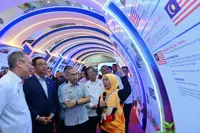
KUALA LUMPUR: Malaysia is committed to investing in regions bordering its Asean neighbours to boost economic growth, says Datuk Seri Anwar Ibrahim.
The Prime Minister said the Johor-Singapore Special Economic Zone was one example of such an initiative.
“Malaysia is also committed to investing in developing our border areas such as in the northern peninsula with Thailand, Sabah and Sarawak border with Kalimantan to promote economic activities for the benefit of people on both sides of the border,” he said during the Asean Investment Conference hosted by the Securities Commission here on Tuesday (April 8).
“By lowering barriers and coordinating policy between two closely linked economies, we create a demonstration effect— a case study in cross-border economic logic,” he added.
However, the economic integration within the region also extends to other areas.
ALSO READ: Asean should remain firm on core principle of open, free trade, says Amir Hamzah
Anwar also noted that green growth was no longer a matter of environmental virtue, but a strategic economic necessity.
“Technologies such as carbon capture, circular production models, and low-emission innovation are not peripheral experiments.
“Indeed, they are poised to define the industrial landscape of the coming decade,” he said.
He said this is because resilience requires investment in infrastructure that can weather storms, both in the literal and financial sense.
“Our South-East Asian neighbours are especially prone to natural disasters. Furthermore, the effects of climate change have become more insidious. Our capacity to manage adverse weather events, safeguard critical infrastructure and protect vulnerable communities must be significantly improved,” he said.
ALSO READ: Anwar: Officials to leave for US to begin tariff discussions
As for the digital economy, he said it offers both great promise and inequality.
“The region’s digital transformation is well underway, but uneven. Meantime, the trajectory of artificial intelligence is surging ahead with the speed of lightning. If the asymmetrical digital progress is left unchecked, it risks deepening divides. Investments in digital literacy, infrastructure, empowerment and governance must go hand in hand.
“Meanwhile, small and medium-sized enterprises, which form the bulk of our employment base, are often the most exposed to shocks and the least equipped to respond.
“Compliance with global sustainability standards is daunting for a company of, say, five people. That is why Malaysia, with the support of our partners, is launching the Asean Simplified ESG Disclosure Guide for SMEs. This is a practical tool to help small businesses take their first steps towards more sustainable and transparent operations,” he added.
ALSO READ: Tariff discussions held between Asean senior officials with US Treasury rep
As for the Asean power grid, he said the private sectors and multilateral development banks have been engaged on financing projects to transmit electricity from Vietnam to Kelantan via submarine cables and on to Singapore via land transmission lines.
Asean payment connectivity is set to improve with the launch of digital payment systems linking Malaysia, Indonesia, Singapore, and Thailand, as well as a payment link between Malaysia and Cambodia.
This he said will help promote intra-Asean trade and tourism.
He said the need for Asean to pursue economic integration is greater than ever now.
“At times like these, there is a temptation to retreat into nostalgia or fatalism, to assume that the international order is beyond repair or that regional cooperation is too slow to matter,” he said.
ALSO READ: Amir Hamzah: US tariff fiasco presents Asean with both challenges and opportunities
“But Asean has always been a creature of evolution, not revolution. Its strength lies not in drama, but in durability.
“Over nearly six decades, it has withstood wars, crises, and coups, and still managed to inch forward, often frustratingly, but forward nonetheless.
“Our vision for Asean is a prosperous, sustainable, and inclusive region. This will require political will, serious capital, fortitude and a strong dose of good fortune. It will also require swift progress in initiatives at the sub-regional level,” he said.