



PETALING JAYA: An accurate reflection of the country’s socio-economic demographics is vital to the national effort in eradicating poverty, a task made tougher in the Covid-19 economic landscape.
The government took heed of this and increased the national poverty line last year, the first review in 15 years.
Praised by many as a bold move, the revision saw an increase of the monthly household income from RM980 to RM2,208; pushing the country’s poverty rate from 0.4% in 2016 to 5.6% in 2019.
Minister in the Prime Minister’s Department (Economic Affairs) Datuk Seri Mustapa Mohamed (pic) said studies conducted by his ministry estimated that the poverty line income (PLI) could increase by 3% due to the pandemic, pushing the country’s poverty rate to more than 8% in 2020.
“We are informed that the figure may be larger than reported and therefore we will go to the ground to see the actual situation, ” he said recently.
The higher number does not look pretty, but for Mustapa, an accurate reflection of the Malaysian livelihood is vital to draft effective policies to eradicate hardcore poverty.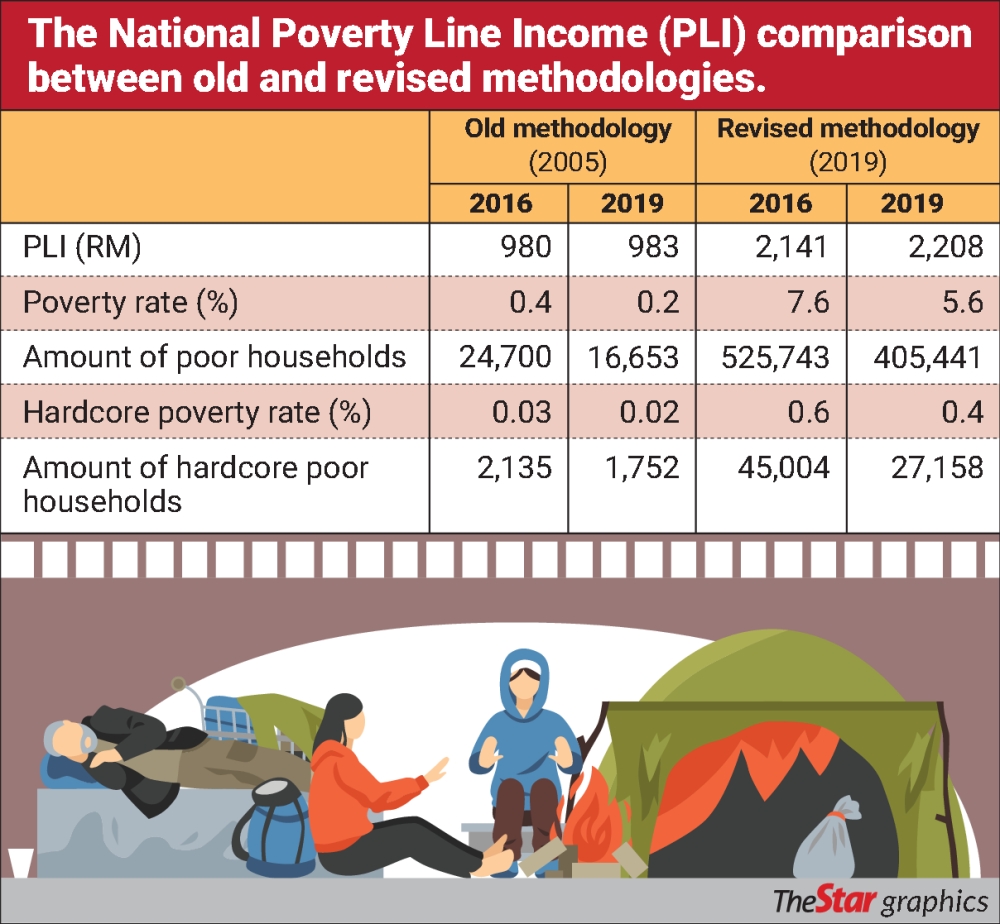
“I want to ensure that data collected on poverty is accurate. I will head to the Taman Maluri PPR and, beginning next week, I will go to Kota Marudu, Sabah, with the necessary team to validate the numbers, ” he said.
Program Perumahan Rakyat (PPR) is a government programme to resettle squatters and provide housing requirements for low-income earners.
Previously, Mustapa said the PLI would be revised under the 12th Malaysia Plan (12MP) to craft a more targeted and focused approach to tackle poverty effectively.
Mustapa, fondly known as Tok Pa, said 2020 was a year of unprecedented challenges and with that, the government had responded by rolling out aids such as the EPF i-Sinar withdrawals, the wage subsidy programme, loan moratoriums and various welfare programmes.
“Most importantly, we realise that we are not perfect. But, we listen to the people and this is a responsive government, ” he said.
To address the economic impact on various sectors, the government through the Economic Action Council secretariat under the Economic Planning Unit (EPU) organised many forums with stakeholders.
“We did our best and we believed that we saved many lives and livelihoods, ” he said.
Mustapa added that the delayed 12MP was expected to see several changes due to the Covid-19 pandemic.
“It is an ongoing process involving various engagements with stakeholders, the private sector, ministries and academics.
“The 12MP will focus on people-centric development, addressing the Covid-19 economic fallout, setting the country’s direction for the coming five years, accelerating economic growth and ensuring that the nation’s wealth is distributed evenly and equally, ” he said.
He also stressed that 12MP would focus on reducing income gaps nationwide and prioritising growth in Sabah and Sarawak.
“12MP is nearly completed; it is still undergoing some updating, ” he added.
On a positive note, Mustapa expressed optimism for 2021, saying that with the national vaccination programme running, the path to economic recovery should be clearer ahead.
“With a caring government that listens to the people, we will do our best and we are confident that we will achieve full recovery this year compared to 2020, ” he said.
Already a subscriber? Log in
Get 20% OFF The Star Digital Access
Cancel anytime. Ad-free. Unlimited access with perks.
