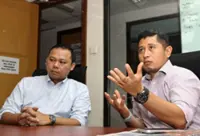
The young ace


Youth and Sports Minister Syed Saddiq Syed Abdul Rahman is championing the “Yellow Ribbon” initiative, a campaign to encourage the public to change their perceptions towards former convicts.

Our Youth and Sports Minister wants to lead a generation of empowered young people, and he is not leaving anyone behind. 

AS a former champion debater, Youth and Sports Minister Syed Saddiq Syed Abdul Rahman rarely pauses when you speak to him, but when asked about his Yellow Ribbon campaign to support ex-convicts, he seemed to choke up for a bit.

His confident demeanour as he fielded questions on politics and press freedom took a change as he spoke about a former schoolmate who was committed to the Henry Gurney correctional school.

“He was sidelined by family and friends, couldn’t get a job because of the criminal record, and in the end, an unfortunate tragedy happened,” said Saddiq, who became visibly emotional.

The minister is determined to change public perception, and wants to lead the way by hiring three ex-convicts to work in his office in the ministry.

“Being in the position that I am, I should not just speak up for the privileged or average youth, but also for the youths at risk,” pledged the 25-year-old, who is the youngest minister in Malaysian history.

The Yellow Ribbon campaign is the latest in Saddiq’s ministerial agenda, including advocating for e-sports and various youth issues.

The fresh-faced Minister, who is also Muar MP, is hardly a political veteran, but his social media influence and optimism at advocating for young people makes him a face to watch.

He recently took R.AGE on a tour of his office in Putrajaya before settling down for a one-on-one conversation about the challenges of being the nation’s youngest Minister, how his ministry will uphold press freedom, and the impact he hopes to leave behind.

R.AGE: Can you bring us back to the time you won the election?

I knew I had won my parliamentary seat at about 8.30pm, so I was already excited like never before. As the results came in one by one, I thought “man, we are actually doing the impossible”, that history could be made. But in less than a few hours, we also knew that the burden on our shoulders was exceptional. So the excitement was there, but we were quickly overwhelmed with a sense of duty and responsibility.

> Some people have said that someone more experienced would probably have been a better choice for Youth and Sports Minister, and that you should start off as deputy minister. How does that make you feel?

I always believed that the best way to prove the skeptics wrong is through one’s success. The same narrative was used against me when I was fielded as the parliamentary candidate. People said I should start off as a state assemblyman first. But in the end it’s about showing that one’s age doesn’t define one’s experience, maturity and success. In reality, it’s how the person works and the moral consciousness which a person puts into that work.

If in any other parts of the world you can have people like Justin Trudeau, Emmanuel Macron, or Sebastian Kurz who’s already a chancellor at the age of 32, being a minister at 25 is not impossible. It can be done and I must perform. In the end, I need to prove to Malaysians that it’s not just about me, that all young people should be given a chance to lead, and when they are given that chance, they can shine and succeed.

> You’ve advocated for lowering the voting age to 18. Should we also lower the age for election candidates?

Definitely. I know there has been brickbats on this front, saying “Ah 18-year-olds yang masih tidur bawah ketiak ibu”, are immature. But voting ages are 18 across the world and in Asia. Even Singapore is debating to reduce the voting age to 18. It signals the distrust of the electorate in young people when they don’t believe 18-year-olds should be given the right to make a big decision. Ironically, that very same community believes that those at 13 or 14 years old can get married.

I don’t think it’s controversial to say that the decision to get married is humungous in comparison to voting, which comes every five years, whereas marriage often lasts a lifetime.

Beyond that, looking at countries like Indonesia in the 1960s-1970s, the UK in the 1920s-1930s, and US in the 1950s, those were times when young people did not have access to the Internet, the rate of literacy was exceptionally low and tertiary education was minimal. Even then they gave young people the right to vote, because they knew that they represent not just the present but the future.

So in Malaysia today where the literacy rate is almost 95% to 100%, and Internet penetration is huge, education is better, why are young people still seen as incapable? It would be up to our generation to prove that if opportunities are not given to us, we will find them and we will disrupt, as we are the disrupters.

> Have you ever felt unfairly targeted because of your age?

Yes, but that’s the challenge. There has been a myriad of people before me who have broken walls after walls, and opened up the path for me to be here. I need to pave a larger path for more young people to climb up. So while the criticisms are there, we must confront these challenges together, because in the end it’s about youth power and succeeding together.

I remember the first time I spoke in Parliament, one of the MPs called me a “budak”. He then apologised, but there were also a few who tried to heckle me. There was a parliamentary debate between me and my predecessor (Rembau MP Khairy Jamaluddin), where I was talking about the need for transparency and integrity in an open-tender process, and he said I didn’t know anything about the open tender process.

I responded with a list of problems that occur when we do not have an open tender process, and the public judged on their own. In the end, it’s a normal part of a parliamentary democracy. There will be those who try to heckle, but you just take it in and fight back.

> You recently called on the media to focus on more important topics than the social media “ice bath” post. Do you stand by that statement?

Once, I had answered a critical question in Parliament about reforming the Malaysian Stadium Corporation, which governs main stadiums in Malaysia. We are in debt of RM30mil to RM60mil, though in reality if we did the work well, we could actually milk a profit and return money to our athletes.

But when I exited (Parliament), the media asked me (about the “ice bath” post).

I really wanted the media to ask me (about the stadium issue) though I understand why some media wanted to focus on (the “ice bath” post), and they have the right to do so because it’s not about media censorship. At the same time, it’s my responsibility to redirect attention to more pressing issues, especially things which fall under this ministry. It’s not for me to dictate but it’s for me to advise, and in the end we’ll try to reach a middle ground.

> On that note, Pakatan’s election manifesto promised press freedom. How could you and your ministry help to make that happen?

I agree with that 100%, which is why when there is a way for me to add value to ensure that press freedom would be upheld, I would do so. In the Cabinet meeting when it was discussed how to approach the media, Printing Presses and Publications Act, and the Anti-Fake News Act, these are all part of something which I have spoken quite vocally about to ensure that press freedom can be sustained.

Politicians can change quickly, but it is the press who holds them to account. If we repeat the mistakes of the past by trying to monopolise the press, even politicians who are conscientious and start off well tend to lose their identity and moral consciousness, because they know they are shielded from criticisms. In the end they lose themselves, and I don’t want to lose myself.

That’s why it is important not to be arrogant, to always work with the press and answer criticisms, and go through a process of self-reflection to know what we could have done better to move forward.

It’s critical that we uphold press freedom in all layers of government and corporate sectors, because without free press it is difficult to have a free democracy.

> What inspired you to come up with the “Yellow Ribbon” campaign?

It’s for both personal and public reasons. I had a friend who was one of the best students in school. But because of a mistake, he spent some time in Henry Gurney. Even as a non-violent offender, his family sidelined him, his friends left him, and he didn’t get a job because of the criminal record. In the end, an unfortunate tragedy that could have been avoided, happened.

Everyone deserves a second chance, because if we don’t then the person is more likely to reoffend. Do we really want to be like the United States, which claims the strongest democracy and fights for human rights, but their rate of recidivism is almost 60%? We spend so much on prisons, but in reality there should be a lot more rehabilitation and second chances to move Malaysia forward.

I care a lot because there are many young ex-convicts. These are people who are young and made mistakes, and I have a responsibility to speak up for these groups.

Being in the position that I am, I should not just speak up for the privileged or average youth, but also fight for belia berisiko (youths at risk). If we sideline this group, we are sidelining one of the most emotionally vulnerable groups in Malaysia.

> France recently won the World Cup with a team full of descendants of immigrants. Is Malaysia doing enough to integrate immigrants and refugees into our society?

I am happy to hear that the Education Ministry will integrate children of refugees into our school system, as these are people who are pushed into the corners of desperation and have suffered violent war crimes, genocide and crimes against humanity.

It’s much better to integrate than to sideline and ostracise them, because it’s the same problem which we were talking about again (with former convicts), and it becomes a vicious cycle. There’s a lot more that Malaysia can do, and I believe that the new government will do so to move forward.

> What’s the one legacy you hope to leave this ministry in five years?

I want all groups of young people to feel that they are empowered, and know that their voices will be heard by this new government. That no matter which field they are in, they are young decision-makers, and that by the end of this term, young people will feel a lot more empowered than before. No one can ever look at them and say just because you are 16, 18 or 25, that you should not have a say in the nation-building agenda.

Get 20% OFF The Star Digital Access

Monthly Plan

RM 13.90/month

RM 11.12/month

Billed as RM 11.12 for the 1st month, RM 13.90 thereafter.

Best Value

Annual Plan

RM 12.33/month

RM 9.87/month

Billed as RM 118.40 for the 1st year, RM 148 thereafter.

Follow us on our official WhatsApp channel for breaking news alerts and key updates!

Next In Nation

Bangladesh seeks Malaysia’s help to address urgent LNG shortage, says PM
Negri polls: Analysts can analyse, but voters are those voting, says Aminuddin
Welder dies while repairing water tank in Parit
Teen found drowned after being swept away by current in Sungai Kampar
Negri polls: 91% turnout for early voting, says EC
Company gave RM1mil to Bersatu after securing RM141mil contract, court hears
Enforcement of amended rice act will not target paddy farmers, says Deputy Minister
Immigration nabs 50 illegal immigrants in Kulai
Locals first when hiring, foreign workers only when needed, says Ramanan
Selangor MB orders immediate action over illegal foreign settlement in Setia Alam

Others Also Read