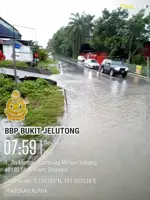
PETALING JAYA: Forcing your way through flooded roads or highways may turn an ordinary journey into a life-threatening ordeal, warns the Fire and Rescue Department.
Its director-general Datuk Seri Nor Hisham Mohammad said floods can conceal damaged road surfaces, collapsed sections, open drains, potholes and debris.
“Strong currents can also cause vehicles to lose traction, float or be swept away.
“Water entering a vehicle’s engine or electrical system can cause it to stall, leaving occupants trapped.
“Do not underestimate the depth, speed and force of floodwaters,” he said in an interview.
Drivers, he said, must never assume that a four-wheel-drive vehicle is capable of safely navigating floods.
“Even larger vehicles can be swept away under the right conditions. The safest decision is to turn back, use an alternative route, or wait until the road has been confirmed safe by relevant authorities. No journey is worth risking a life,” he said.
Last week, pre-dawn flash floods forced the emergency closure of critical sections along the New Klang Valley Expressway (NKVE) and the North-South Expressway Central Link (Elite) near Shah Alam.
According to highway concessionaire Plus Malaysia Bhd, all lanes at NKVE KM 9.1 between Shah Alam and Subang remained completely closed in both directions as of 9.04am on Nov 4.
Nor Hisham also said receded floodwaters in housing areas do not mean the danger is over.
Among the biggest mistakes residents can make is assuming their homes are safe to enter after a heavy downpour.
“Residents should never immediately switch on the main electrical supply or use appliances that have been submerged.
“Water can damage insulation and electrical components, creating risks of electrocution, short circuits and fires.
“Electrical installations affected by flooding should be inspected and tested by an electrical contractor registered with the Energy Commission before being reused.
“The main switch should only be operated when it can be reached safely from a dry location,” he said.
He added that residents should also inspect structural elements for visible cracks, leaning walls, damaged ceilings and signs of ground movement.
“Look out for indications of damaged gas installations. If a gas leak is suspected, avoid operating electrical switches, lighting flames or using anything that can generate sparks. Leave the premises immediately, keep others away and contact the authorities,” he said.
For cleaning activities, Nor Hisham advised residents to wear appropriate protective equipment, including waterproof boots, gloves and suitable respiratory protection where necessary.
“Post-flood recovery must be carried out safely and systematically. Restoring a house to its previous condition is important, but protecting the lives of its occupants must always come first.”