
ONCE a home of the Manhattan Project, the fields surrounded by forested valleys and rolling hills in Oak Ridge, Tennessee, could soon yield another nuclear first.
Concrete foundations and pilings are going up for one of the first small modular reactors, marking a new generation of nuclear power plants.
The company behind it, Kairos Power, has been developing its technology for almost a decade and is now deep in construction.
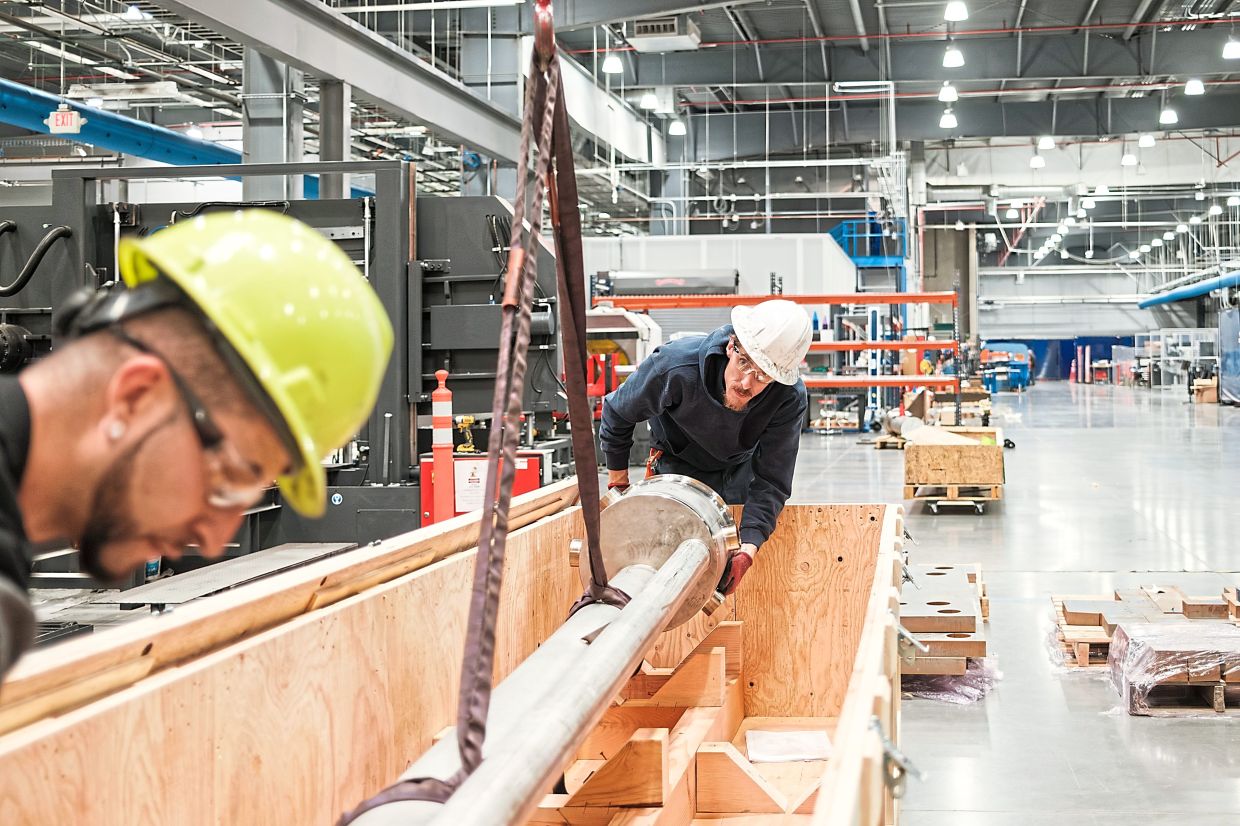
Many companies are racing to build reactors that could, over time, be cheaper than the large-scale plants that have dominated the industry for decades.
To hear corporate executives and government officials tell it, the world is at the dawn of a new nuclear age, one that promises abundant energy for households, industry – and the staggering appetite of artificial intelligence technologies.
At the centre of the promise is a simple idea: shrink the vessels where nuclear reactions heat water to produce steam.
Smaller reactors can be mass-produced and assembled more easily than conventional designs, which rely on armies of highly-skilled workers.
The nuclear industry has long struggled to complete projects.
Almost all US nuclear plants in operation started decades ago; few have been built since. Steep costs, long delays and safety concerns have stymied the sector.
“I think a lot of people recognise the value of what nuclear can bring but are still a little bit nervous about whether it can actually be done,” said Mike Laufer, co-founder and CEO of Kairos Power.
“Credibility can be very hard to earn, but it can be lost very quickly.”
The United States has more reactors than any country, but it trails in new construction.
Over the past decade, China built more than three dozen reactors, while the United States completed just two – at the Alvin W. Vogtle Electric Generating Plant in Georgia, years late and nearly three times over budget.
Nine years ago, the three founders of Kairos Power began developing their designs, pinning hopes on a new approach.
All three studied nuclear and mechanical engineering at UC Berkeley, where J. Robert Oppenheimer, leader of the Manhattan Project, once taught.
Kairos opted to test each phase of development as it progressed, rather than follow the conventional “design, construct, hope for the best” method.
Unlike traditional plants, Kairos’ reactor will not have domed concrete buildings or billowing water towers. Instead of water, it will heat salt.
The reactor will rise just over 10m. The full commercial design includes two reactor buildings and a turbine across a footprint of 24ha.
Kairos, with 540 employees, designs and produces many of its components nearby in Albuquerque, New Mexico, close to Los Alamos, the Manhattan Project’s ultimate headquarters.
High costs and the challenges of first-of-a-kind projects have hampered the nuclear industry.
NuScale, once expected to deliver the first small reactor, cancelled a project in Idaho last year after utility agreements fell through due to rising costs.
Its technology is now advancing through a partnership with Entra1 Energy and the Tennessee Valley Authority, with units in Oak Ridge projected to deliver power by 2030.
At its Oak Ridge site, Kairos is building a test reactor expected in 2028, and a demonstration unit capable of producing electricity is slated for 2030.
The company has a contract to supply 500 megawatts – about half the capacity of a large-scale plant – to Google by 2035.
Tech companies investing in AI bring money and focus that were missing during the last US nuclear resurgence.
Kairos and others will use TRi-structural ISOtropic particle fuel, or Triso, developed by the Department of Energy.
Thousands of poppy-seed-size uranium kernels are coated in carbon and ceramic, embedded in golf-ball-sized graphite pebbles. The shell contains the radioactive material as it produces heat.
With the fuel’s built-in containment and molten salt coolant, reactors won’t need the same costly reinforced buildings required by conventional plants – though some scientists caution that risks remain.
“In my view, the claims that are being made about Triso are way oversold,” said Edwin Lyman, director of nuclear power safety at the Union of Concerned Scientists. “We’re really headed towards a very dangerous experiment on the American people.”
Charles Oppenheimer, grandson of J. Robert Oppenheimer and CEO of Oppenheimer Energy, is optimistic.
He said Kairos “has been executing very well. The other ones that are making more noise aren’t building as much. In this game, it never counts until you’ve got it running”.
For now, the Oak Ridge fields are quiet except for construction crews and equipment. In less than a decade, the region that once birthed the atomic age could host a new chapter in America’s nuclear story – smaller, smarter reactors promising cheap, reliable power, if the technology delivers. — ©2026 The New York Times Company
This article originally appeared in The New York Times