WHEN Oxford University initially posted an Instagram to celebrate the discovery of a rare Rafflesia hasseltii in West Sumatra, it credited only British botanist Chris Thorogood, failing to name the Indonesian researchers who made the discovery possible.
Indonesian researchers and the public responded decisively. The backlash was swift and massive. Former Jakarta governor Anies Baswedan captured the collective anger in a viral post.
"Our Indonesian researchers, Joko Witono, Septian Andriki and Iswandi, are not NPCs. Name them too," he said. The metaphor struck a nerve. NPCs, or non-playable characters, exist only as background scenery in video games. They serve the hero's journey, but never become protagonists themselves.
The comparison revealed a centuries-old pattern: local knowledge is transformed into Western discovery through systematic erasure. This controversy raises uncomfortable questions about how scientific collaboration actually works.
Indonesia has laws to prevent knowledge extraction. International partnerships are supposed to ensure equal credit. Yet, the erasure happened anyway.
Understanding why requires looking beyond individual mistakes to the structures that make such omissions routine. The Oxford incident was not an isolated lapse in communication.
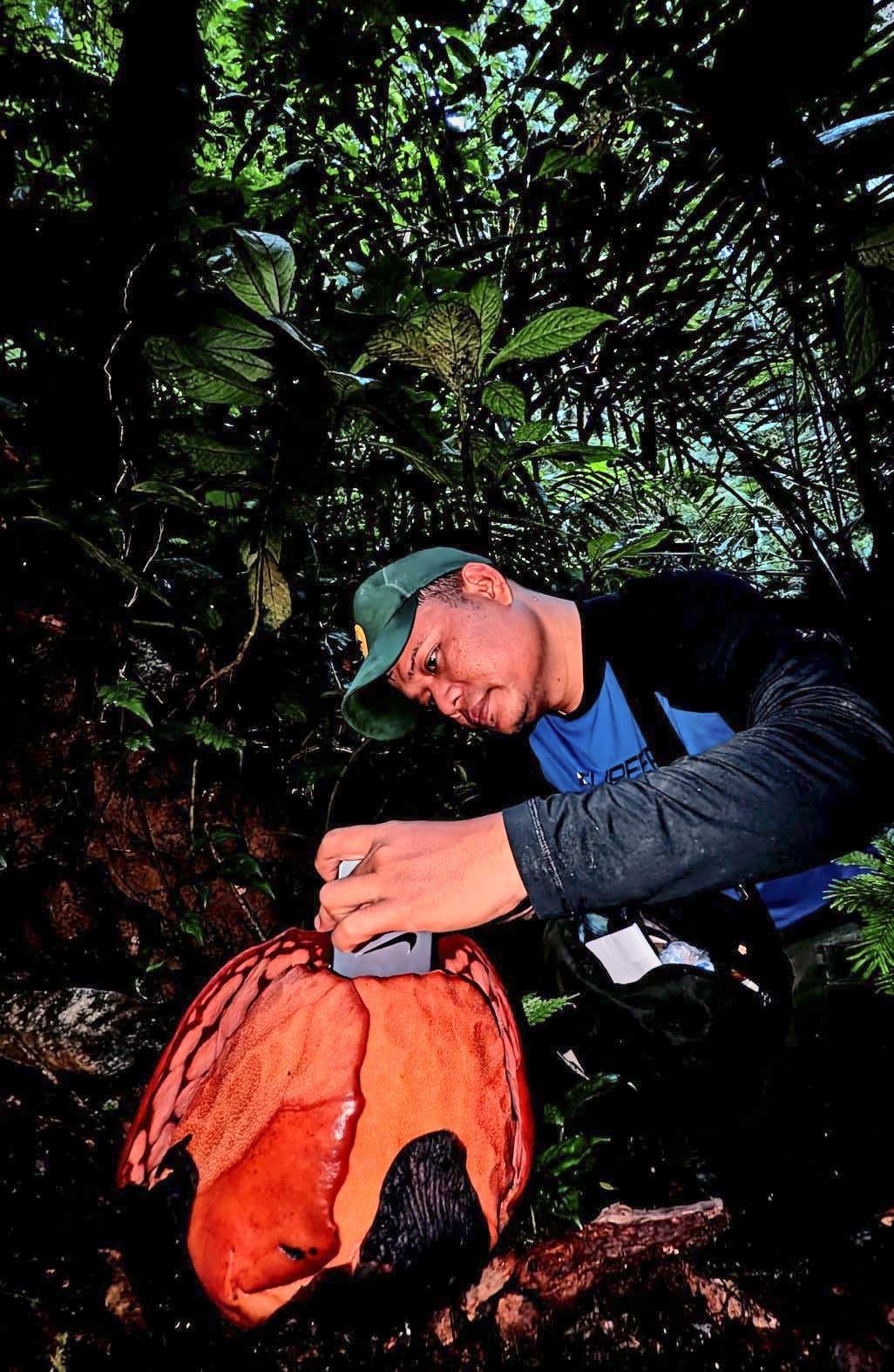
Septian “Deki” Andriki spent 13 years searching for Rafflesia hasseltii. When he finally found the blooming flower, he wept with joy. Yet Oxford's institutional communications initially omitted Indonesian names entirely, while Thorogood's personal posts referred to them merely as “foresters of West Sumatra” who shared their “special flower”.
This pattern has a name in scientific circles: parachute science. Foreign researchers arrive, collect data using local expertise, and then publish without proper attribution. The practice remains common despite growing criticism.
Research on coral reef studies published in 2021 found that host-nation scientists are excluded from authorship nearly twice as often when research is conducted in lower-income countries compared to high-income nations (Stefanoudis et al., 2021).
Each erasure compounds into a structural disadvantage. Indonesian researchers produce excellent science yet remain invisible in international narratives.
Indonesia’s 2019 National Science Law mandates equal partnership in research collaborations, including provisions for fines and research bans for violations. Formal agreements had been established for the Rafflesia research, recognising Indonesian collaborators as partners.
Yet, when the communications team crafted their post, Indonesian names disappeared. The gap between policy and practice reveals something more profound than oversight. Formal equality does not overcome the unconscious hierarchies that shape how institutions process information.
Western researchers become protagonists by default, local collaborators become scenery, regardless of their actual contributions. This separation has colonial roots.
In the early 19th century, Stamford Raffles conducted botanical work in Indonesia. The Rafflesia genus itself memorialises this colonial naming practice. Similar patterns continue today, dressed in the language of international partnership rather than explicit extraction.
After the backlash, Oxford issued corrections and apologies. The Indonesian researchers were finally identified, as indicated by the “Edited” tag on the Instagram post. But the damage was done.
The initial post had already spread globally, establishing a narrative of British discovery. The corrections reached only a fraction of the original audience.
The discovery was actually part of a study conducted by Indonesia's National Research and Innovation Agency (BRIN) in collaboration with the University of Bengkulu and the Bengkulu Rare Plant Care Community. It is part of the First Regional Pan-Phylogeny for Rafflesia project, which seeks to reconstruct the evolutionary tree of all Rafflesia species in South-East Asia. The work is funded by the University of Oxford Botanic Garden and Arboretum and BRIN’s RIIM Expedition Program.
What is obscured in this process are the diverse forms of knowledge that enable discovery. Deki’s years of ecological knowledge mattered. His relationships with forest communities enabled the finding. His capacity to locate rare species through lived experience proved essential.
Yet this expertise became invisible in Western scientific narratives. What counted was the Western institution's ability to validate and publish the findings. The knowledge itself got separated from the knowers who produced it.
The viral backlash forced Oxford to acknowledge its error, but can genuine change happen within existing structures? Some researchers argue for moving beyond seeking recognition from Western institutions.
Instead, they advocate building alternative platforms where Indonesian scientists lead narratives about Indonesian biodiversity.
This involves publishing first in Indonesian journals, establishing terms of collaboration, and determining when and how to engage with international partners. Others focus on reforming existing structures, advocating for stronger enforcement of partnership laws, enhanced training for international institutions on research ethics, and more diverse representation on editorial boards.
Both approaches recognise that the Oxford incident demonstrated something crucial: millions of Indonesians will no longer quietly accept erasure. Coverage across every major news outlet and intervention by political figures showed that the time for passive acceptance has passed.
Real systemic change requires looking beyond corrected social media posts. Western institutions must examine how unconscious biases shape their narratives. Who becomes the protagonist is not just about malicious intent; it reflects deep patterns regarding whose knowledge counts and whose contributions merit recognition.
Partnership agreements need genuine enforcement mechanisms that include oversight of public communications, not just publication authorship. Scientific institutions need to value different forms of expertise.
Deki’s field experiences represent knowledge that cannot be quickly acquired through formal training. Yet, current systems privilege Western scientific validation over local ecological expertise. The conversation also needs to shift from individual attribution to understanding how collective knowledge production actually works.
Science advances through collaboration. Framing discoveries as the work of lone heroes obscures the reality of how knowledge gets made.
The Oxford-Rafflesia controversy matters beyond one social media post. It represents accumulated historical patterns of who gets credited in science. Each erasure reinforces the message that Indonesian researchers exist to support Western science, never to lead it.
This affects not just individual careers but national scientific capacity. The intensity of the public response showed that Indonesians understand these stakes.
The controversy has not really been about one omitted name. It has been about whether Indonesian researchers will ever be seen as equal partners in producing knowledge about their own country. Indonesian researchers are scientists, experts, and knowledge-holders in their own right.
The Rafflesia incident demonstrated that they will demand recognition and reshape how scientific collaboration works. — The Jakarta Post/ANN
Benni Hasbiyalloh is lecturer at Paramadina University, Jakarta.