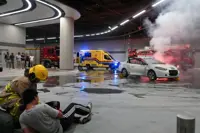
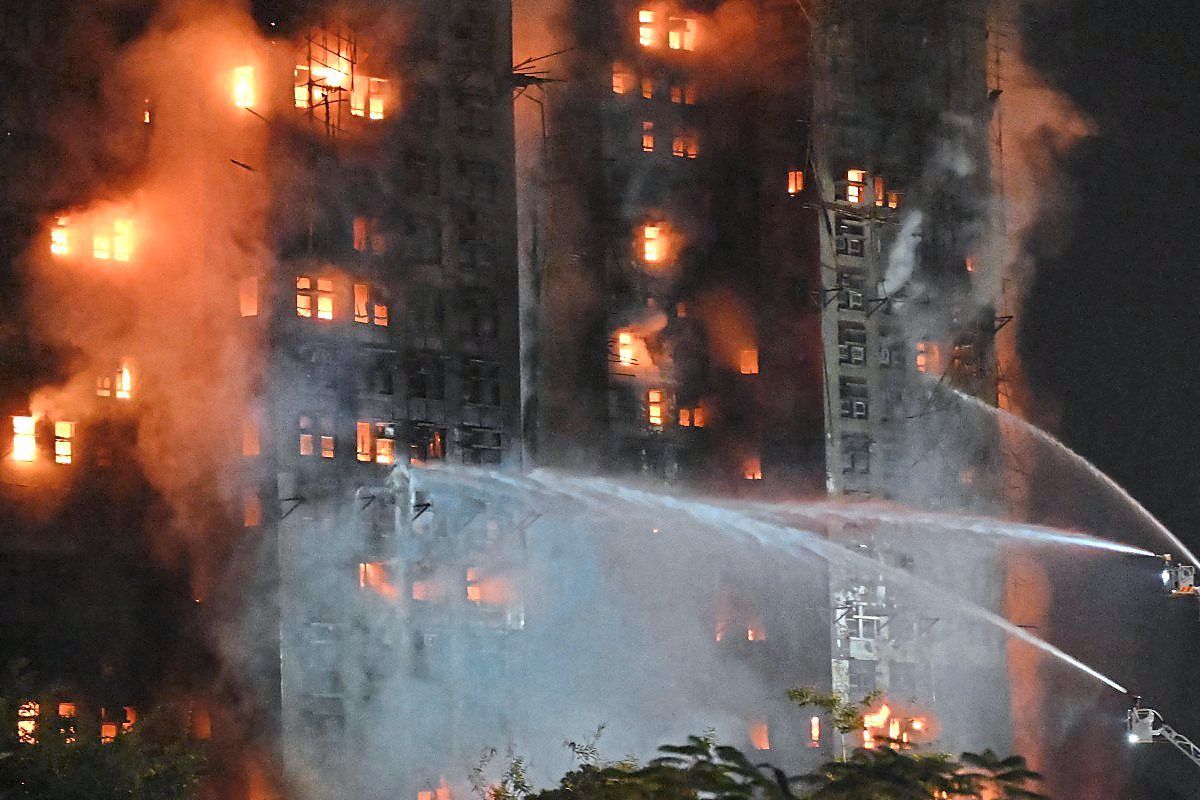
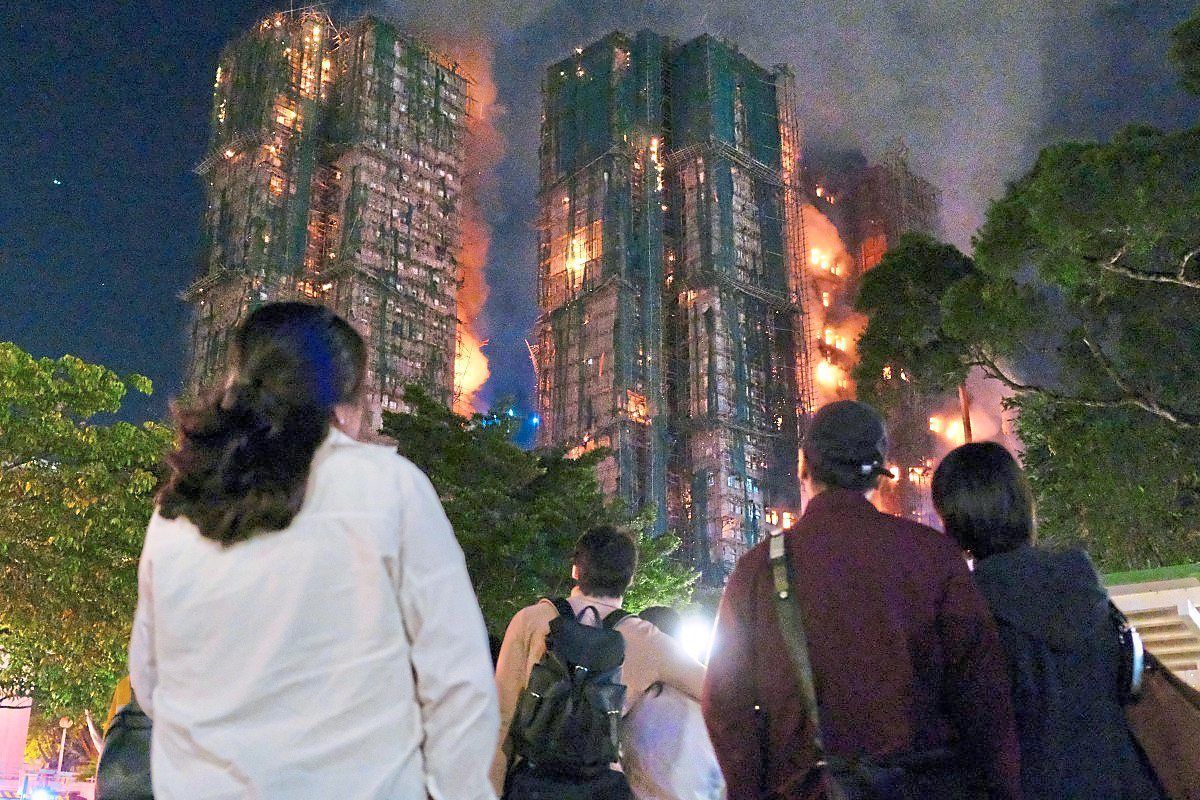
THE Hong Kong high-rise fire, which spread across multiple buildings in a large residential complex, has over 100 people, with hundreds reported missing.
The death toll at the time of writing was over 140, with close to 150 people still unaccounted for and scores in hospital with serious injuries.
This makes it one of Hong Kong’s deadliest building fires in living memory, and already the worst since the Garley Building fire in 1996.
Although more than 900 people have been reportedly evacuated from the Wang Fuk Court, it’s not clear how many residents remain trapped.
This catastrophic fire – which is thought to have spread from building to building via burning bamboo scaffolding and fanned by strong winds – highlights how difficult it is to evacuate high-rise buildings in an emergency.
When the stakes are highest
Evacuations of high-rises don’t happen every day, but occur often enough. And when they do, the consequences are almost always severe. The stakes are highest in the buildings that are full at predictable times: residential towers at night, office towers in the day.
We’ve seen this in the biggest modern examples, from the World Trade Center in the United States to Grenfell Tower in the United Kingdom.
The patterns repeat: once a fire takes hold, getting thousands of people safely down dozens of storeys becomes a race against time.
But what actually makes evacuating a high-rise building so challenging?
It isn’t just a matter of “getting people out”. It’s a collision between the physical limits of the building and the realities of human behaviour under stress.
It’s a long way down to safety
The biggest barrier is simply vertical distance. Stairwells are the only reliable escape route in most buildings.
Stair descent in real evacuations is far slower than most people expect. Under controlled or drill conditions, people move down at around 0.4 to 0.7 metres per second (m/s). But in an actual emergency, especially in high-rise fires, this can drop sharply.
During 9/11, documented speeds at which survivors went down stairs were often slower than 0.3 m/s. These slowdowns accumulate dramatically over long vertical distances.
Fatigue is a major factor. Prolonged walking significantly reduces the speed of descent. Surveys conducted after incidents confirm that a large majority of high-rise evacuees stop at least once. During the 2010 fire of a high-rise in Shanghai, nearly half of older survivors reported slowing down significantly.
Long stairwells, landings, and the geometry of high-rise stairs all contribute to congestion, especially when flows from multiple floors merge into a single shaft.
Slower movers include older adults, people with physical or mobility issues, and groups evacuating together. These reduce the overall pace of descent compared with the speeds typically assumed for able-bodied individuals.
This can create bottlenecks. Slow movers are especially relevant in residential buildings, where diverse occupants mean movement speeds vary widely.
Visibility matters too. Experimental studies show that reduced lighting significantly slows down people going down stairs. This suggests that when smoke reduces visibility in real events, movement can slow even further as people hesitate, misjudge steps, or adjust their speed.
Human delays
Human behaviour is one of the biggest sources of delay in high-rise evacuations. People rarely act immediately when an alarm sounds. They pause, look for confirmation, check conditions, gather belongings, or coordinate with family members.
These early minutes are consistently some of the costliest when evacuating from tall buildings.
Studies of the World Trade Center evacuations show the more cues people saw – smoke, shaking, noise – the more they sought extra information before moving. That search for meaning adds delay. People talk to colleagues, look outside windows, phone family, or wait for an announcement. Ambiguous cues slow them even further.
In residential towers, families, neighbours and friend-groups naturally try to evacuate together. Groups tend to form wider steps, or group together in shapes that reduce overall flow. But our research shows when a group moves in a “snake” formation – one behind the other – they travel faster, occupy less space, and allow others to pass more easily.
These patterns matter in high-rise housing, where varied household types and mixed abilities make moving in groups the norm.
Why stairs aren’t enough
As high-rises grow taller and populations age, the old assumption that “everyone can take the stairs” simply no longer holds. A full building evacuation can take too long, and for many residents (older adults, people with mobility limitations, families evacuating together) long stair descents are sometimes impossible.
This is why many countries have turned to refuge floors: fire- and smoke-protected levels built into towers as safe staging points. These can reduce bottlenecks and prevent long queues. They give people somewhere safe to rest, transfer across to a clearer stair, or wait for firefighters. Essentially, they make vertical movement more manageable in buildings where continuous descent isn’t realistic.
Alongside them are evacuation lifts. These are lifts engineered to operate during a fire with pressurised shafts, protected lobbies and backup power.
The most efficient evacuations use a mix of stairs and lifts, with ratios adjusted to the building height, density and demographics.
The lesson is clear: high-rise evacuation cannot rely on one tool. Stairs, refuge floors and protected lifts should all be made part of ensuring vertical living is safer. — The Conversation
Milad Haghani is associate professor and principal fellow in urban risk and resilience, The University of Melbourne, Erica Kuligowski is principal research fellow, School of Engineering, RMIT University, and Ruggiero Lovreglio is professor in digital construction and fire engineering, Te Kunenga ki Purehuroa – Massey University.
This article was first published in The Conversation.