



AT Seoul’s Yeouido Hangang Park, the mecca for the city’s running crews, four new taboos are shifting the vibe of the jogging trail.
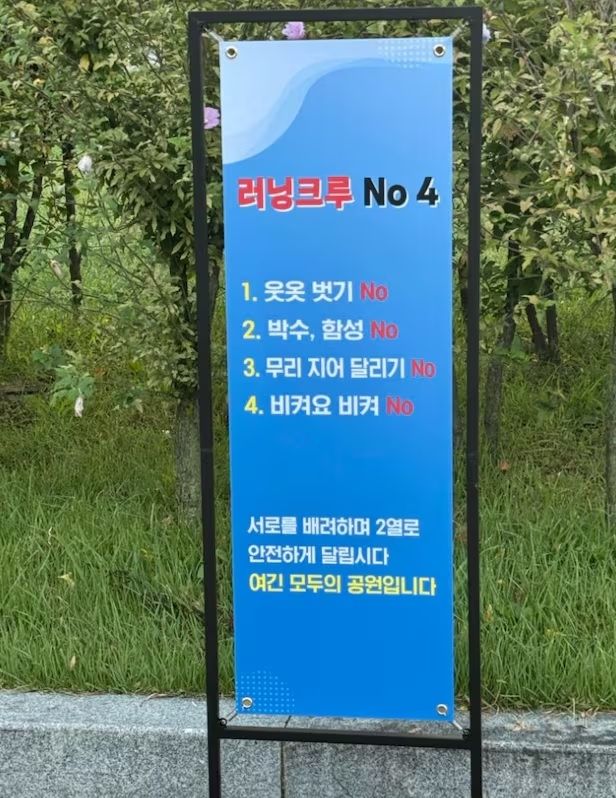
A banner, posted along the walkway, outlines the four guidelines which prohibit: 1) shirtless running, 2) clapping or cheering, 3) running in large groups and 4) shouting “make way” at other pedestrians.
The banner comes amid a surge of group running clubs across the city, prompting growing complaints about public nuisances they can cause, including noise and pedestrian inconvenience.
This is not the first time group runners have been restricted.
The shirtless prohibition, however, leaves many perplexed.
Some running crew members and fitness enthusiasts argue that criticism of shirtless running reveals the divide between those who work out and those who don’t.
Yun Jeong-hoon, a trainer in his 30s at a gym in Seoul’s Gangnam District, tells The Korea Herald that running shirtless is not about showing off, but rather a form of “self-motivation.”
“I still remember an elderly man running shirtless along the Hangang River who gave me a cheer as I ran beside him. That moment became a great source of motivation for me to keep exercising,” he says.
He notes that shirtless running functions as a way to find motivation by observing others’ bodies as well as one’s own, and to closely track physical changes.
“People who exercise see it through the lens of fitness, while non-exercisers often regard it as provocative simply because it’s unfamiliar to them.”
Often running shirtless with his friends, Yun believes going topless fits well with the spirit of running.
“Running is a sport that symbolises freedom. That’s why some even choose to run barefoot. It maximises the feeling of escaping daily constraints, and that’s what makes it so enjoyable,” he says.
At the same time, he says he recognises the criticism and avoids running shirtless in crowded spots.
Jin Jang, 29, who runs with the running crew DRBR in Mokpo, South Jeolla Province, shares Yun’s sentiment, saying, “I don’t think running shirtless itself is wrong. But if the majority feels uncomfortable in certain places, it’s right to refrain from it.”
Meanwhile, for some foreign residents, the backlash against shirtless running is a culture shock.
“It’s simply easier to run without a heavy, sweat-drenched shirt,” says Beaudette, 34, an English instructor from Quebec, Canada, living in Korea.
“In my country, the attitude is that it’s fine as long as it doesn’t directly harm others. Because we spend so much time in outdoor school sports clubs from a young age, sweating and even showing your body is considered normal,” he says. — The Korea Herald/Asia News Network
