
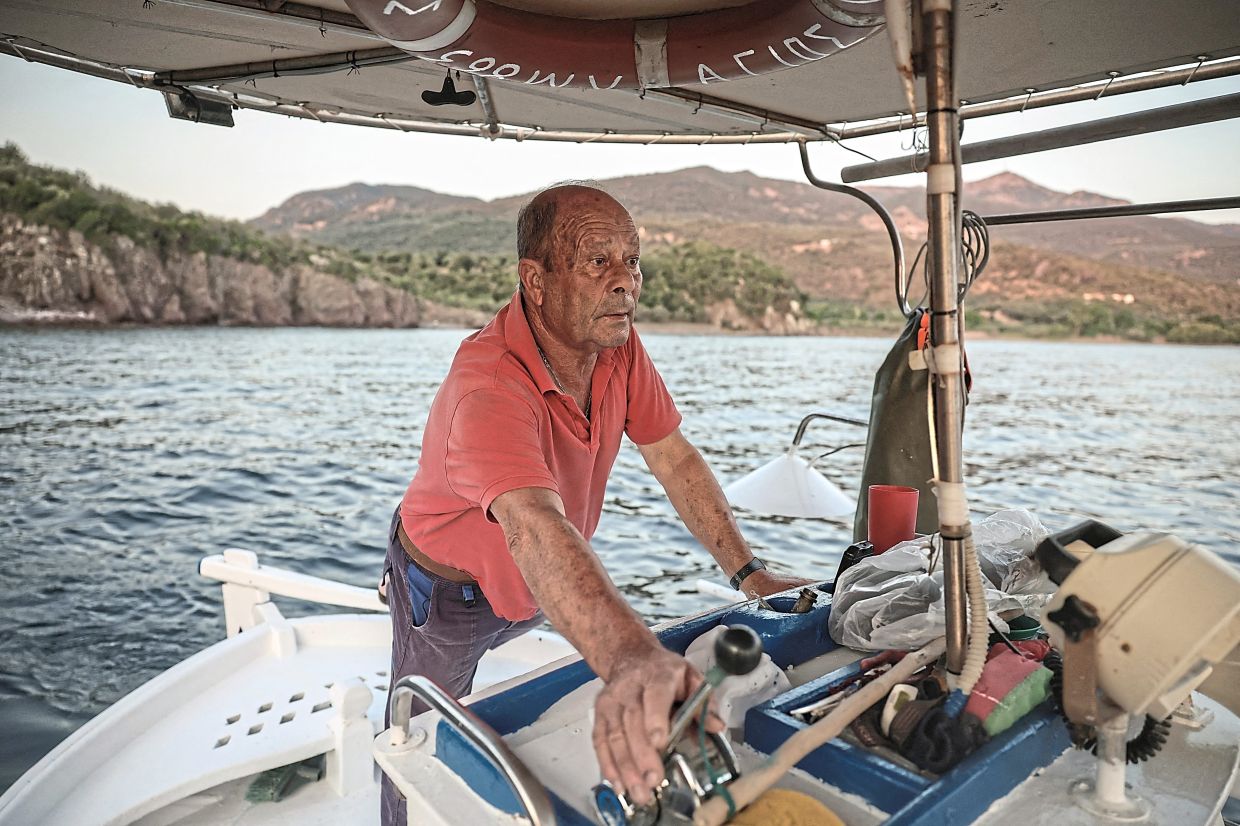
SAILING in the June sunshine off the island of Lesbos, Greek fisherman Thanos Marmarinos recalls a night, 10 years ago, when he pulled migrant women and children from the sea.
It was bitterly cold and he had already been on one rescue mission that evening. Thousands of migrants were arriving in rickety boats every day back then. When the midnight call came, he hesitated.
“You’ll feel guilty if they drown,” his wife told him.
Soon, he was hauling people aboard. One infant was wrapped so tightly that only their eyes were visible.
“We would help again,” says the 70-year-old. “I would be the first to.”
But now, doing so could put him in jail. Under a 2021 law – part of Europe’s effort to curb mass migration from the Middle East and Asia – anyone caught helping migrants to shore may face charges of facilitating illegal entry or aiding a criminal enterprise.
It’s one of many deterrents that have cut arrivals to Europe since the 2015 migration crisis – but rights groups say such measures endanger those still attempting the journey.
From haven to hard line
In 2015, Lesbos – a tourist island near Turkiye with quiet villages and pine-fringed coves – became the first European stop for half of the million people fleeing countries such as Syria, Afghanistan and Iraq.
Residents offered food and shelter. The island became a hub for charities and a symbol of Europe’s solidarity.
Some nations initially welcomed the influx, especially Syrians escaping civil war.
German Chancellor Angela Merkel opened the borders to nearly 900,000 asylum seekers. But political backlash followed. By 2024, anti-immigration policies were widespread across Europe.
Arrivals to the EU fell to about 240,000 in 2024 – less than a quarter of 2015’s total, according to Frontex. Lesbos recorded just 11,200 migrant arrivals last year, UNHCR data show.
Today, migrants nearing the island are often intercepted by police before they reach coastal roads. Charity workers must get special permission to help or risk fines and prison. A new camp is rising in a remote pine forest.
In Skala Sikamias – once crowded with broken dinghies, exhausted migrants and aid workers – tourists now linger over grilled fish as cicadas hum.
Tourism has bounced back: international arrivals topped 76,000 in 2024, back to pre-crisis levels.
“The island is moving on,” says Mytilene’s mayor, Panagiotis Christofas. “The crisis is in the past for us.”
Not for everyone
At 2am on April 3, Afghan migrant Beck Morad Sadeji was approaching Lesbos in a dinghy with 30 others, including his wife of 55 years and his daughter. He says the Greek coast guard ordered the boat back to Turkiye.
When a coast guard vessel drew near, the overloaded craft – carrying six families, including infants – destabilised. People fell overboard.
Sadeji says the crew watched for several minutes without helping. Eight people drowned, including his wife and a two-year-old boy.
“If they had helped, no one would’ve died,” he says.
The coast guard says it launched a rescue as soon as it saw the dinghy taking on water, and insists it always acts “with professionalism and absolute respect for human life”.
It notes that since 2015 it has rescued 263,000 people in danger at sea.
Still, migrant deaths in the Mediterranean remain frequent: in the Eastern Mediterranean alone, 191 died or went missing in 2024, International Organisation for Migration (IOM) figures show.
Across all routes, 2,573 deaths and disappearances were recorded.
Greece has faced scrutiny for alleged pushbacks and rights violations, including a 2023 shipwreck that killed hundreds. The European Court of Human Rights has found it guilty of similar violations. Athens denies the accusations.
Meanwhile, rhetoric has sharpened. In July, new migration minister Thanos Plevris called sea arrivals an “invasion”.
UNHCR’s Maria Clara Martin warns that such language drives demand for even harsher measures.
From transit point to holding pen
The shift began after a 2016 EU-Turkiye deal requiring that Syrian refugees arriving from Turkiye be returned there.
Greece went from being a transit country to a holding zone, with migrants waiting months or years for asylum decisions.
Numbers swelled. By 2018, the Moria camp – on an old military base – held more than 10,000 people, compared to a few hundred before 2015.
Tensions rose. Locals accused migrants of theft and cutting down trees for firewood. Businesses installed cameras after break-ins.
“I couldn’t sleep at night because my alarm kept going off,” recalls factory owner Thanasis Chatziargyriou.
Support for the far-right Golden Dawn Party jumped from 4.6% to over 8% in 2015. The political conversation became dominated by complaints that “refugees destroyed the island”, says social scientist and charity worker Efi Latsoudi.
In 2020, a fire destroyed Moria’s makeshift housing, forcing thousands to sleep on roadsides. Four Afghan asylum seekers were jailed for arson – verdicts their lawyers dispute.
A smaller camp, Kara Tepe, was built on the coast and now houses about 1,000 people. Plans are under way to replace it with port facilities. The Moria site will become a music school.
Watching from a distance
Public sentiment remains hardline: a 2023 poll found 70% of Greeks want tougher controls on migrant flows.
The EU is also pushing for stricter rules, including a proposal to allow deportations of rejected asylum seekers to countries with which they have no connection.
The UK, France and Greece have recently tightened migration laws, with Greece temporarily halting asylum claims from migrants arriving from North Africa.
Lesbos’s future EU-funded camp is being carved into a valley 40km north of Mytilene. It will house up to 5,000 people in rows of grey shipping containers.
Unlike Kara Tepe, it’s far from shops or services. Locals fear it will raise wildfire risks in a dry region.
“The camp is too big for the island,” says Christofas, arguing there’s no need for it with arrivals slowing.
Still, migrants keep coming.
One June morning, Marmarinos spotted another dinghy – this one with 19 people from Yemen and Sudan, according to Legal Centre Lesbos.
In 2015, he spent so much time rescuing migrants that his fishing income collapsed. This time, he hesitated to approach, fearing trouble with the coast guard. He watched from a distance.
The boat landed in a rocky cove. The migrants scrambled up a hillside. Police monitoring the cliffs picked them up and took them to a holding camp.
“Someone will call to say a boat has come, and the coast guard will come. We’d better get out of here,” he said. — Reuters