Palestinians walking away with aid supplies from the US-backed Gaza Humanitarian Foundation, in Khan Yunis. — Reuters
WHEN university professor Nizam Salama set out for an aid point in southern Gaza in early June, he came under fire twice, saw bodies strewn across the ground, was crushed in a frantic crowd – and returned home with nothing.
The shooting started not long after he left his family’s tent at 3am on June 3 to join the crowds heading toward an aid distribution site in Rafah.
The facility was run by the Gaza Humanitarian Foundation (GHF), a new US-based group working with private military contractors to deliver food in the war-torn enclave.
The second burst of gunfire erupted as Nizam reached Alam Roundabout, close to the GHF site. There, he saw six dead bodies.
That day alone, 27 people were killed by Israeli fire while trying to get aid, according to Palestinian health authorities.
At the aid distribution centre – known as SDS 1 – people queued in narrow cage-like fences, according to CCTV footage shared by GHF.
When the gates opened, thousands surged forward into an area cordoned off by sand barriers.
Supplies were laid out on tables and in boxes on the ground.
What followed, Nizam said, was pure chaos.
“It was a death trap,” said the 52-year-old professor of education administration. “Survival is for the stronger: people who are fitter, who can make it earlier, who can push harder to win the package. I felt my ribs going into each other. My chest was going into itself. I couldn’t breathe.”
Nizam’s account echoes the testimonies of other aid seekers who described crawling and ducking as bullets zipped overhead.
All said they saw dead bodies during their journey to or from the aid sites.
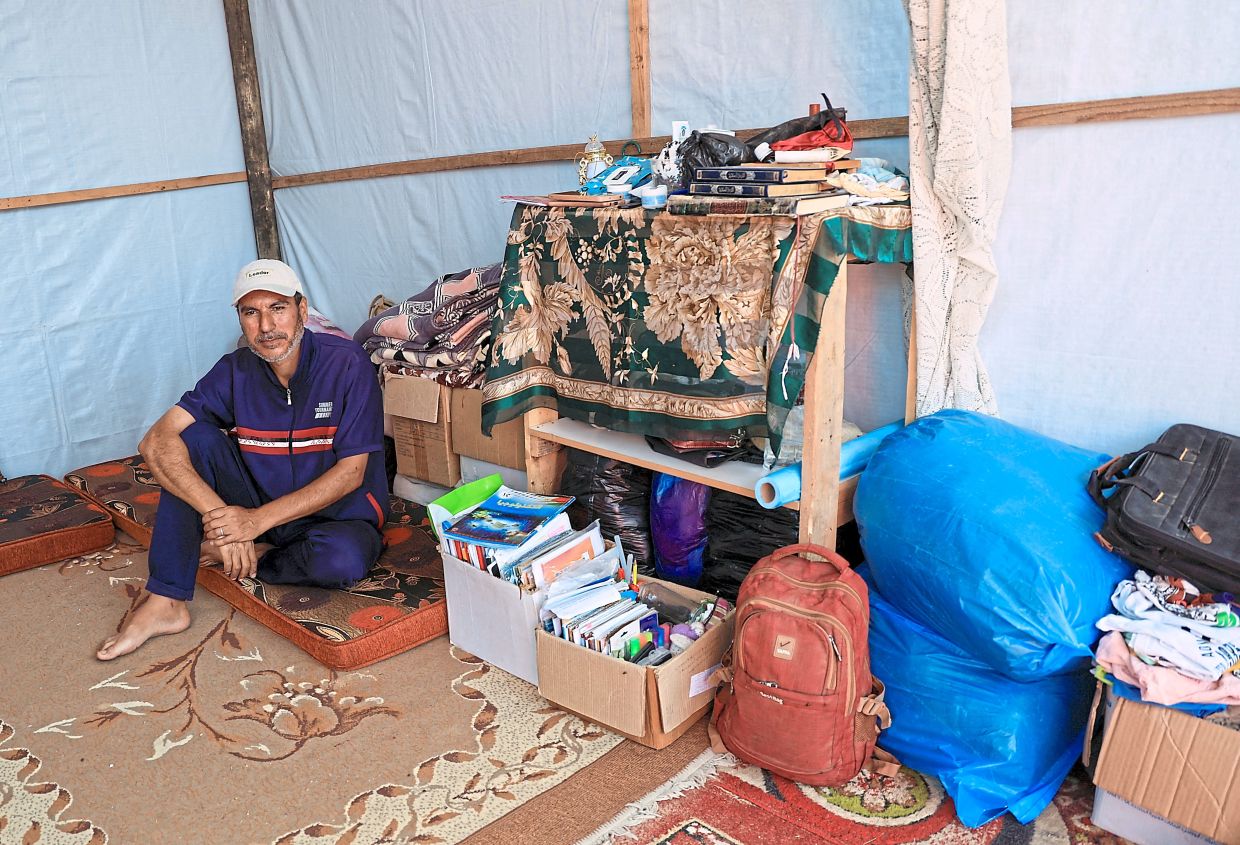 Nizam sitting inside the tent where he and his family have taken refuge, in Khan Yunis, southern Gaza Strip. — Reuters
A nearby Red Cross field hospital confirmed the death toll from that day.
Yet GHF claimed there had been no casualties at or immediately around its sites. Nizam had been hesitant about going.
“I was completely against going to the aid site of the American company because I knew how humiliating it is to do so,” he said. “But I had no choice.”
His five children – including two adults, two teenagers and a nine-year-old – had been surviving on lentils and pasta for months, often just one meal a day.
Since GHF began operations on May 26, 127 Palestinians have reportedly been killed trying to access aid from its sites, mostly in near-daily shootings, according to Gaza’s health ministry.
Jan Egeland, head of the Norwegian Refugee Council, said the system violates the core principles of humanitarian aid.
He likened it to The Hunger Games, where people are forced to fight for survival.
“A few will be rewarded and the many will only risk their lives for nothing,” he said.
“Aid in war zones should be provided by neutral intermediaries, ensuring the most vulnerable receive relief according to need – not as part of a military strategy.”
GHF didn’t directly address questions about its neutrality.
It said it had delivered enough aid for 11 million meals over two weeks – in a territory with a population of around 2.1 million.
Drop in the ocean
Israel allowed limited UN-led operations to resume on May 19 after an 11-week blockade, during which experts warned famine was imminent.
The UN has described the current aid levels as “a drop in the ocean”.
Alongside the UN effort, Israel authorised GHF to open four sites, effectively bypassing traditional aid agencies.
GHF is overseen by a US logistics firm headed by a former CIA official and part-owned by a Chicago-based equity firm, with security provided by US military veterans working for a private contractor, according to two sources familiar with the operation.
An Israeli defence official claimed GHF’s centres can reach around 1.2 million people.
Israel and the United States have encouraged the UN to cooperate with GHF, despite denying they fund it.
Further, Washington is reportedly considering an Israeli request to contribute US$500mil (RM2.12bil).
GHF coordinates directly with the Israeli military for access and said it plans to expand distribution points.
It has paused and resumed deliveries multiple times after violent incidents, and said it had urged Israel to improve civilian safety beyond its perimeter.
The foundation also accused the UN of failing to deliver aid and pointed to a spate of lootings.
Israel claims Palestinian resistance group Hamas has hijacked UN deliveries for its fighters – something both Hamas and the UN deny.
The UN, which previously managed the bulk of Gaza aid, says it operates over 400 distribution points.
It too has reported increasing lawlessness and has urged Israel to allow more of its trucks into the territory.
A deadly journey
Nizam left with four neighbours from the Mawasi area of Khan Yunis, walking for around two hours to reach Rafah, several kilometres away near the Egyptian border.
Shooting began early in the journey, with some gunfire coming from the sea – an area under Israeli control.
Despite the danger, they pressed on, navigating uneven terrain in the dark.
“I saw people carrying wounded persons back toward Khan Yunis,” he said.
At Alam Roundabout, around a kilometre from the aid site, the crowd was enormous.
More shots rang out. Nizam saw bullets strike nearby. “You must duck and stay on the ground,” he said.
He described seeing people wounded in the head, chest and legs, and bodies lying motionless – including that of a woman.
Another aid seeker described crawling for several hundred metres, fearing sniper fire. He saw a body with a gunshot wound to the head just 100m from the distribution point.
According to the International Committee of the Red Cross, the Rafah field hospital received 184 gunshot victims on June 3 – the highest number it had ever seen in a single incident. Twenty-seven people died.
“All responsive patients said they were trying to reach an assistance distribution site,” the ICRC said.
When Nizam finally arrived, there was nothing left.
“Everyone was pulling empty boxes from the floor,” he said. “I found nothing: a very, very, very big zero.”
Even though the aid was gone, more people kept flooding in, pushing Nizam toward the GHF security staff.
He said he saw guards using pepper spray to control the crowd.
GHF said it was unaware of any such incident but confirmed that non-lethal methods are used to manage civilians.
“I started shouting at the top of my lungs, ‘Brothers, I don’t want anything! I just want to leave!’” he recalled.
“I left empty-handed. I went back home depressed, sad, angry – and hungry too.” — Reuters