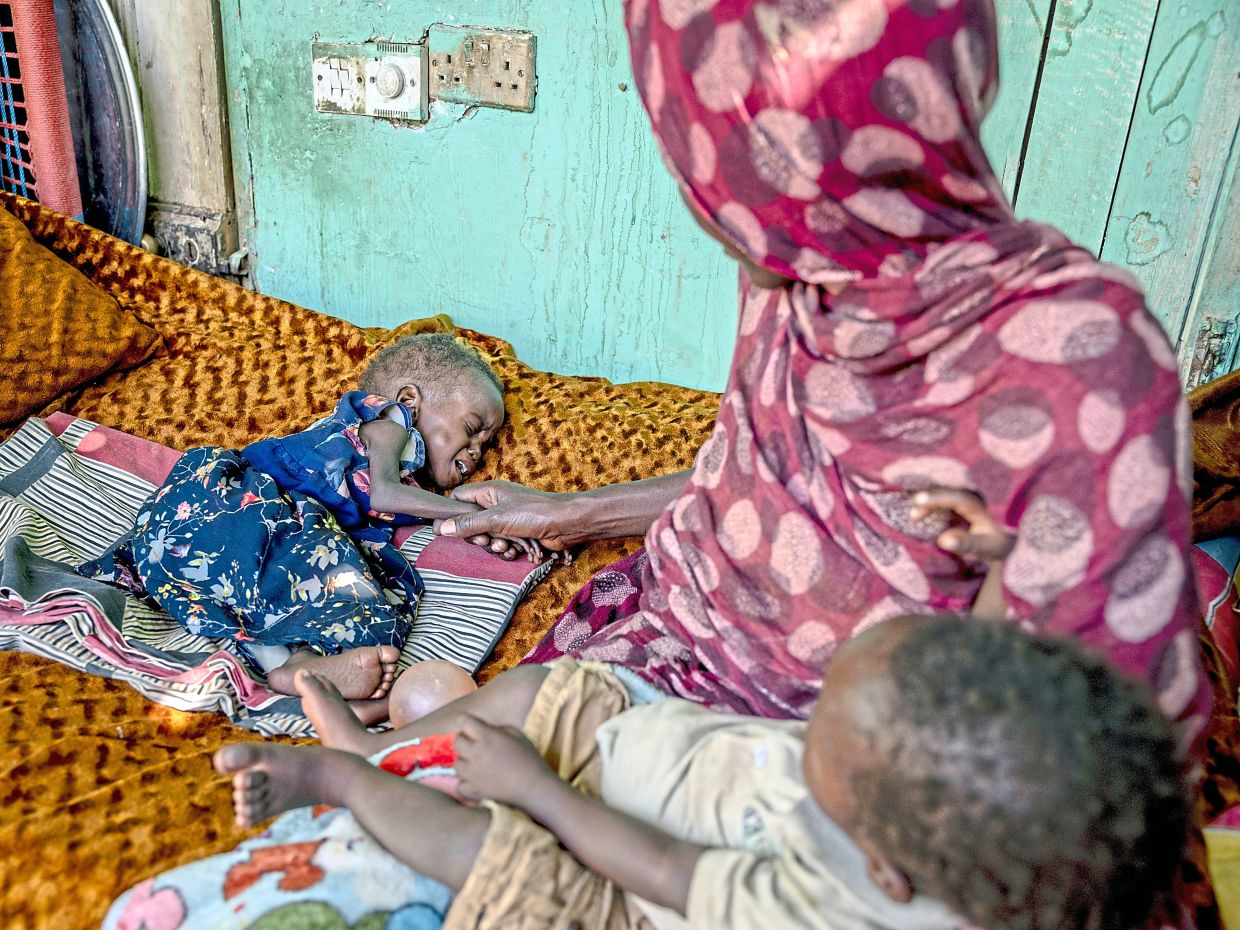
THE children died one after the other. Twelve acutely malnourished infants living in one corner of Sudan’s war-ravaged capital, Khartoum.
Abdo, an 18-month-old boy, had been rushed to a clinic by his mother as he was dying. His ribs protruded from his withered body. The next day, a doctor laid him out on a blanket with a teddy bear motif, his eyes closed.
Like the other 11 children, Abdo starved to death in the weeks after President Donald Trump froze all US foreign assistance, said local aid workers and a doctor.
US-funded soup kitchens in Sudan, including the one near Abdo’s house, had been the only lifelines for tens of thousands of people besieged by fighting.
Bombs were falling. Gunfire was everywhere. Then, as the US money dried up, hundreds of soup kitchens closed in a matter of days.
“It was catastrophic,” said Duaa Tariq, an aid worker.
The stark consequences of Trump’s slashing of US aid are evident in few places as clearly as in Sudan, where a brutal civil war has set off a staggering humanitarian catastrophe and left 25 million people – more than half of the country’s population – acutely hungry.
Sudan’s civil war, now in its third year, is the world’s worst humanitarian crisis in decades, aid groups say.
Famine is spreading rapidly, with some resorting to eating leaves and grass.
About 400,000 people were scattered and hundreds killed in Darfur recently as paramilitary fighters overran the country’s largest camp for displaced people, the United Nations said.
Last year, the United States gave US$830mil in emergency aid, helping 4.4 million Sudanese, the United Nations estimates. That was far more aid than any other country provided.
But after Trump halted that lifeline in January by dismantling the US Agency for International Development, the effect in Khartoum was devastating.
Within days, more than 300 soup kitchens run by Emergency Response Rooms, a network of democracy activists-turned-volunteer aid workers, were forced to close.
In Jereif West, the neighbourhood where Tariq works, hungry residents roved the streets in search of food amid shelling and drone strikes.
“People shared what they could,” she said. “But many went home empty-handed.”
Any cut in aid can be deadly: more than 600,000 Sudanese people are already living in famine, and another eight million are “on the cliff edge”, according to a consortium of major aid groups.
The Trump administration has said that lifesaving aid is exempt from the cuts.
In an e-mail, a State Department spokesman said the United States was still helping four million people inside Sudan, as well as 3.8 million refugees in neighbouring countries.
But on the ground, aid groups say the flow of US money stopped for almost two months and has resumed only in fits and starts, if at all.
USAID officials who once helped make the payments have been fired. A workforce of about 10,000 is being reduced to about 15 positions, leaving the US chain of assistance mired in chaos, delays and uncertainty.
So although the Trump administration says the tap for Sudan is still on, aid groups trying to stave off starvation say the total amount has been reduced and the entire system has been paralysed, cutting off food for weeks at a time in a place where few can afford to miss a single meal.
Other rich countries have not filled the gap.
Despite new pledges from Britain and the European Union at a conference in London, the UN is still billions of dollars short of what it says it needs to save lives in Sudan this year.
“This is the darkest hour for Sudan,” said Jan Egeland, head of the aid agency Norwegian Refugee Council, who described the cuts as a “moral failure”.
The United States resumed payments recently to several large aid organisations that work in Sudan, aid officials confirmed.
But little of that money appears to have yet reached Emergency Response Rooms, and nearly half of the 746 kitchens in Khartoum remain closed, said Gihad Salahaldeen, the network’s financial coordinator for the capital.
Nor is US aid guaranteed to continue, the State Department said in its e-mail.
The United States continues to review its aid to Sudan “with the goal of restructuring assistance to be more effective, efficient and aligned with US interests”, it added.
Last month, the UN World Food Programme announced that the Trump administration was terminating emergency food assistance for 14 fragile countries around the world.
“This could amount to a death sentence for millions of people,” the agency warned.
In Sudan, rates of acute child malnutrition in parts of the once-proud capital are 10 times above the emergency threshold, aid workers estimate.
Sudan’s military swept across the city in recent weeks, pushing out its paramilitary rivals, the Rapid Support Forces, in the civil war tearing the country apart.
Neighbourhoods that had been cut off for two years suddenly opened up, revealing a picture of hunger and suffering on a shocking scale.
In Bahri, in northern Khartoum, Wasfi Nizameldin said four of the nine kitchens he operated have remained closed since the US funding cuts.
In an interview, he railed against Trump’s aid pullback and pleaded for him to change course.
“People are dying from it,” Nizameldin said.
Out in the yard, Musa Salim, a street vendor-turned-volunteer, prepared food for needy residents.
Lifting his shirt, he showed where he had been wounded in a drone strike, then told of how RSF fighters had barged into his daughter’s home and tried to rape her.
It has been an unimaginable few years, he said.
By some estimates, three-fourths of Khartoum’s pre-war population of eight million has fled.
He would have fled, too. “But to leave, you need money,” he said. “Where would I get that?” — ©2025 The New York Times Company
This article originally appeared in The New York Times
Already a subscriber? Log in
Get 20% OFF The Star Digital Access
Cancel anytime. Ad-free. Unlimited access with perks.