
HANGING from a ladder attached to the hull of a giant, bobbing tanker, Capt Efrain Hallax began his climb up to the crew awaiting him atop the Athina, a ship anchored in Panama Bay and third in line to transit the Panama Canal.
The daunting 30m ascent up the shifting ship was nothing new for Hallax, 73.
He has been a ship’s pilot in the Panama Canal for over 40 years, responsible for guiding vessels through the trade-critical corridor that connects the Pacific Ocean with the Caribbean Sea.
On this night in February, Hallax reported for work half an hour before midnight – just hours after US President Donald Trump cancelled a call with Panamanian President Jose Raul Mulino to continue negotiations over the canal’s future. Trump has demanded its return to American control.
But the overnight crossing was routine for Hallax. With about 3% of the world’s maritime trade passing through its locks, the Panama Canal never sleeps.
“Business as usual,” Hallax said. “Always business as usual in the Panama Canal, no matter Christmas, no matter rain, no matter fog, no matter nothing – no matter Trump.”
As he took his first sip of the night’s many coffees, Hallax said alertness was a pilot’s essential ally. He relies on caffeine – and ice pressed over his eyes – to stay sharp.
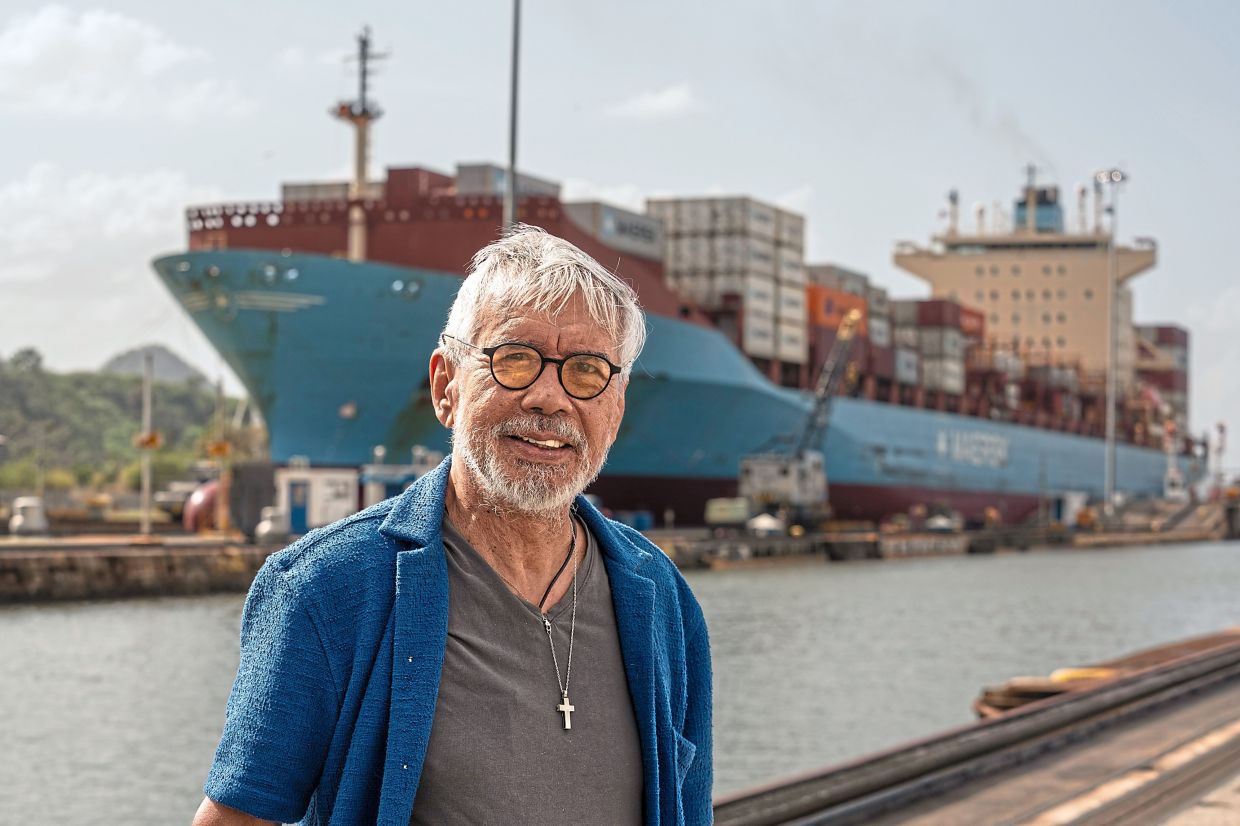
“You see nothing at this time, just little lights,” he said. “Blinking can cost you your life.”
Hallax is one of 310 pilots – only six of them women – authorised by the Panama Canal Authority to steer ships through the waterway.
They are the only ones permitted to navigate the 80km transit, with the ship’s captain required to cede control for the intricate journey.
Informed by marine traffic control about the night’s schedule, Hallax knew what to expect: which ship to follow, speed restrictions and potential delays.
“It’s a bit like chess, a constant calculation,” he said.
The Athina was small enough for the original locks – Miraflores, Pedro Miguel and Gatun – built by the US and operating since 1914. Wider locks for bigger ships opened in 2006.
In good weather, the transit takes about 10 hours.
Around 40 ships cross daily, each paying hefty tolls.
The canal is Panama’s golden goose, contributing US$2.4bil to government coffers in 2024.
“It’s a cash cow for the country,” Hallax said.
Raised in a semi-rural neighbourhood outside Panama City, Hallax dreamed of seeing the world.
His father and stepfather were seamen, “so that was an influence.” But it was an American canal pilot, a family friend, who gave him crucial advice: “If you want a future in this country, find yourself a job in the Panama Canal.”
At the time, the US-controlled Canal Zone was off-limits to most Panamanians.
To young Hallax, it was a forbidden paradise: “Everything was perfect in the Zone. The streets, the trees, the mangoes. The light bulbs worked. The buses ran.”
After studying at Chile’s Arturo Prat Naval Academy, he worked on “lousy tramp steamers” while picking up maritime training in New York and Italy.
When Panama signed the 1977 treaty to reclaim the canal, Hallax applied immediately.
In 1983, he became one of the first nine Panamanians hired to replace Americans.
The most perilous moment of his career came in 1989, during the dictatorship of Gen Manuel Noriega.
After witnessing police brutally beat women in the streets, Hallax, “tears rolling down my face from rage,” dropped anchor mid-transit in protest.
“The dumbest thing I’ve ever done,” he admitted.
The 15-minute stoppage got him fired, and with Noriega’s henchmen hunting him, he went into hiding.
But two weeks later, the United States invaded Panama, toppling Noriega.
Hallax was reinstated after his lawyer argued his act was resistance, not insubordination.
Now, as Trump reignites tensions over the canal, Hallax remains unfazed.
Whether under US or Panamanian control, the sea, the wind, and the exhaustion remain the same.
“Politics won’t change these things,” he said, sipping his coffee before another long night guiding giants through the dark. — ©2025 The New York Times Company
This article originally appeared in The New York Times
Already a subscriber? Log in
Get 20% OFF The Star Digital Access
Cancel anytime. Ad-free. Unlimited access with perks.