FILE - M23 rebels escort government soldiers and police who surrendered to an undisclosed location in Goma, Democratic republic of the Congo, Jan. 30, 2025. (AP Photo/Moses Sawasawa, File)
GOMA, which fell to M23 fighters and the Rwandan military late last month, has become a symbol of the conflict that has ripped apart the eastern Democratic Republic of Congo (DRC) over three decades.
In early January, a push on the capital of North Kivu province, where thousands of UN and humanitarian workers were based, was seen as unlikely.
But worrying signs soon emerged as clashes intensified in the surrounding region.
First, M23 fighters and Rwandan soldiers took Minova, a port on Lake Kivu to the southwest, tightening the noose around Goma, which is home to about a million people and nearly as many displaced by the fighting.
On Jan 23, the front still held on the plain around Sake – the last obstacle to the north-west of the city.
DRC army helicopters flew overhead, launching rocket salvos. Columns of reinforcements headed out from Goma to cheering crowds from nearby camps for the displaced, as explosions rang out in the distance.
The military tried to contain the offensive, with help from the local militia, United Nations peacekeepers in armoured vehicles, heavy artillery from a southern Africa regional force and Romanian paramilitaries.
Since 2021, the DRC army has been steadily retreating due to the M23 advance and Rwandan troops, which are seen as significantly better armed and trained.
Eventually pushed back to Goma, there was nowhere to go, trapped by the enemy on one side and Lake Kivu on the other.
On the morning of Jan 23, several Rwandan army units routed thousands of their DRC counterparts and militia near Sake.
The military governor of North Kivu was killed near the front line.
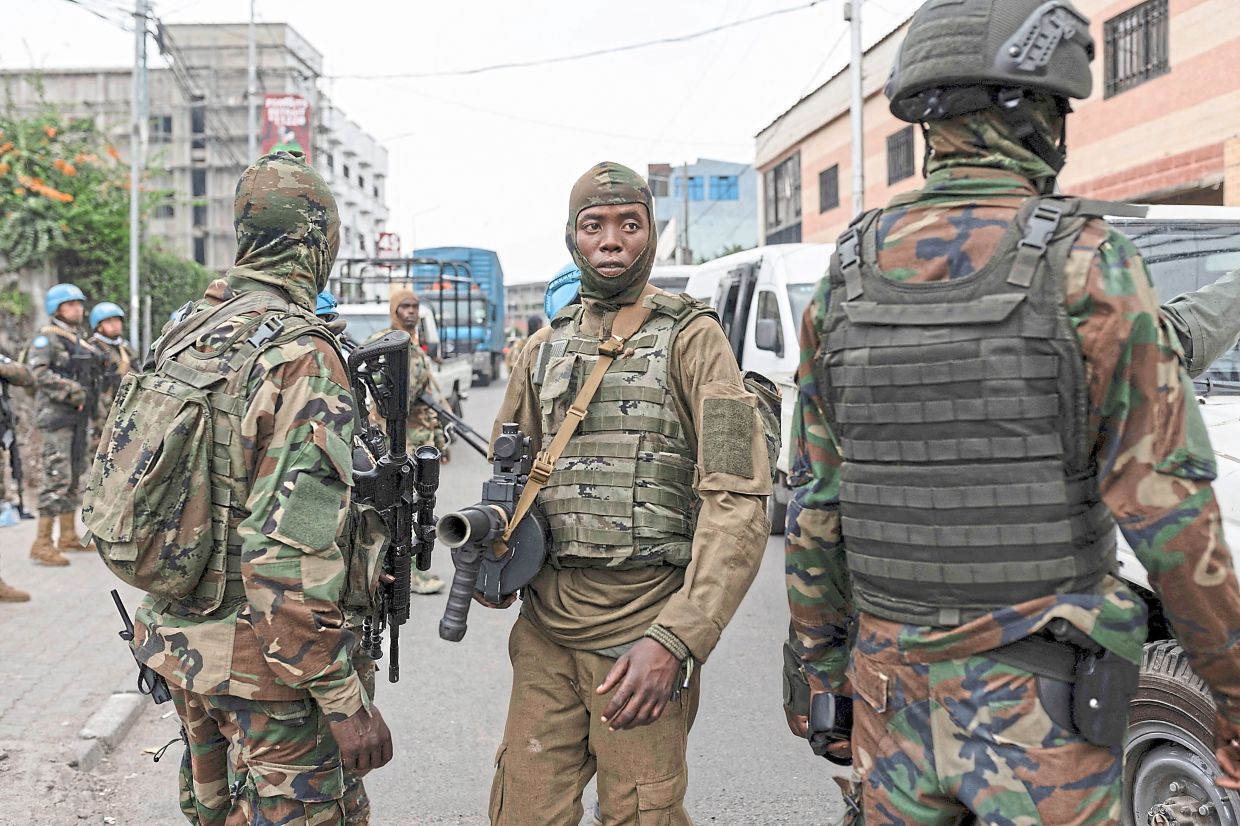 Members of the M23 rebel group supervising the exit of mercenary troops in the streets of Goma.
The brief counter-offensive around Sake would be the last. Two days later, an assault on Goma was seen as inevitable.
NGOs and the UN evacuated their non-essential staff from the city.
On the volcanic plain of Sake, the road leading to the front consumed men and materiel, spitting out stragglers and the wounded in the rain.
The smouldering wreck of a UN armoured vehicle was left by the roadside, its roof caved in by a direct hit.
The UN and southern African forces paid a heavy price: at least 19 of their soldiers were killed, while the DRC army, riven by corruption and incompetent leadership, seemed unable to fight back.
Spotting a weak link on the poorly secured northern front, M23 fighters made their move.
Goma woke on Jan 26 to the sound of bombs, as Rwandan forces crossed the border, taking the DRC army and Romanian paramilitaries by surprise.
Fighting broke out in the heart of impoverished, densely populated neighbourhoods. Bullets and shells flew, forcing civilians to seek shelter in their homes.
DRC forces meanwhile retreated towards central Goma.
The UN peacekeepers, aware of the army collapse, stopped fighting and switched their focus to protecting civilians.
As night fell, the streets were deserted. Anxious residents huddled indoors, cut off from the outside world by an internet and phone outage as gunfire rang out.
The next morning, Jan 27, saw prisoners break down the doors of their cells and set fires at Goma prison, near the city’s airport. Many inmates were stuck inside the burning building.
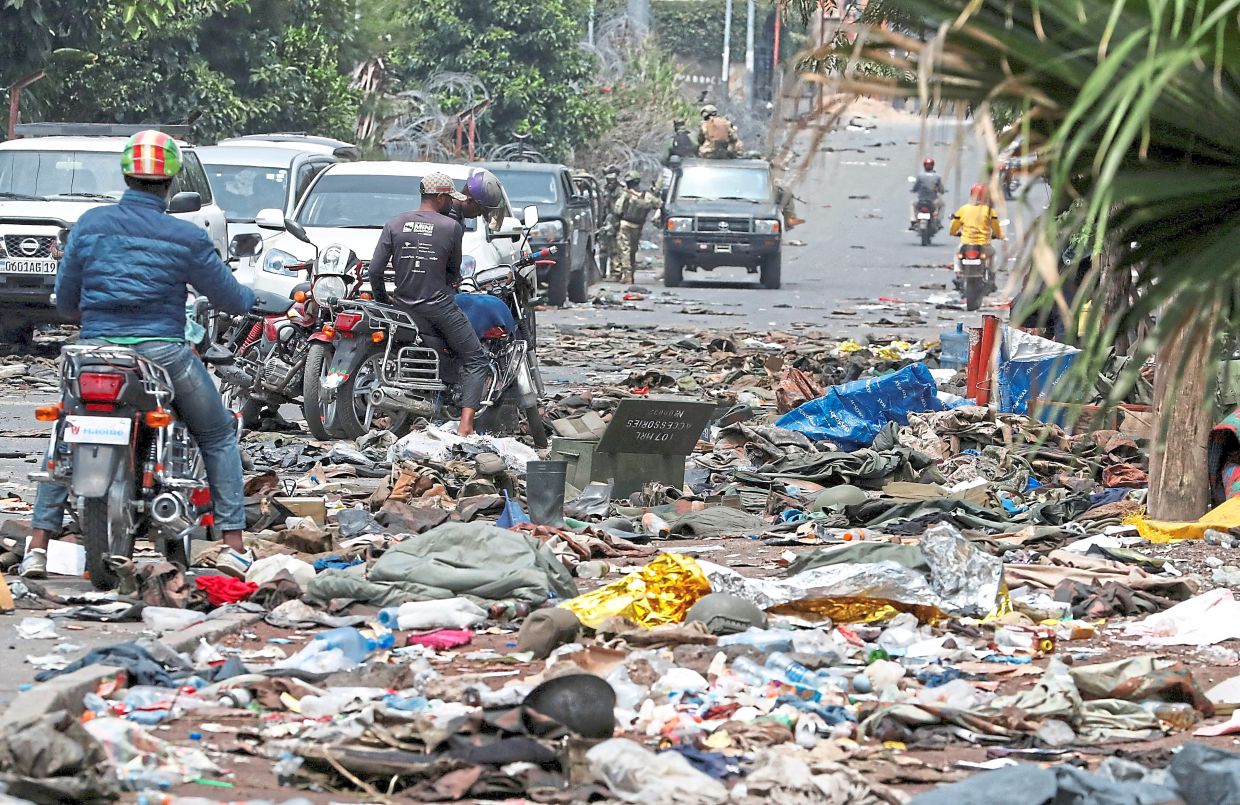 Motorcycle taxi operators looking at military uniforms and ammunition left behind by the DRC armed forces. — Reuters
In the women’s wing, fewer than about 20 of the 157 detainees managed to escape.
In the city, the few DRC units that still held their positions discovered they were on their own.
During the night, most senior officers had fled by boat on Lake Kivu. Ordinary soldiers had nowhere to go.
At the end of 2012, the M23 briefly took Goma and left clear a route for DRC troops to withdraw.
This time, they did no such thing, and the remaining DRC soldiers were trapped.
Columns of dishevelled men wandered the streets, looking for a way out.
In central Goma, a few units decided to hold their position and put up fierce, unexpected resistance.
Some even tried to attack the town of Gisenyi, just across the border in Rwanda, provoking return fire from the Rwandan army.
Both sides of the frontier were hit, including in well-to-do neighbourhoods where no one expected to see fighting.
Soldiers also fought back near the port and the DRC army’s regional headquarters.
But they were dislodged by Rwandan soldiers that afternoon, after heavy bombardment.
DRC soldiers still trying to flee on the last boats came under fire and in desperation threw themselves into the dark waters of Lake Kivu under a hail of automatic weapons fire.
There were still skirmishes on the morning of Jan 28, but observers agreed: despite pockets of dogged resistance, especially around the airport, Goma had fallen.
In the city, M23 fighters and Rwandan soldiers went methodically from street to street to root out remaining resistance.
The respite allowed thousands of DRC troops and Romanian paramilitaries to head to the UN peacekeeping base to seek refuge, abandoning bullet-ridden pickups, helmets, uniforms and automatic rifle magazines.
Bandits, militia and soldiers in civilian clothing picked up thousands of discarded weapons and hid them close by.
On the morning of Jan 29, it was the civilians’ turn to take advantage of the lack of law and order, looting shops and humanitarian warehouses.
Thousands of wounded flocked to overwhelmed hospitals. Hundreds of bodies littered the streets. Mortuaries ran out of space.
Goma’s inhabitants woke up stunned. DRC soldiers and the militia had vanished. In their place, Goma’s new masters marched in orderly fashion through the grey streets of the devastated city.
Some people, wary of what tomorrow would bring, clapped timidly as they passed. — AFP