After 24 years of guiding whitewater trips on the Nolichucky River Gorge for other companies, Patrick Mannion finally received a permit last year to operate his own outfitter business. But following the devastation of Hurricane Helene, he doesn’t know if Osprey Whitewater will be around for a second year.
Flooding driven by the September hurricane cut the fall rafting season short and devastated this mountainous region on the Tennessee-North Carolina border. Miles of railroad tracks and entire houses were thrown into the river. Some outfitters lost buildings and equipment. Guides lost their homes. Some lost friends. The river itself changed dramatically.
But with the spring season set to open next month, the biggest problem outfitters are facing is silence from the US Forest Service, which manages the river corridor and issues their permits to operate.
“It’s been an interesting, interesting first season,” said Mannion, who reckons he has run the scenic 12.8km gorge more than 3,500 times. “It was certainly not the end of our first season that we were hoping for.”
Whitewater rafting on the Nolichucky is a keystone of the local outdoor tourism industry, which helped generate over US$18 million in visitor spending in Tennessee’s Unicoi County in 2022, according to a study.
While most rafting rivers in the Southeast are dam-controlled, the upper Nolichucky runs freely, making every trip a different experience and attracting boaters who seek adventure.
It also feels particularly remote, flowing through a deep gorge surrounded by national forests with the occasional CSX train the only sign of human activity for miles.
“There’s no cellphone service.
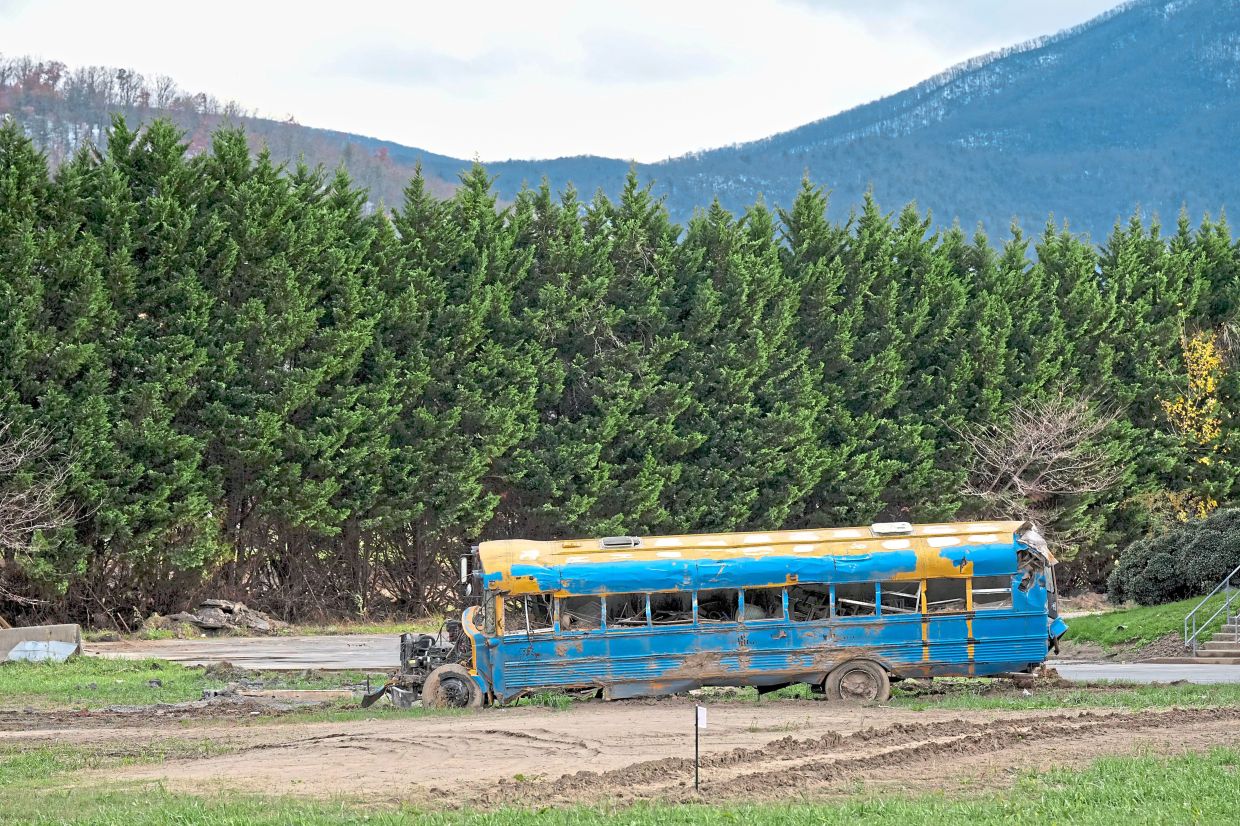 A bus normally used for transporting whitewater rafters lies wrecked as a result of Hurricane Helene. — AP
“It’s rugged. It’s wild and scenic. It’s the steepest, the deepest and the most remote river corridor that’s commercially rafted in the southeastern United States,” said Mannion, who calls the river “my therapy”.
Matt Moses owns USA Raft, the largest and oldest outfitter on the river. The flood destroyed much of his business, taking out campgrounds, lodging, a day recreation area, vehicles and equipment. He is determined to rebuild, but the Forest Service is not making that easy.
Moses said that typically this is the time of year that big groups book with companies like his. He has people answering phones, but they are not taking reservations.
“We tell them that our future is uncertain,” he said. “I’m not taking anybody’s money. I’ve got enough refunds I’m trying to figure out.”
The Forest Service has temporarily closed the boat ramps in Poplar, North Carolina and Erwin, Tennessee, where outfitters put in and take out rafts.
CSX Transportation is using them as access points as it attempts to rebuild miles of railroad tracks lost to the flood. And that is yet another worry for the whitewater community.
Mannion supports repairing the train tracks but has been disturbed by the sight of heavy equipment removing rock, sand and gravel from the riverbed to rebuild the railbed and embankment.
A lawsuit filed in November by nonprofit groups accuses federal regulators of failing to enforce the Clean Water Act and other laws, as well as failing to monitor the work that is being done.
In the meantime, boaters have taken it on themselves to document the destruction, kayaking through the gorge in frigid winter conditions to shoot photos and videos from spots not visible from any road or trail.
The US Army Corps of Engineers referenced video it had received of “potentially unauthorised work being conducted in the Nolichucky River” in December, when it ordered a temporary halt to the reconstruction.
The Corps later issued permits that Southern Environmental Law Center attorney Patrick Hunter says are insufficient to protect the river.
A Jan 21 letter from Hunter to the Corps suggests that CSX’s plan to use material from the Nolichucky gorge as reconstruction material will have “significant consequences for scenery, water quality, wildlife habitat, protected species, flood risk, recreation, and the navigability of the river.”
Mannion said it is perplexing that he had to go through a long, arduous process to get a permit to run rafting trips on the Nolichucky from the Forest Service while he believes CSX has not been held to the same standard.
“I think in the grand scheme of things, we just want to make sure that the I’s are being dotted, the T’s are being crossed, and that, in this remote corridor, that there is just a little bit of oversight, because I don’t think that this would be happening if this was in downtown Erwin,” he said.
CSX President and CEO Joe Hinrichs has said they are working with the Corps, and “I believe we’re going to leave the territory better than we found it.”
The flooding moved huge boulders and made big changes to the river, but after running it many times since September, outfitters are excited.
“The whitewater has gotten better,” said Brannon Schmidt, of Blue Ridge Paddling. He is considering raising the age limit on trips “because it has stepped up a bit in adventure.”
Schmidt and his brother Mason Schmidt spent five years working to get a permit for the Nolichucky before they were able to run their first trips there last year.
They have a large building with a taphouse that was heavily damaged by the flooding, but they managed to save a majority of their equipment.
“This next season we were definitely planning on going all out. You know, having a big springboard year. Yeah, the flood definitely is derailing that for us,” Brannon Schmidt said.
There is no timeline for when the Forest Service will open the river up to commercial rafting, spokesperson Sheila Holifield said.
“Safety of rafters and our commercial outfitter partners is one of our top priorities while we continue working to identify any hazards left by Helene in the Nolichucky, and we continue to advise the public to stay off the river for their own safety,” Holifield wrote.
The uncertainty around permits and concerns about what affect the CSX work will have on the river are making it hard to plan for the future, Schmidt said.
“It’s hard to talk about financial decisions like where your money’s going to go to rebuild,” he said. “You know, if we are going to rebuild? Is the river going to be ruined? You know, there’s all these questions.” — AP