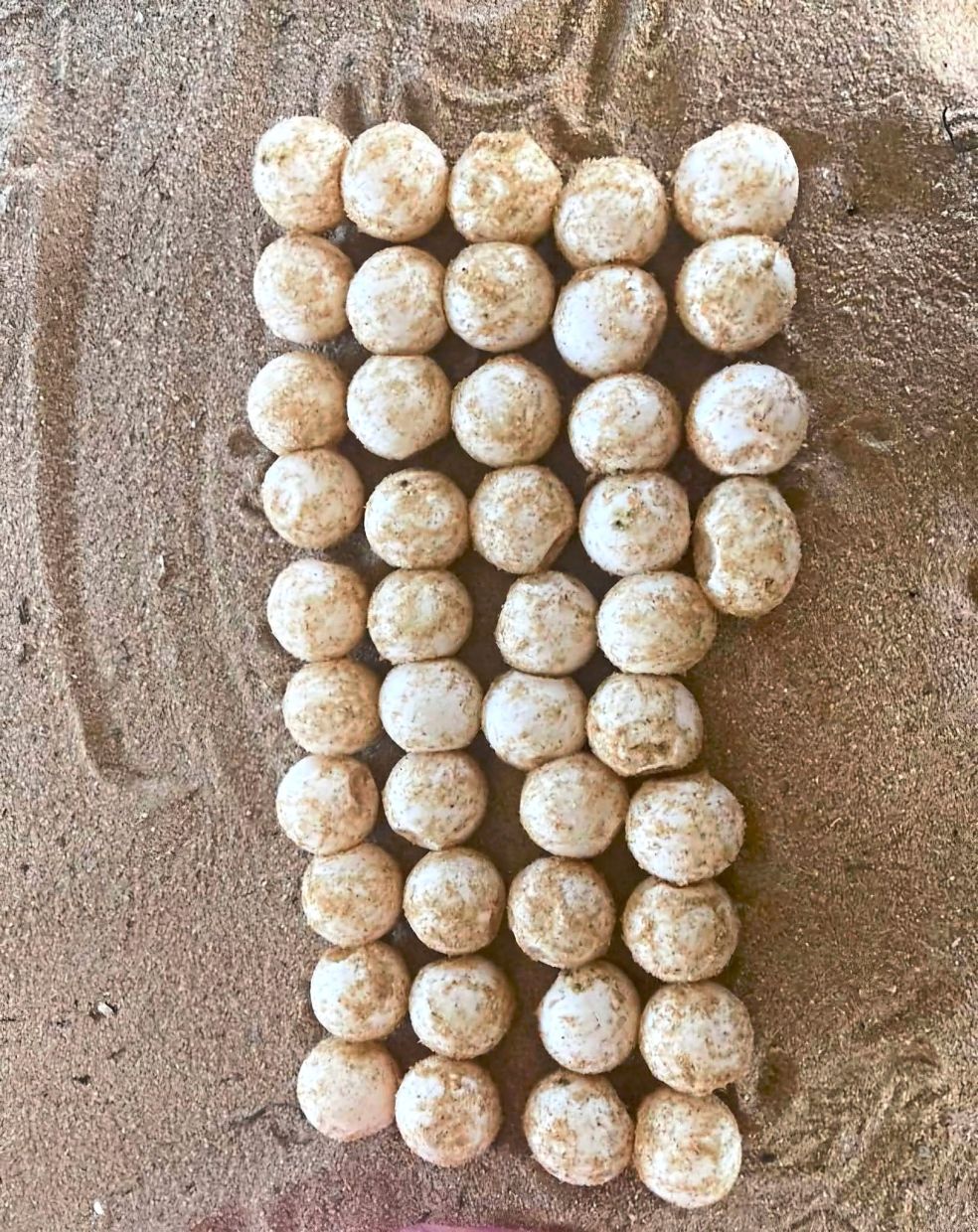
There is a lot riding on these eggs, with everyone hoping
they will hatch successfully and eventually help to kickstart the appearance of leatherback turtles on Malaysian shores once again. — Terengganu Fisheries Department
THE news broke early on the morning of Sept 2, 2026.
A little known NGO had pipped Terengganu’s Fisheries Department to the announcement by blasting out an e-mail to the media: A giant leatherback turtle – known locally as the king of turtles – had returned to Malaysian shores after nine years.
The department took a little longer, but by 2.55pm it went on Facebook to confirm that, yes, a leatherback had indeed made an appearance on Sept 1 in Terengganu, leaving its distinctive tracks on a beach in Marang and laying 44 eggs.
Department staff members had made their confirmation based on the analysis of the 2.1m-wide tracks in the sand, and the size of the eggs, which have an average diameter of 52mm.
Because a female leatherback turtle would typically return to shore four to seven times to lay its eggs in a single nesting season, state executive councillor Datuk Razali Idris urged tourism operators and business owners along the Rantau Abang coastline to reduce lighting to avoid disturbing it. And return it did, a few days later, laying 81 eggs this time.
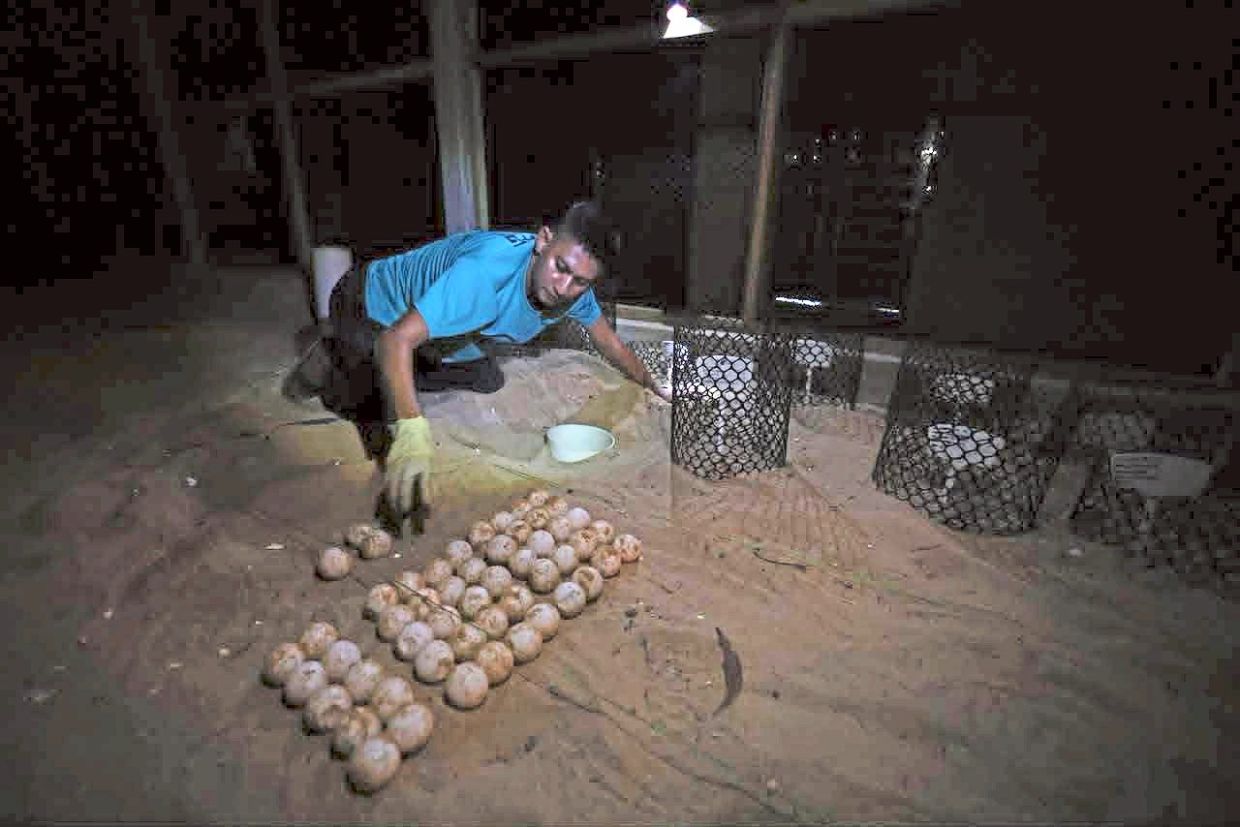
In total, the female laid 195 eggs. As is standard practice, the eggs were moved by fishery officials to a hatchery in nearby Rantau Abang for safety from poaching and to give them the highest chances of hatching.
The last recorded landing by a leatherback was back in 2017, during which the female reportedly laid 124 eggs in two nesting events. None hatched (see "Will the eggs hatch this time?").
The leatherback turtle has deep cultural roots in Terengganu, once home to one of the world’s largest nesting populations in Rantau Abang. The marine animal used to serve as the state’s main tourism and sports mascot – its football team is known as the Turtles – and it made a comeback in the logo for the Visit Terengganu 2027 campaign.
All of which makes it particularly tragic that the leatherback is actually functionally extinct.
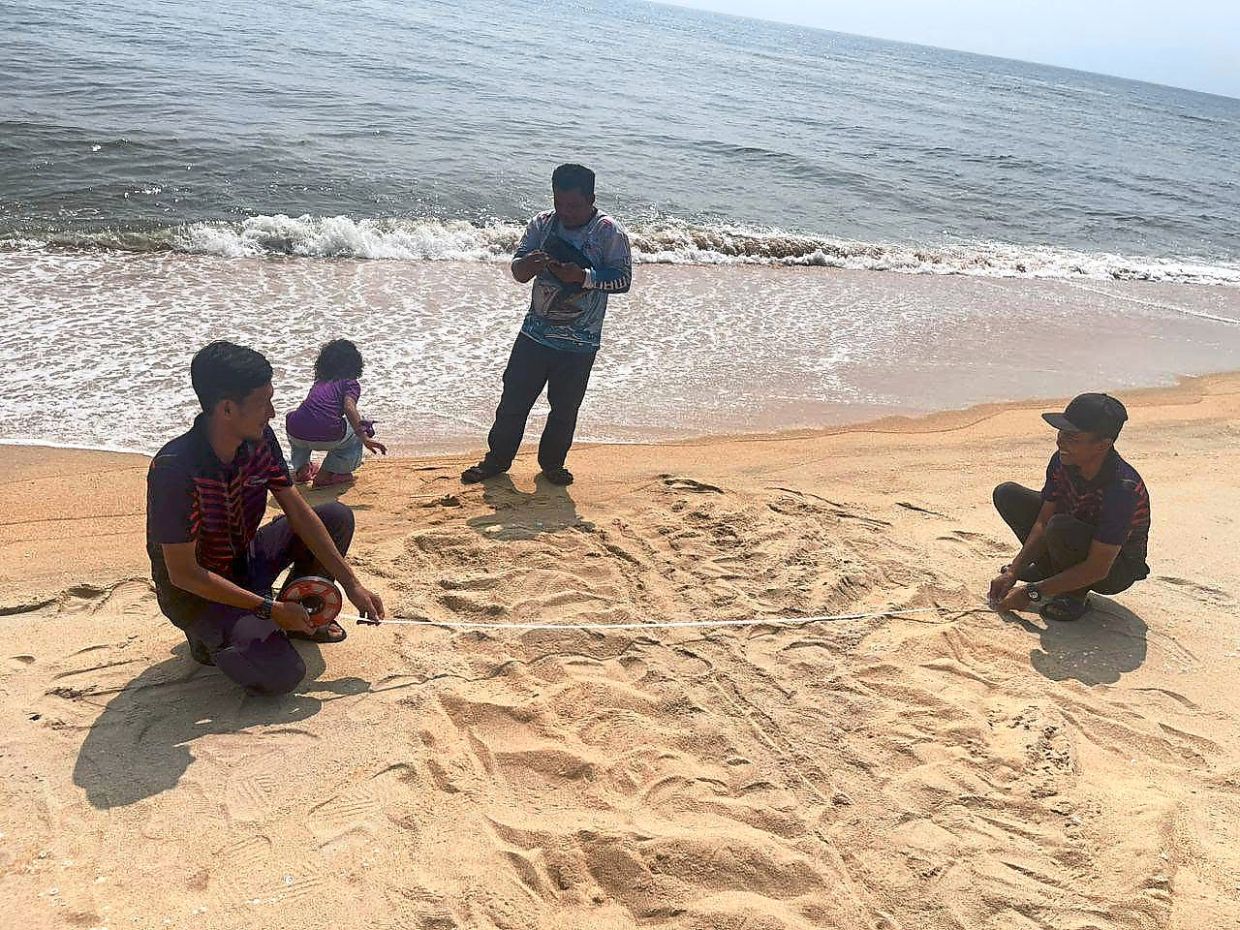
Checking the tracks after the turtle's first landing and comparing them with records to confirm a leatherback's appearance. Mama turtle was only actually sighted at her third landing. — Terengganu Fisheries Department‘Enormously important’ event
The largest living turtle species, the Dermochelys coriacea can weigh between 250kg and 700kg and grow up to 2m long. The largest specimen ever recorded was a male weighing some 916kg; it drowned after being caught in a fishing net off the coast of Wales in 1988.
With a carapace covered by what looks like thick leathery skin instead of a hard shell, the leatherback typically lives for 30 to 50 years in the wild.
Natal homing, when an animal returns to the place where it was born to reproduce, is a characteristic of sea turtles. That is why this female’s arrival has been greeted with such excitement, as it could mean future generations will return to our shores. (See "Protect the beaches, protect the leatherback's future".)
But marine biologist Assoc Prof Dr Mohd Uzair Rusli says that while it is indeed extremely significant, the event needs to be interpreted carefully.
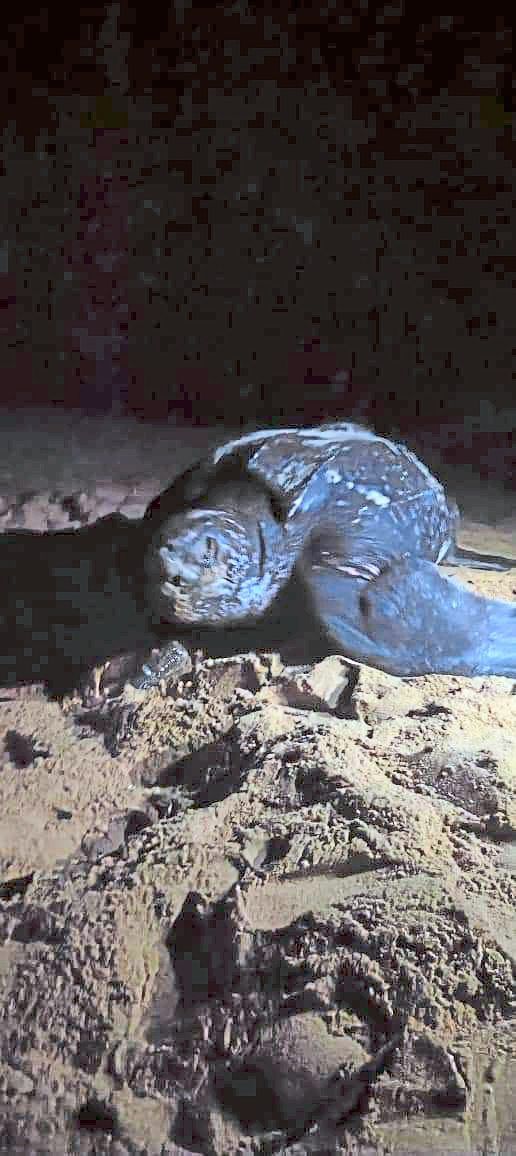
The female leatherback making her way up the beach. — Terengganu Fisheries DepartmentTerengganu, he points out, once recorded more than 10,000 leatherback nests in a year; yet today, a single nest becomes national news.
“That contrast tells us how much we have lost. So scientifically, one nest is not evidence that the leatherback population in Terengganu is recovering. It may still be an isolated event.
“But from a conservation perspective, it is enormously important because it tells us that Terengganu has not completely disappeared from the reproductive landscape
of this species,” he explained in an e-mail interview in September 2026.
Prof Mohd Uzair is the head of the Centre for Marine Conservation at Universiti Malaysia Terengganu’s Institute of Oceanography and Environment; he also heads the university’s long-running Sea Turtle Research Unit (well-known as Seatru).
Why would a leatherback return to a beach that has seen decades of little to no nesting activity? That, he says, is actually a very interesting conservation science question.
Scientists, he adds, do not yet know whether this female is a remnant of the original Terengganu population, perhaps an individual connected to previous nesting records, or whether she originated from another population in the region and is now using Terengganu.
Leatherbacks, according to Prof Mohd Uzair, are highly migratory animals and do not recognise national boundaries.
Recent genetic work also makes the regional connection particularly interesting, with historical Malaysian samples showing close genetic affinity with the Nicobar Islands population in the eastern Indian Ocean, he says.
“Therefore, rather than immediately saying that ‘our leatherbacks have returned’, we have to ask an important question first: Whose turtle is this, and why has she chosen Terengganu?”
Should the female return to nest again this season, it would be an extremely valuable opportunity to identify and measure her, collect genetic samples, tag her and, if appropriate, deploy satellite telemetry to determine where she goes after leaving Terengganu, he says.
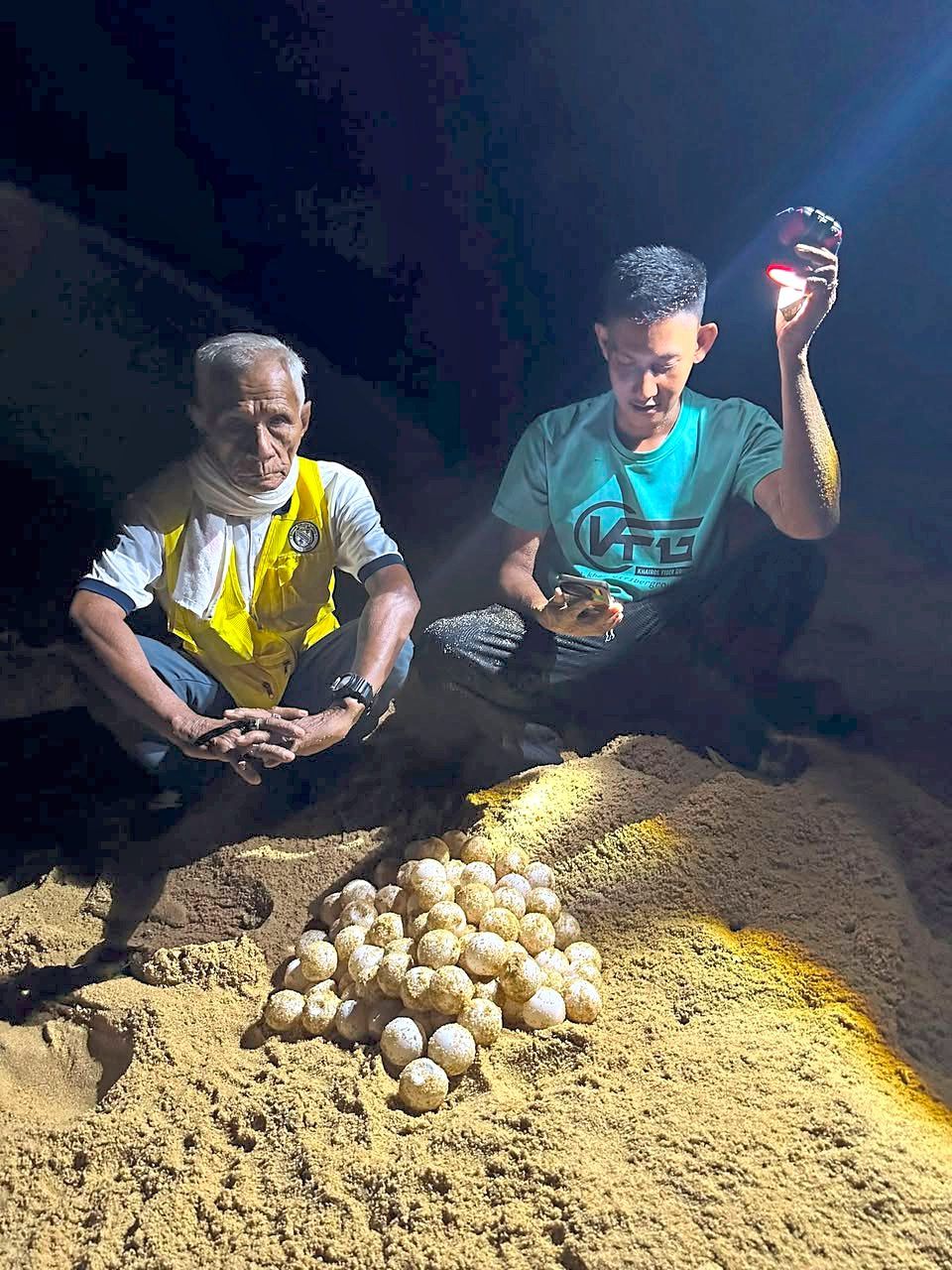
A treasure trove found.— Terengganu Fisheries DepartmentConstant battle to survive
Even if, miraculously, the leatherbacks are truly back, is that stretch of the coastline in Terengganu still as welcoming as it was during the 1960s and 1970s heyday of the turtles?
Turtles of all species continue to face dangers ranging from drowning after becoming entangled in fishing nets, boat strikes, and illegal egg poaching, to over-tourism that disturbs nesting attempts, and noise and light pollution that stop them from laying eggs.
More recently, climate change is posing a new danger by skewing the sex ratio of hatchlings. Unlike in most species, the sex of a turtle is not set during fertilisation but is determined by the temperature of the sand the eggs are laid in. Warmer temperatures produce females, and a female-skewed population would not be viable in the long-term.
Another result of a warming planet, rising sea levels, is flooding nesting sites and eroding beaches, raising more human-caused threats to turtle survival.
Prof Mohd Uzair explains that a leatherback coming ashore and nesting shows that a suitable habitat still exists. However, he cautions against using a single nesting event to conclude that Terengganu’s coastline remains as suitable as it was historically, adding that it has changed considerably over the decades.
“Coastal development, artificial lighting, human activity, vehicles, and beach modification and disturbance can all influence whether a turtle successfully approaches, nests, and returns to the sea.
“For me, the question is not whether we can recreate the Rantau Abang of the 1960s or 1970s. We cannot turn back time. The more useful question is, can we ensure that the beaches that remain suitable today stay suitable for the next generation of leatherbacks?” he says.
Leatherback eggs are, like the turtles' carapace, leathery and slightly flexible.— Terengganu Fisheries DepartmentThis means identifying potential nesting areas and managing them proactively, particularly at night during the nesting season.
The next few weeks in the nesting season, he stresses, are particularly important because the same female may return to lay more clutches of eggs.
He recommends targeted night patrols and monitoring of suitable beaches together with a clear response protocol if another leatherback comes ashore.
At the same time, disturbances should be minimised as bright lights, vehicles, crowds, and excessive human presence can interfere with nesting.
“Sometimes good conservation is not about doing more around the turtle, it is about knowing when to step back and give the animal space,” he says.
Most importantly, Prof Mohd Uzair says, we should be scientifically prepared
“This could be a rare opportunity to collect information that helps us understand whether this is simply an isolated visitor or part of something larger happening in the region.”
Beginning the process of moving the eggs in the hatchery.— Terengganu Fisheries DepartmentA new hope – maybe
There are many reasons turtle eggs sometimes don’t hatch: The eggs could have been incubated at the wrong temperatures, humidity in the incubator could have been poor, or wrong orientation or movement could have torn internal membranes and killed the embryos. Or they were simply not fertilised in the first place.
So even before asking whether these hatchlings will return decades from now, Prof Mohd Uzair says the immediate question now is will these eggs hatch?
“If these eggs develop successfully and produce hatchlings, that alone would be an important conservation milestone,” he says, adding that this would also provide evidence of successful reproduction, rather than simply the return of an adult female.
Even should these eggs hatch, the probability of the survival of individuals to adulthood is historically very low, he points out. Sea turtles lay many eggs precisely because mortality is extremely high during the early stages of life.
Even after reaching the ocean following their hatching, leatherbacks face threats throughout their life cycle, including fisheries interactions and other pressures across enormous oceanic areas.
And finding out whether any hatchlings eventually return to Terengganu is something that may take decades to discover, says the professor.
“That is also what makes this event so powerful. Conservation requires us to protect animals today for outcomes that we may only see much later.
“The mother returning is only the first chapter. The bigger story is whether Terengganu can once again produce a new generation of leatherbacks,” he says.
What steps should marine authorities take to protect the species now that it’s – tentatively – back?
Prof Mohd Uzair replies that while “protecting the nest is essential, we should not protect only the nest”.
“We should protect the opportunity that this event has given us.”