
CONCERNS that artificial intelligence (AI) could render engineers jobless are unfounded, says Prof Dr Vinesh Thiruchelvam.
Describing AI as “just an enabler”, the Asia Pacific University of Technology & Innovation chief innovation and enterprise officer said engineering students and professionals already possess critical thinking, problem-solving and computational skills, as well as complex engineering know-how to excel in the profession.

“When it comes to the workflow, AI can guide engineers towards the right reading materials and references.
“Now, with added AI applications, engineers get to work more efficiently because technology can help check the entire process,” Prof Vinesh, who is an electrical engineer by profession and also the International Strategy Board chairman of the Institution of Mechanical Engineers, shared.
Exposure to AI and other emerging technologies needs to happen throughout the learning journey, he said, adding that these skills can be picked up during workshops, webinars and extra classes that universities run.
Stressing the need for students to be proactive, he said it is up to each individual to pick up these skills based on their interests.
Industry realities
Despite the country’s need for engineers, Prof Vinesh acknowledged that many students are not interested in entering the field.
The perceived AI threat is just one of the reasons. The four-year duration of engineering courses and their heavy focus on mathematics are also discouraging some students.
In addition, to become a certified engineer, one must graduate from an accredited programme and register with the Board of Engineers Malaysia.
“If you don’t have the basic skills at secondary school level, you’re going to struggle in the four years.
“Engineering students are also expected to do a lot of practical work, lab work, assignments, reports and projects, which take up a lot of their time,” he said.
Compounding this reluctance are low remuneration and the income gap between emerging technology careers and those in the engineering field.
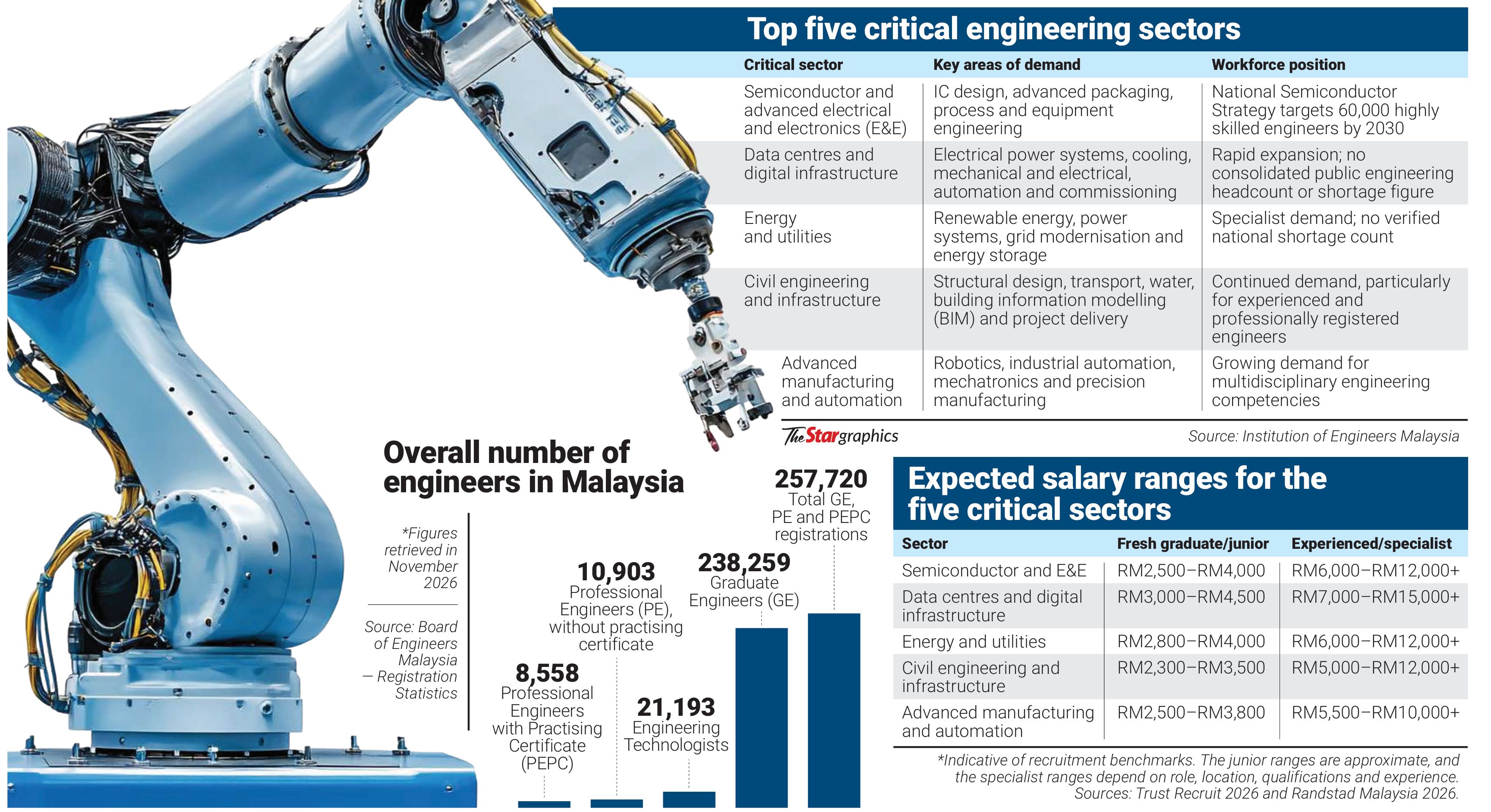
“An engineer’s starting salary ranges between RM2,500 and RM3,500 depending on the sector (see infographic) but a tech person can earn from RM3,500 to RM4,500.
“As a result, many qualified engineers jump into the tech industry because they see that as something more exciting and rewarding in terms of income,” he added.
School-leavers are also put off by the alleged lack of opportunities in the job market today.
“Such stories sometimes go viral on social media but it is not the reality on the ground.
“Engineers are necessary as Malaysia is still a developing nation,” Prof Vinesh said, adding that this is clearly illustrated in the 13th Malaysia Plan (RMK13).
RMK13, he noted, has identified infrastructure and high-impact projects as key priorities.
These include new shipping ports and transport projects such as the completion of the East Coast Rail Link, the potential revival of the Kuala Lumpur-Singapore high-speed rail project, and metro lines in various cities.
“Along with these, utilities and power distribution in Malaysia will also need to be upgraded, especially with many data centres popping up.
“There is also the fast-growing semiconductor industry, with the Investment, Trade and Industry Ministry targeting to recruit 60,000 engineers by 2030.
“These clearly require specialised knowledge and skills engineers bring to the table,” he said, adding that Malaysia also faces a myriad of flooding, transportation and town planning issues that require engineers to solve.
He advised aspiring engineers to work towards specialised certifications, even if it may seem tedious.
This, he said, can give them an edge when they enter the workforce.
“Becoming an expert in a niche area through certification helps you survive in the future, because then you’re in demand and very marketable,” he said.
Although engineering is a challenging career pathway, Prof Vinesh said companies will always need engineers, making these graduates indispensable.
“Regardless of AI, it is very important to understand that any organisation with a business based on operations will always need an engineer,” he concluded.
I found out during my internship that AI is going to automate a lot of different tasks within the semiconductor and other industries. At the same time, I know that if I have the experience and know-how to utilise AI properly to make my work more efficient, it can make me more competitive as an engineer in the field. This is all necessary as, being a tech person, I know that we cannot stop technology from developing. So, we need to know how to use it to our benefit instead of avoiding it.
– Electrical and electronics engineering student Lek Yong Bin, 24

I worry about whether my skills will still be relevant after graduation, considering the rapid growth of technology nowadays. I also wonder if I will be able to climb the career ladder quickly and bring value to my organisation and also the nation. However, I don’t look at this as a setback but as motivation, and am constantly trying to ensure I develop the right skills while I’m in university.
– Mechatronic engineering student Thiriidev Kumar Murlidaran, 22

One problem I see happening post-graduation is the supply and demand imbalance for graduates. I worry that there are a lot more graduates than there are jobs. On top of that, the job market has a lot of people with similar skills. To counter this, I would have to develop a marketable skill that is hard to replace, but that can only come with work experience.
– Electrical and electronics engineering student Hooi Cheng Kang, 24

During my internship, we used AI a lot to come up with a more efficient way to make chips as production numbers are always rising. I know AI is very popular right now and my plan for the future is to create new AI applications. I feel engineering can help me accomplish that.
– Electrical and electronics engineering student Lau Yi Jing, 22