IT started with spaghetti growing on trees, and ended with an alien spaceship hovering over Dataran Merdeka in Kuala Lumpur.
In between, some 2,208 students across the Klang Valley got a masterclass in why believing everything on one’s screen can get one into serious trouble.

That was the main message The Star’s True or Not team conveyed during a recent media literacy roadshow, which engaged five schools as part of Star Media Group’s 55th anniversary celebrations.
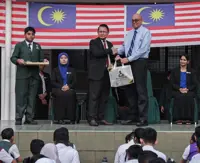
The talks, held between June and August, were presented by social media specialist Bernard Cheah and assistant editor Niklas Albakri under The Star’s long-running Newspaper-In-Education (NiE) programme, which has promoted English language learning and media literacy in Malaysian schools since 1997.
Hoax alert
To set the scene, the pair opened with a clip that CNN once called “the biggest hoax that any reputable news establishment ever pulled”.
On April Fools’ Day 1957, the BBC’s current affairs programme Panorama aired a deadpan three-minute report on a bumper spaghetti harvest in southern Switzerland, narrated by Richard Dimbleby – the corporation’s own first war correspondent.
Hundreds of viewers rang in afterwards to ask how they could grow their own spaghetti tree.
The BBC’s response: “Place a sprig of spaghetti in a tin of tomato sauce and hope for the best.”
The point landed.
If a trusted broadcaster could pull it off in 1957, the speakers asked, what chance does a teenager have against a slickly produced artificial intelligence (AI) video today?
During the talks, Cheah and Albakri covered why misinformation spreads – profit, political manipulation and the simple fact that outrage travels faster than accuracy – before touching on Malaysia’s legal framework, where sharing unverified content can result in fines and even jail time under the Communications and Multimedia Act 1998 and the Penal Code.
They also introduced students to practical tools for verifying content, including the SIFT method (stop; investigate the source; find better coverage; trace claims to the original context) and local fact-checking resources such as The Star’s own QuickCheck section.
Then came the second video. An AI-generated clip showed a panicked “scientist” in a white lab coat sprinting near Dataran Merdeka, declaring that aliens had landed.
More than a few students did a double take. Albakri then walked them through Carl Sagan’s Baloney Detection Kit – a nine-point framework from the astronomer’s 1995 book The Demon-Haunted World – to pull it apart.
Reaching students
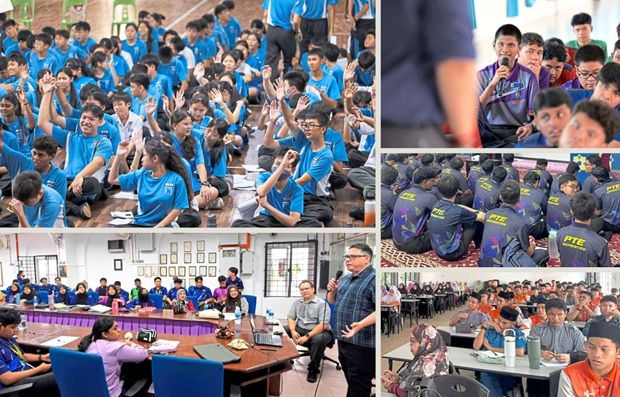
The roadshow kicked off at SMK Maxwell in KL on June 10, with 80 Upper Six students engaging in the question-and- answer session – the longest in the entire roadshow.
Teacher Che Fauziyati Che Zakaria said the talk was “very informative, engaging and relevant to students”.
“The speakers explained the topic clearly and used examples that were easy for students to understand and relate to,” she said.
The second stop was SMK Taman Tun Dr Ismail in KL on June 16, attended by 70 Form Three students.
Teacher Nur Iman Ahtira said the talk provided students with greater awareness of the importance of thinking critically before believing, sharing or responding to information online.
“The programme was timely, engaging and educational, and it complemented what teachers are trying to instil in students about responsible digital citizenship,” she said.
The third session, held at SMJK Katholik in Petaling Jaya, Selangor, on July 16, recorded the biggest turnout. The team ran two sessions for a combined audience of 1,674 students.
Teacher Kho Hui Yen, who held a follow-up session titled “Can we beat ChatGPT?” after each talk, said students found the practical tools easy to remember and apply.
“The talk was relevant and eye-opening for many of my students,” she added.
The roadshow continued in Selangor with a stop at Kolej Tingkatan Enam Gombak on Aug 4 for 245 students before culminating in a session at SMA Persekutuan Kajang (SMAPK) on Aug 5 for 139 students.
“The students benefited from the talk, saying they would not simply share any information they receive,” said SMAPK teacher Zuraidah Khairi.

With the theme of the article in mind, carry out the following English language activities.
1 In a group, come up with two three-sentence news reports – one must be based on facts, while the other must be based on a lie. Exchange your reports with another group, who will identify which is factual and which is fictional.
2 Look through today’s newspaper and choose a news article that interests you. Then, come up with a clickbait headline for it. Exchange your headline with a friend, who will rewrite it as a responsible news headline.
The Star’s Newspaper-in-Education (Star-NiE) programme promotes English language learning in primary and secondary schools nationwide. For Star-NiE enquiries, email starnie@thestar.com.my.