IN the modern pursuit of holistic student excellence, the line between “giving a child the best start” and “overwhelming them” has become increasingly blurred, experts say.
What begins as good intentions, they warn, can gradually turn into parenting anxiety – and eventually a situation where both parent and child feel persistent pressure to perform.
Their views come as parents told StarEdu they spend hundreds to several thousand ringgit a month on their children’s enrichment activities.
The trend aligns with a March 12 report in The Star that tuition centres are seeing strong demand from students seeking additional academic support in the age of artificial intelligence.
In fact, the report noted an increase in students signing up, according to the tuition centre operators interviewed.
Clinical psychologist Tan Ei Win said children today may be carrying performance expectations much earlier in life, as achievement is increasingly measured across multiple domains.
“In practice, I often see parents worry that if they do not enrol their child in the right classes, schools or programmes, they may be limiting the child’s future.
“Even when parents try to be thoughtful and balanced, they may still question themselves after seeing what other families are doing,” she told StarEdu.
‘Optimised’ childhood
Traditionally, Tan said, a “good childhood” was associated with safety, family connection, play, moral upbringing and doing reasonably well in school.
Today, for some families, she noted, that definition has expanded to include optimisation – ensuring children receive the “best start”, early enrichment and carefully planned developmental pathways.

“This shift is understandable. Many parents are raising children in a more competitive social and educational environment, and they understandably want to prepare them well,” she said.
Importantly, she stressed that such anxiety is often rooted in care rather than selfish ambition.
“Parents genuinely want the best for their children. However, the amount of information, advice and comparison available today can make it difficult to feel settled in one’s choices,” Tan, who is also Bright Start Child and Adolescent Psychology director, said.
Chiming in, Taylor’s University Department of Psychology head Prof Dr Rozainee Khairudin pointed to the role social media plays in reinforcing the belief that “more is always better”.
Such settings, she explained, can distort a parent’s view by creating the impression that a busy schedule is directly linked to future success.
Ripple effects
Prof Rozainee warned that this “more is always better” mindset can sometimes overlook the reality of diminishing returns.
“Once a child’s schedule becomes too crowded, the resulting stress may interfere with the very skills – such as creativity and executive function – that these activities were intended to build,” she said.

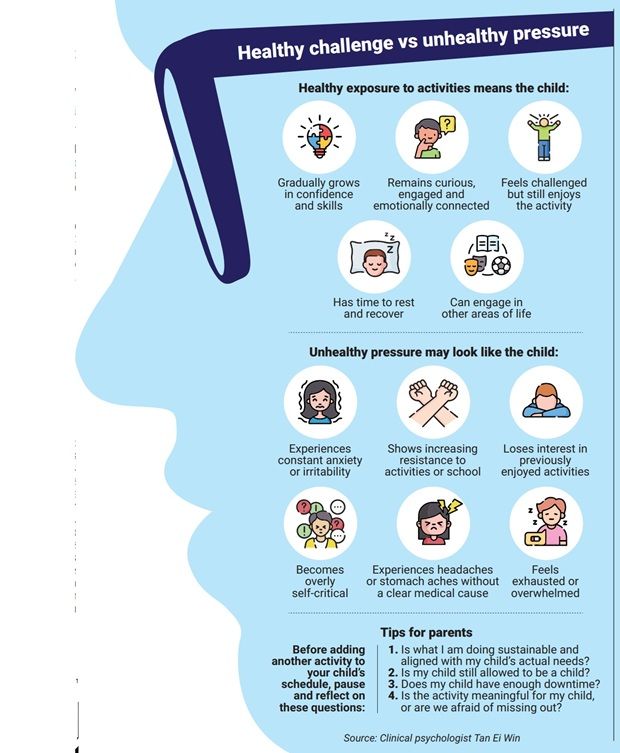
What is also concerning, Tan said, is that children do not always openly express the pressure they feel (see infographic).
“In younger children, stress may appear through irritability, frequent emotional outbursts, perfectionistic tendencies, school refusal, sleep difficulties, or a strong fear of making mistakes,” she said, adding that some children may also begin to equate being constantly busy with being successful.
Tan emphasised that children need rhythm in their lives – not just routines.
“If every part of the week is structured, evaluated or goal-driven, there is very little room left for emotional processing and natural recovery,” she said.
Over time, she added, this environment can create a fragile sense of self-worth.
“Some children become perfectionistic and fearful of mistakes because mistakes feel like personal failure,” she said.
Quality over quantity
Enrichment activities can play an important role in a child’s development, but the key, experts say, is balance.
“First, we must consider the nature of the activities and whether they complement academic goals.
“While some enrichment can enhance cognitive development through neuroplasticity – the brain’s ability to form and reorganise synaptic connections – we must still be mindful of cognitive overload.
“If a schedule is too tight, the resulting stress can impair the very cognitive functions, such as focus and memory, that are required for learning,” Prof Rozainee said.
There is also no universal formula for the “right” number of activities, Tan noted.
A child’s capacity, she explained, depends on many factors, including age, temperament, school demands, travel time, family rhythm and the child’s own interests.
“However, as a general principle, primary school children should still have regular protected time for rest, free play and family connection.
“If a child is involved in structured activities on most days of the week, parents should pause and consider whether the schedule is still sustainable,” she advised.
For parents concerned about university admissions, Prof Rozainee offered reassurance that universities and scholarship boards typically value depth and authenticity over a broad but superficial list of activities.
“From a cognitive perspective, a checklist of numerous unrelated interests often signals quantity rather than genuine engagement.
“What tends to stand out more is sustained commitment, meaningful contribution, and evidence that a student has developed real skills or insight through their activities,” she said.