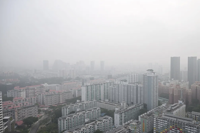
SENTUL is often viewed as a unique area encapsulating old-world charm and modern glamour, much like it is marketed by a housing developer.
Embellishing the area like gems scattered on the ground are several houses of worship that are in relatively good condition despite being decades-old.
“The Athieeswaran Temple, built in 1937, is the country’s first Sivan Temple,” said volunteer S.N. Chandran, 60, proudly.
“The railway workers collected 1 cent from everyone to build this temple. Back then, 1 cent was a day’s salary.”
The Sentul Market, Sentul Cinema and several schools remain untouched as they have been preserved for their historical significance and are considered icons that define the area.
Many old shops and houses still stand. But undeniably, the threat of them vanishing some time in the future looms, especially when contrasted against the nearby skyscrapers, which epitomise modernity.
Sentul also pays tribute to an outstanding politician by naming a housing estate and several roads in the area after Tan Sri Senu Abdul Rahman (1919-1995).
Born in Jitra, Kedah, Senu studied at the Jitra Malay School, Tanjung Malim Teachers’ Training College and in 1954, graduated with a Bachelor of Arts from the University of California, Los Angeles specialising in political science.
He started his career as a teacher in Alor Setar before becoming an officer in the Alor Setar Education Department, then under Siamese rule. Subsequently, he worked at the Indonesian Embassy under the United Nations (1954).
Senu formed post-war Malay nationalist movement Saberkas with his friends in 1943. He was an MP for Kubang Pasu Barat, Kedah; Kuala Kedah/Langkawi replacing Tunku Abdul Rahman in 1973 and Kuala Kedah (19741982).
Senu was Malaysia’s first Information Minister (1964) and first ambassador to Indonesia (1957-1962). He was also the ambassador to Germany (1964), director of Election for the Alliance Party (1964), Youth and Sports Minister (1966-1968) and Umno’s secretary-general (1968-1978).
Senu also had artistic talent. He was an artist at the Japanese Information Department during the Japanese Occupation and was actively involved in drama productions during the Thai occupation of Kedah.
The scripts he penned included Aku Berdosa and Salah Pedoman. Later, he was involved in producing a special document titled The Principles of Umno’s Struggle and the book Mental Revolution, that laid out a vision for Malays.
Taman Dato Senu is mostly residential and the area is best symbolised by Jalan Sentul.
Even though some old traces can be found, many long-time residents say a vast swathe of Sentul has been wiped out over the past 10 years.
Not much is left to suggest that Sentul was first opened as quarters for KTM, Public Works Department (JKR) and Telekom workers.
Most of the early residents in Sentul were Indians working in the train depot and central workshop built by the British, dating back to 1896.
The older and larger of the two depots there, known as the Sentul Works, has been operational since 1905.
Sprawled over 5.2ha, it was the country’s largest train depot consisting of numerous brick buildings and metal sheds used for storage. Most of these have been demolished, the western-most brick train shed is retained as the Kuala Lumpur Performing Arts Centre.
The Sentul KTM station is now draped in a futuristic design. It is also an integral link to the new Sentul-Batu Caves Electrified Double Tracking project.
Some locals find the high-rise projects intimidating.
D. Pala Kumaran, 43, said he felt that in two years. Sentul would have too many cars as there are not enough access roads into the area.
He misses the old Sentul, but he welcomes one change — that the area is finally shedding its notoriety as a gangsters’ den.
“It used to be so bad that you could sometimes see people armed with parang running around the area.
“Gangsterism was rife as many residents were labourers. Now, the younger generation in Sentul are educated,” he said.
The gruesome Japanese Occupation added a dose of mystery to Sentul, especially in its schools. A former student from SMK Convent Sentul, which was built in 1940, said it was used as a hospital for Japanese soldiers and bodies are said to have been buried under the school field during World War II.
“There were plenty of ghost stories flying around when we were there. Whenever camps were held on the school grounds, students were not allowed to leave the hall at night. These stories stirred our imagination,” she said.
Sentul is also said to be the birthplace of Botak Chin, the notorious criminal whom some call Malaysia’s Robin Hood.
Son of an ex-employee of Malayan Railways, Botak Chin grew up in the quarters. He studied at Sentul Methodist Boys’ School up to Form 3.
Before his execution, he revealed to the director of Tanjung Rambutan Mental Hospital that he formed triads to protect the poor because as a child, he was brutally attacked by gangsters at his vegetable stall in the market.
It seems like the gangster-ridden environment of Sentul helped explain Botak Chin’s criminal past.
Already a subscriber? Log in
Get 20% OFF The Star Digital Access
Cancel anytime. Ad-free. Unlimited access with perks.