For eight years, a cardboard palm has beaten the odds and thrived in a moss-covered kokedama ball.
Plant stylist Tan Kwok Kuang said it was proof that with proper care, kokedama plants can last for years.
The plant, known by its scientific name of Zamia furfuracea, at Mossy Bola in Kedai KL, Kuala Lumpur, has developed an
“independent” character.
Unlike the other plants, it does not need constant “reminders” to look good to impress Tan’s customers.
Nevertheless, Tan feels it is still necessary to “talk” to it as he believes in communicating with his plants.
“Our conversations are simple. I say ‘hello’ to it and ask why it has not come out with new leaves.
“If it does not look well, I will ask why and comfort it by telling it that I will move it outside to enjoy some sunlight,” he shared.
At Taman Hati, a plant shop and cafe in SS2, Petaling Jaya, a four-month-old fern kokedama receives similar attention from barista Mior Muhammad Adli Mior Mohd Akhir.
Like Tan, Mior Muhammad Adli talks to his fern kokedama, offering words of affirmation to encourage it to grow strong and healthy.
He also puts music for it to listen to, specifically an album by Canadian-born composer Mort Garson titled Mother Earth’s Plantasia, an electronic work composed specifically to be played for houseplants.
“As to whether my kokedama actually likes the album or not, one just has to believe.
“I haven’t played other types of music for it,” said Mior Muhammad Adli.

What has endeared him to kokedama is the grounding effect that comes with touching grass and soil, which he describes as therapeutic.
“Working directly with soil, moss and plants is calming.
“It helps me slow down, reduces my stress and makes me feel better overall,” said Mior Muhammad Adli.
Caring for kokedama
Tan, who runs a kokedama business full-time, explains what the process of crafting one entails.
A typical kokedama – from the Japanese words “koke” (moss) and “dama” (ball) – begins with a plant and a compact growing medium.
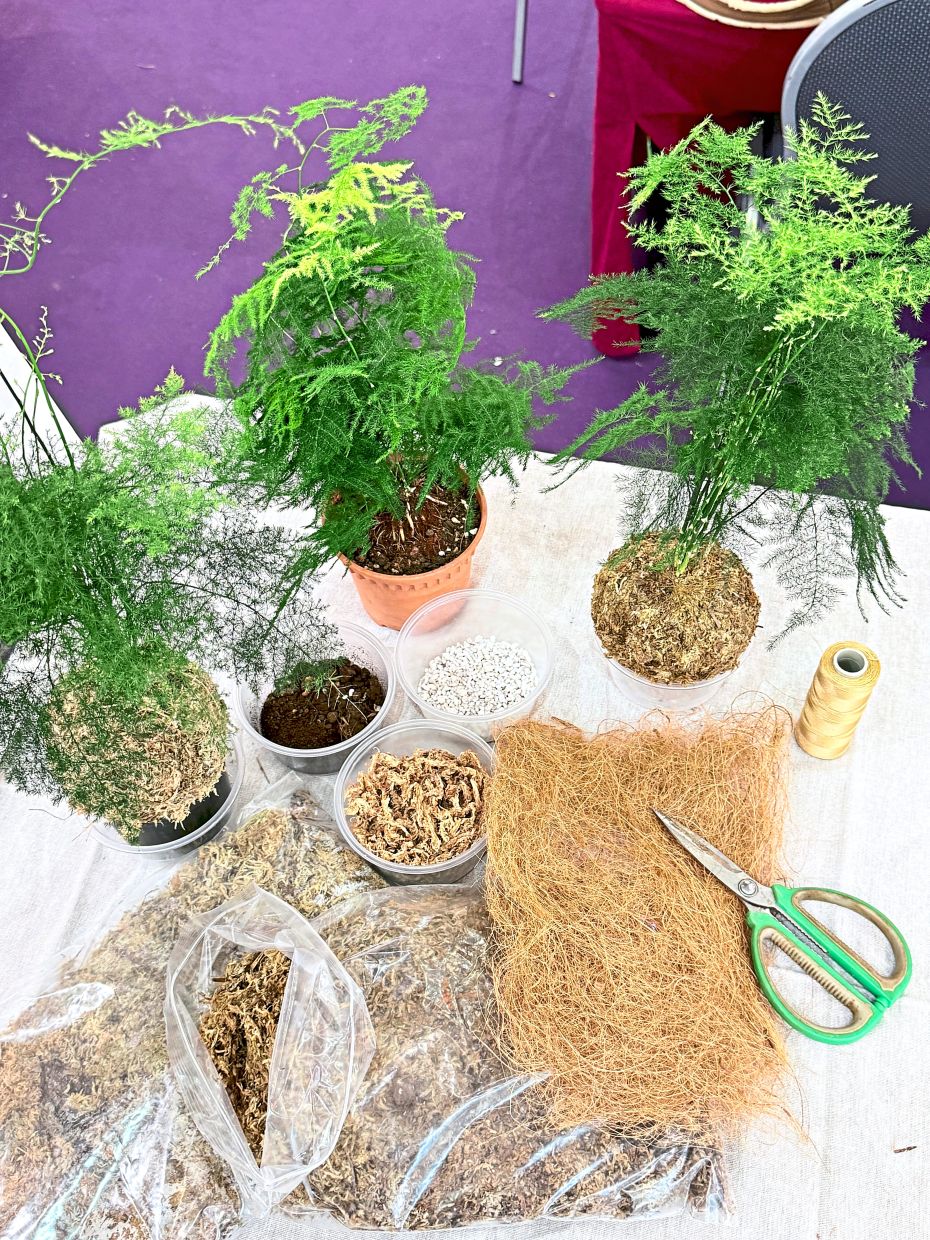
Tan’s formula consists of a self-concocted combination of soil, dried sphagnum moss, fresh moss and an outer covering of dried coconut husk.
He initially used fresh moss on its own, but found that it was too sensitive for Malaysia’s hot weather.
“I got the idea of using coconut husk after observing how local nurseries use it as a top layer to retain moisture in the soil.
“It also gives a natural, textured finish,” said Tan.
To water a kokedama, just soak the entire ball in water for a few minutes, until bubbles stop rising.
“In Kuala Lumpur, a kokedama can last between four and seven days after watering,” said Tan.
“In places such as Cameron Highlands, it can last up to 10 days.”
Tan, who formerly worked with the advertising and promotions department of a German company, ventured into the kokedama business after retiring 10 years ago.
While he generally operates from pop-up stalls, he also runs what he calls a “service centre” at Mossy Bola.
The centre helps kokedama owners maintain their plants, including retying loose strings and reballing plants which roots have outgrown their original moss balls.
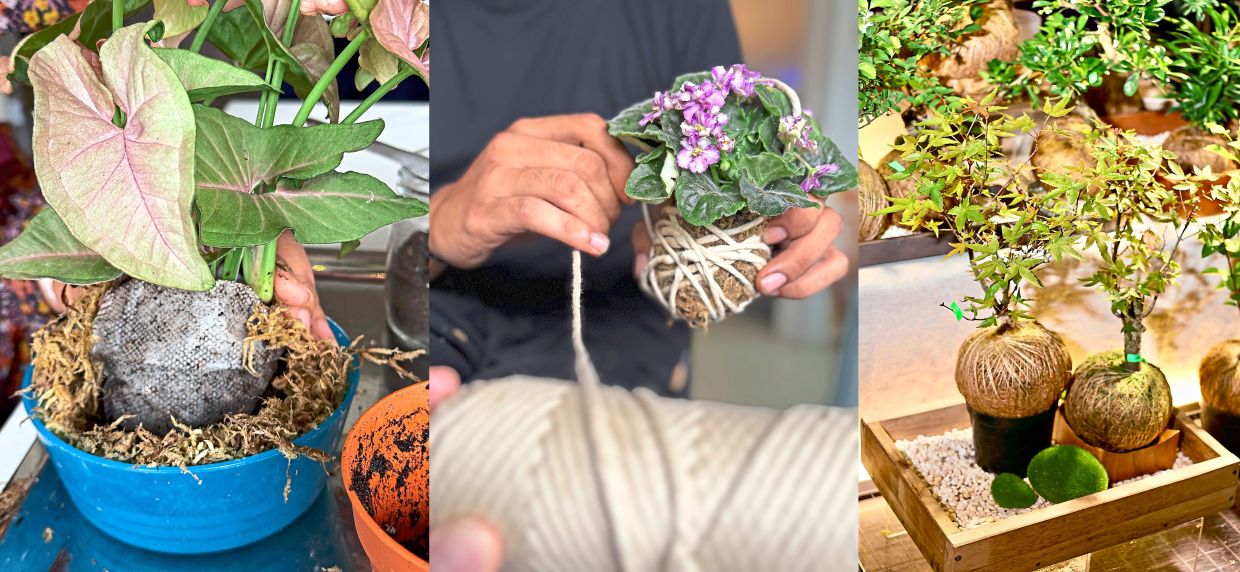
Tan learned about kokedama 30 years ago at a workshop while backpacking in Taiwan, even though it originated as a traditional Japanese botanical art form.
“What drew me to it was how ‘modern’ the end result looked,” he said.
Having started with a fern plant provided at the workshop, he has successfully “kokedama-ed” about 140 types of plants since then.
They include bougainvillea, golden pine − which is popular during the Christmas season − and lucky bamboo, which is synonymous with Chinese New Year.
The largest kokedama Tan has made measured 35.56cm in diameter.
His soil mix includes peat moss, which decomposes over time and adds nutrients for the plant.
Ferns are among the best plants for kokedama, said Tan, while orchids required more research and development to ensure they could survive in the arrangement.
A kokedama can generally last two to three years before its root system outgrows the ball, or before the soil, moss and twine need to be refreshed.
“When making the moss ball, it is better to make it one size bigger so the roots have room to grow.
“Otherwise, the process itself may injure the plant,” said Tan.
On whether the kokedama method can be used to cultivate edible plants like herbs and chillies, he said this would not be cost effective, partly because sphagnum moss is costly.
“Moss costs around RM10 a packet, and one packet can make only two balls,” he said.
Simplified for beginners
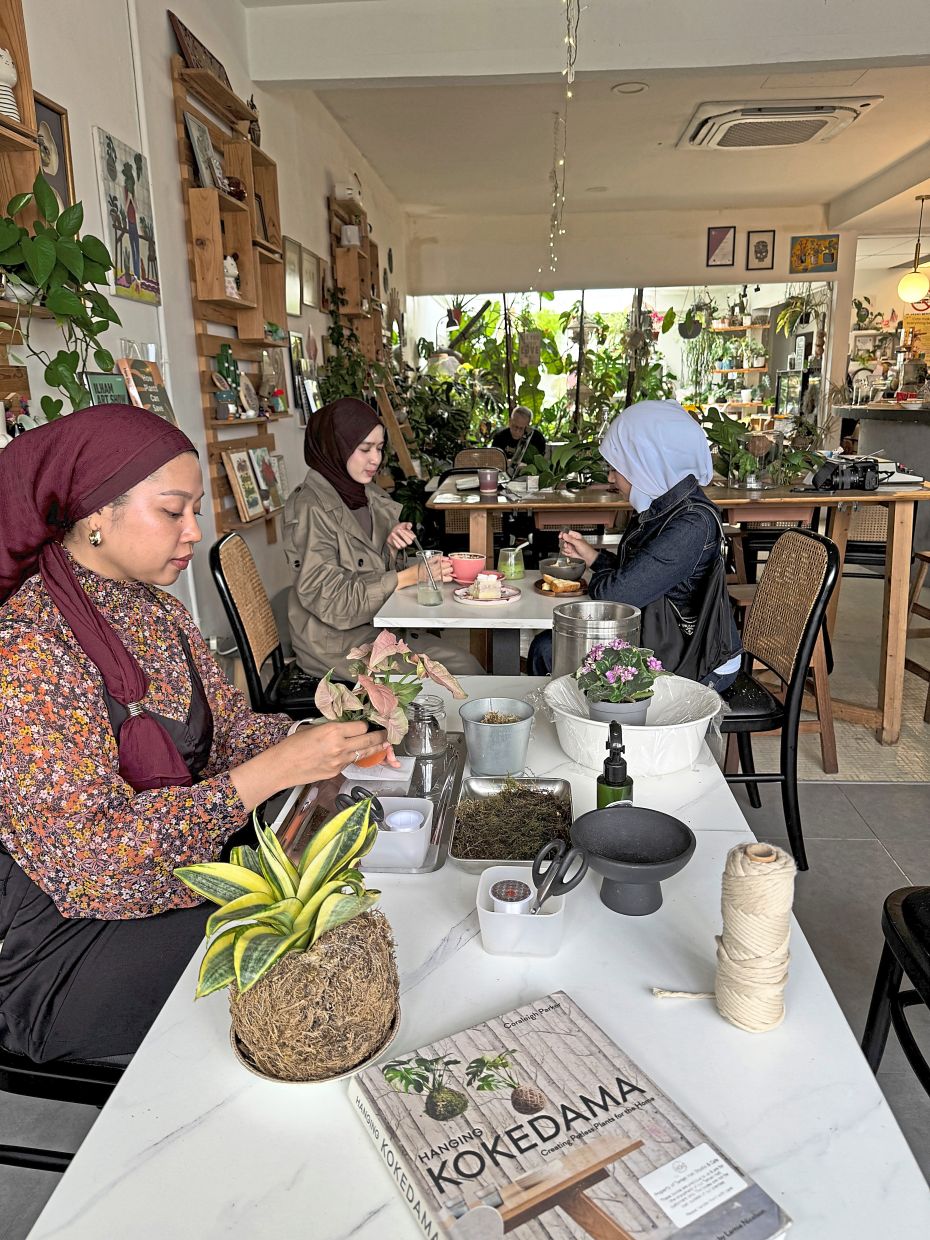
Taman Hati owner Suzana Zainal Abidin has introduced kokedama to a wider audience through beginner-friendly workshops.
She started Taman Hati as a plant shop. It has since grown into a cafe and creative space that hosts acoustic evenings and workshops on activities ranging from edible terrariums and cake painting to kokedama-making.
Suzana conducted her first kokedama workshop in 2019.
The idea came after she met someone in Johor who sold ready-made kokedama pots, allowing customers to simply place a plant into the prepared form.
She likened that to a “cheat” version of kokedama.
Traditional kokedama often begins with a clay-based soil ball that can be firmly packed around a plant’s roots.
But Suzana has developed her own simplified version using netting and tea bags, making it more accessible for workshop participants.
“During workshops, the process has to be simplified because not everyone is an artisan or gardener,” she explained.
“Many people don’t go in-depth. They may not know what soil to use or what makes it stick together.
“What matters is that within 45 minutes, they can take a kokedama home,” she highlighted.
She often holds workshops in conjunction with Earth Day and green-themed events, sometimes with third parties.
She also runs more in-depth, mindfulness-focused sessions, like “Tea-time Kokedama” workshops, where participants can slow down and focus on the tactile process of working with soil, moss and plants.
“The key is in choosing suitable plants and avoiding rare species taken from forests, a practice that is illegal.
“As long as you can put a plant in soil and there is sunlight, you can ‘kokedama’ anything,” said Suzana.
She advises beginners to avoid overly delicate plants, as these require more care.
More suitable choices include sansevieria, ferns and other types of plants that do not require frequent watering.
“Plants that are prone to root rot when overwatered can also work, provided you understand their care requirements,” said Suzana.
Mior Muhammad Adli suggested experimenting with different techniques to create suitable kokedamas.
To make his four-month-old fern kokedama, which now measures about 20cm in diameter, he turned to everyday household items.
“I used a plastic bowl and lined it with sphagnum moss first.
“Then I placed an upside-down nursery pot inside and added another layer of sphagnum moss to create half a ball,” said Mior Muhammad Adli.
Once the form was complete,
he wrapped it in cling film, turned it over and trimmed along the line of the pot before removing the pot.
He then placed the plant, with excess soil removed from its roots, inside the moss structure.
“I tied it with a fishing line and trimmed the excess sphagnum moss,” said Mior Muhammad Adli.
Styling it right
A typical way of styling a kokedama is to place it on a plate.
However, they can also be put in mocktail glasses or suspended upside down in clear vases.
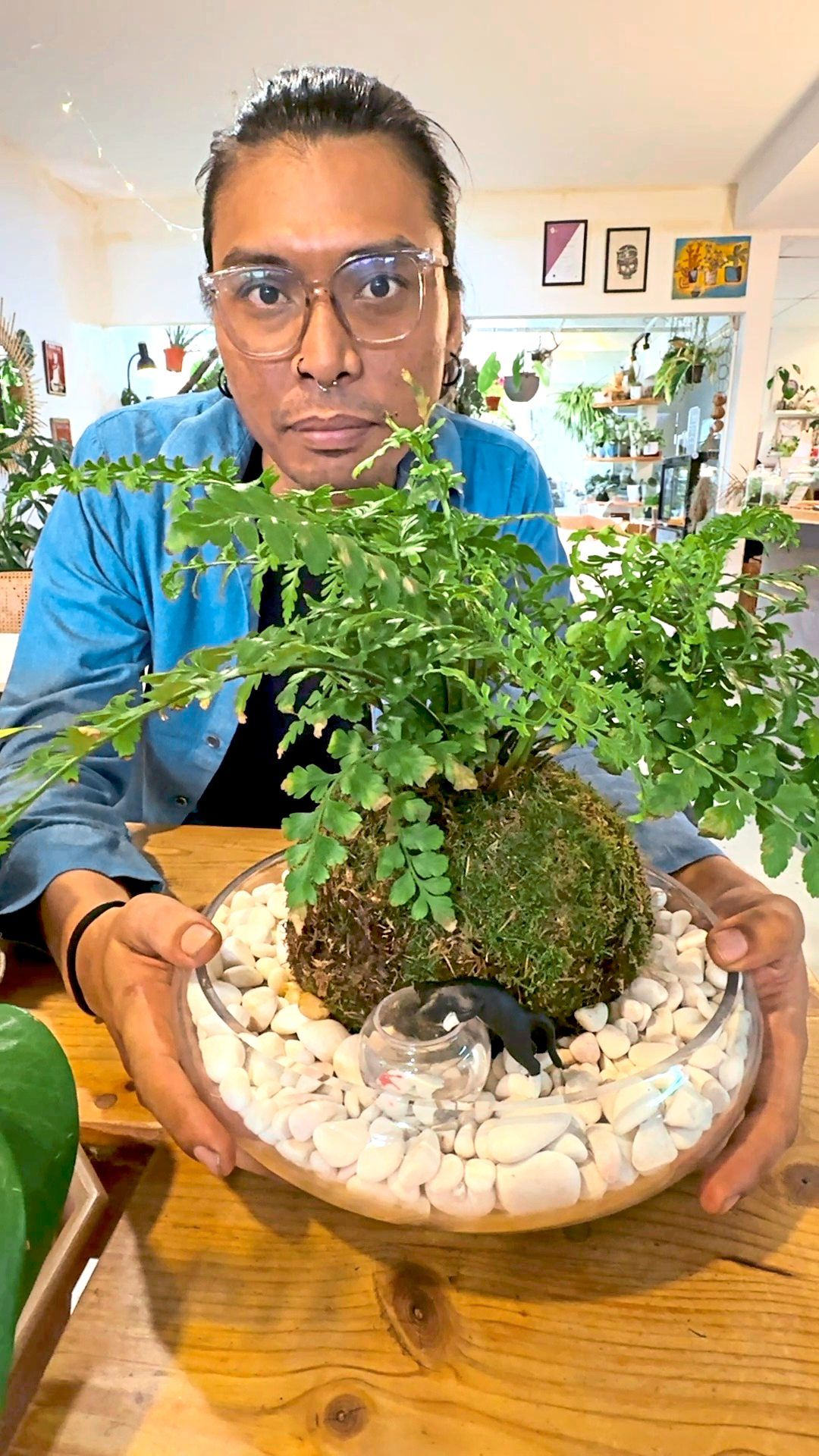
To add a touch of whimsy, they could sit on a bed of white pebbles in a water-filled fishbowl.
The addition of miniature figurines also helps to create an aesthetically pleasing landscape.
For a different look, kokedama crafters also like to tie up their moss balls with nylon string or coloured thread.