



A CITY’S history often disappears quietly, with familiar places giving way to development and old ways of life fading into memory.
Yet through artworks, photographs, videos and artefacts, fragments of the past continue to live on.
Such reflections lie at the heart of an ongoing art exhibition titled “Echoes in Between: Penang as Living Archive” at ChinaHouse on Lebuh Pantai in George Town, Penang.
The showcase invites visitors to view heritage not just as remnants of the past, but as something kept alive because people choose to remember it.
Curator Kenneth Wong See Huat said the exhibition featured 32 artworks by 14 artists and contributors from diverse backgrounds.
Some document places in Penang that are gone entirely, while others highlight those under pressure from urban development, alongside the sense of belonging felt by those connected to them.
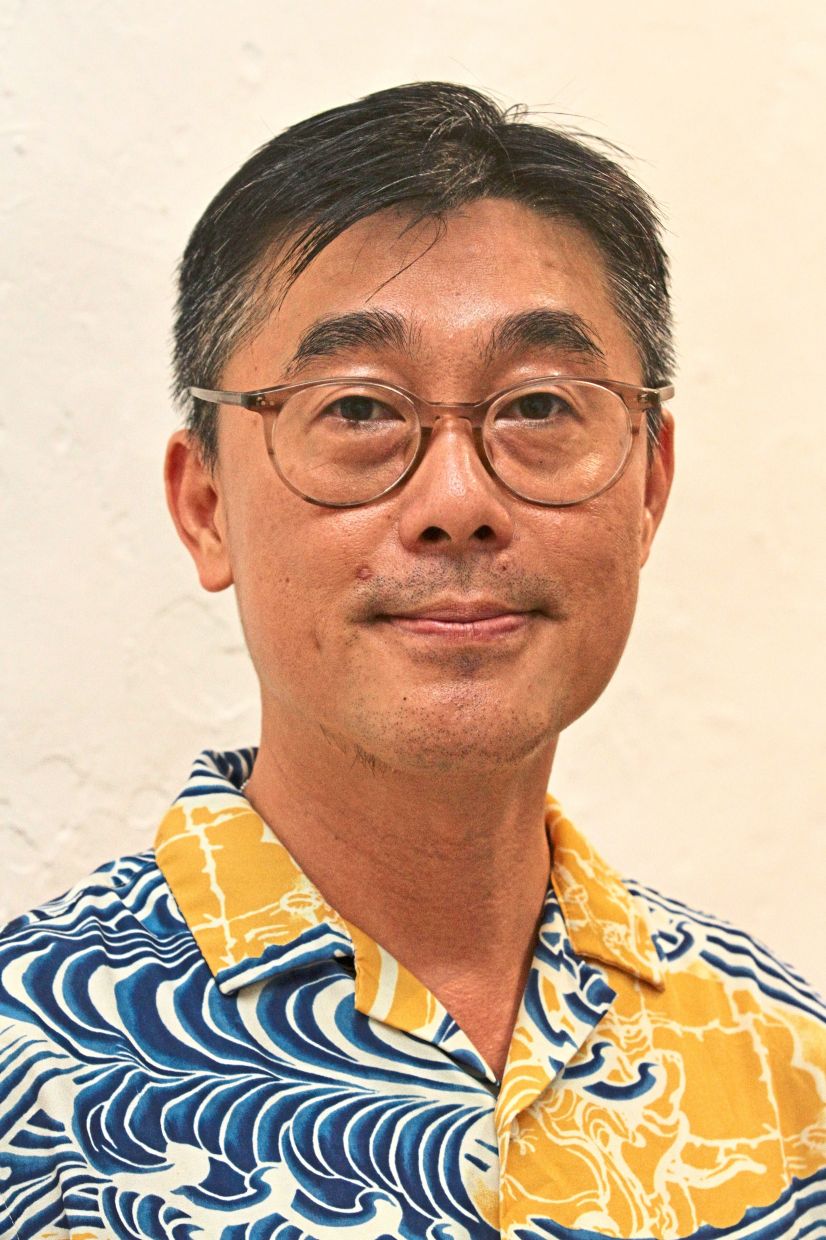
Wong said living archives were not confined to official records, historical documents or museums, but could also be found in homes, streets, markets, places of worship, inherited objects, structural remnants and stories passed between generations.
“Much of what shaped Penang no longer survives in its original form.
“Instead, we experience fragments of it, such as a salvaged piece of architecture from a demolished house, a sketch of a changing streetscape or a fading community story.
“These fragments are echoes – traces that continue to resonate across time,” he highlighted during the show’s recent opening.
Local painter Khoo Cheang Jin put up several watercolour works featuring nostalgic Penang scenes.
One depicts a kampung house along Jalan Perak that has since been demolished, while two others feature structures that could soon meet a similar fate.
The first is of Kampung Sireh, a lesser-known Chinese village nestled between Lengkok Burma and Lebuhraya Codrington in Pulau Tikus.
“I found the site by chance while sketching in Pulau Tikus.
“Some of the original occupants have moved out and the houses have become dilapidated.
“It could soon give way to development,” said Khoo.
Another painting features the Song River coffeeshop in Persiaran Gurney, a mainstay of the local food scene for generations.
“With highrises coming up around it, I fear its days are numbered too,” he said.
Khoo hopes his works will serve as a visual record.
Fellow painter Lim Jee Yuan showcased a watercolour of a house in Kampung Siam, also in Pulau Tikus, which stood for 180 years before being demolished in 2025.
It was the former home of fourth-generation resident
Nai Boon Phrom, one of the last villagers to vacate the enclave after the land was sold for development.
“For nearly two centuries, Kampung Siam stood as a living testament to Penang’s multicultural history, where the Siamese and Burmese communities maintained their traditions and sense of belonging amid a rapidly changing city.
“This was more than the loss of a building.
“It signified the disappearance of a tangible link to the community’s shared history and cultural identity,” Lim noted in his artist statement.
Kuala Lumpur-based Jamal Tumiran, better known as Jamal Tommy, said he loved the pre-war shophouses lining George Town’s historic streets.
His piece depicts a trishaw rider resting in front of one
such structure, with weathered timber, arched windows and ornate shutters recreated in detailed watercolour.
“I visit George Town frequently just to walk around and explore such buildings.
“It really represents the spirit of the city,” Jamal shared.
Summing up the showcase, Wong hopes these pieces of Penang’s cityscape will allow
the public to connect with the past and remember what has been lost.
“Once these structures and scenes are gone, what still bonds the community is their shared heritage and memories,” he said.
The exhibition on the upper floor of ChinaHouse runs until Aug 11.
It is open daily from 10am to 7pm. Admission is free.
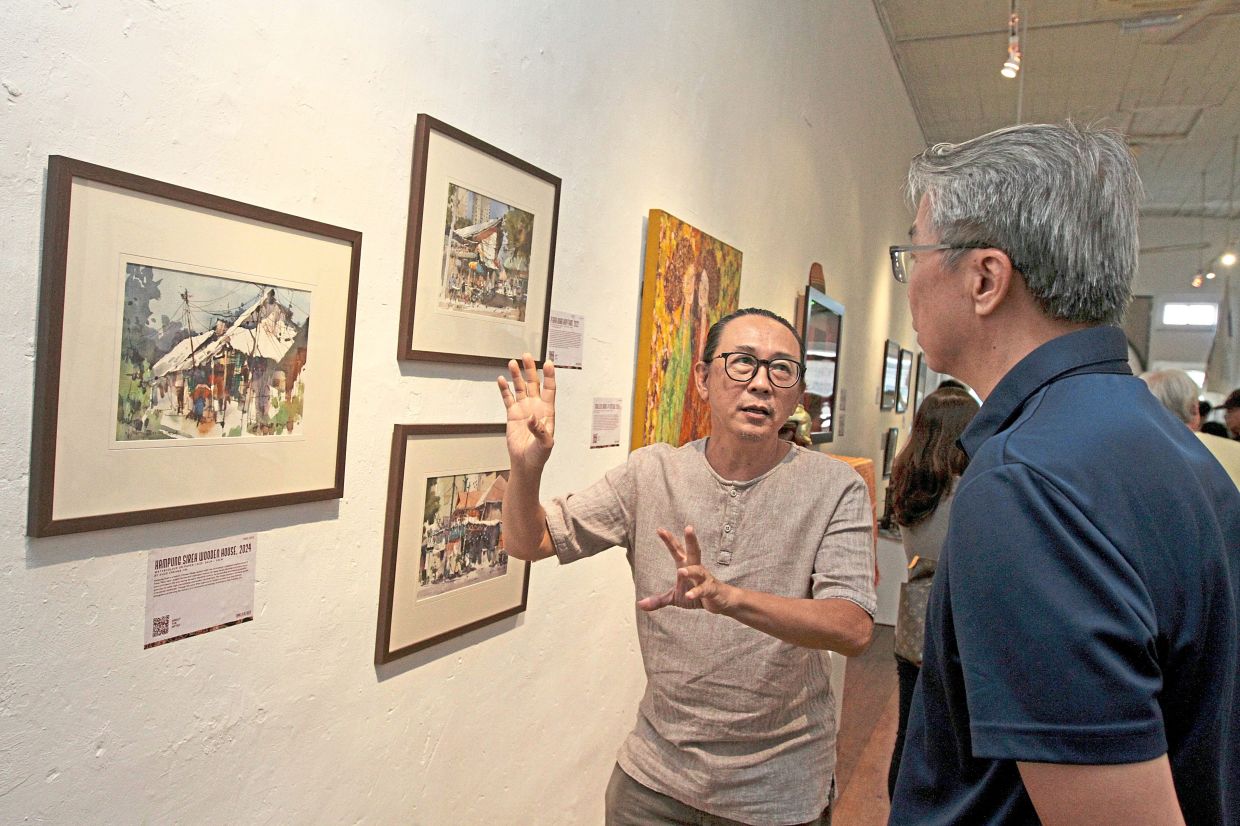


Khoo (left) sharing about the endangered kampung houses in his paintings during the opening of ‘Echoes in Between: Penang as Living Archive’ exhibition at ChinaHouse. (Below) Jamal and his ‘Peace in a Heritage Lane’ artwork depicting a trishaw rider resting in front of a pre-war shophouse.
Wong says some artworks document places in Penang that are gone entirely.
Lim Anuar’s batik painting ‘Return After Work’.
Jamal and his 'Peace in a Heritage Lane' piece depicting a trishaw rider resting in front of a pre-war shophouse.
Mak Yik Mei’s ‘Heritage on Wheels: Studies of Everyday Mobility’ documents the wheeled vehicles that have served Penang’s communities throughout history.
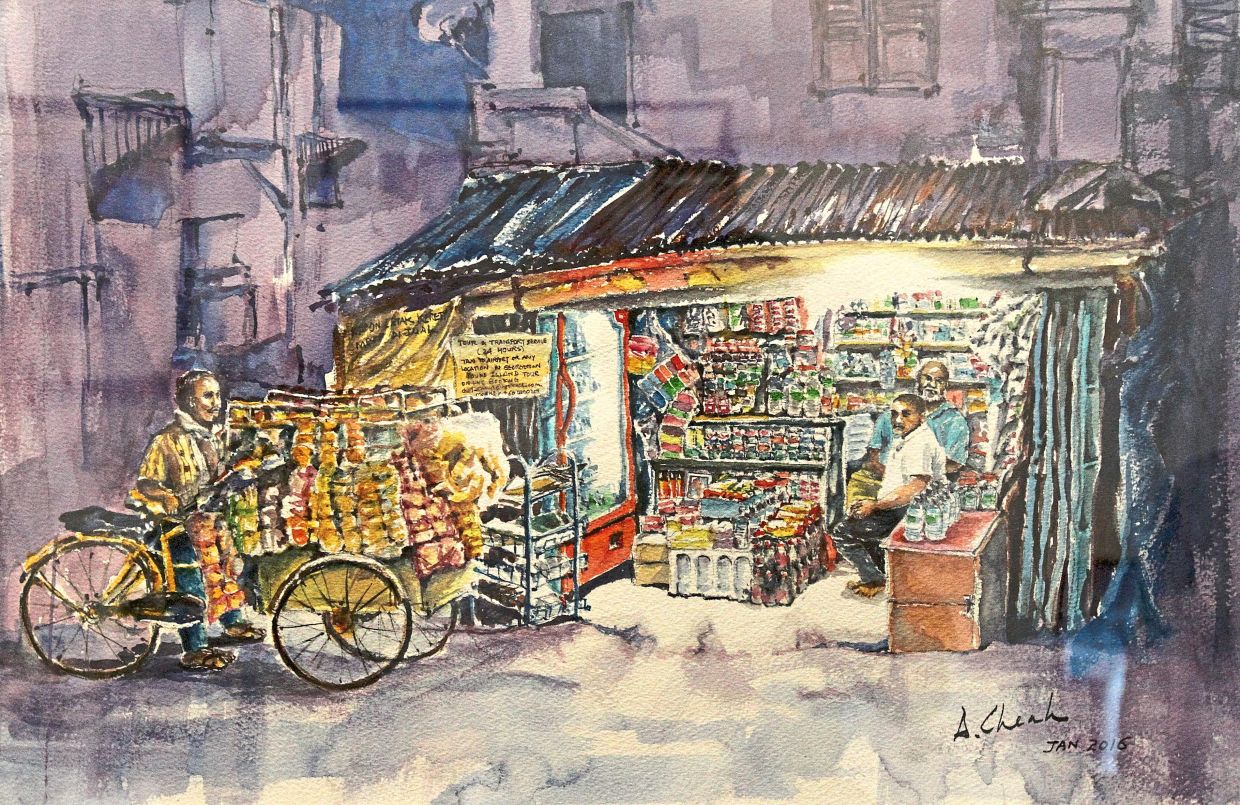
Anthony Cheah’s watercolour painting ‘Ottu Kadai Penang’.
Kow Leong Kiang’s oil on canvas piece titled ‘Space’.

