THERE was a time when cycling seemed to define Penang’s urban landscape.
Back then parts of George Town buzzed with activity on weekend mornings as many out-of-town visitors toured the city by bicycle.
During car-free days, families arrived early along Lebuh Pantai.
Parents fussed over their children’s helmets while teenagers pedalled carefree through the streets.
This enthusiasm extended beyond weekend recreation.
“Bike on Friday” was subsequently launched by a group choosing to cycle to work.
Over time, cycling itself became part of their identity.
It was also quite normal to see carbon-frame bicycles leaning against the kopitiam walls.
Cyclists in lycra jerseys traded stories of conquering Penang’s hills and discovering scenic routes through Balik Pulau.
The growing interest in cycling saw bicycle shops multiply, while Facebook groups and WhatsApp chats filled with ride plans.
The state government responded to the cycling surge with its 2010 Bicycle Lane Master Plan.

The idea was to make cycling part of everyday urban mobility rather than merely a recreational activity.
Another symbolic milestone was the LinkBike launch in 2016 – a bike-sharing system designed to improve connectivity and commuting within George Town.
Rows of brightly coloured public bicycles soon appeared across the city with docking stations near heritage sites, tourist attractions and transportation hubs.
For locals, the bicycles represented progress towards becoming a cycling-friendly state.
Penang seemed poised for a cycling era.
Today, however, that vision is clouded with new challenges.
While dedicated cyclists are still active, the enthusiasm that once surrounded the cycling movement appears to have faded.
The question now is whether Penang’s cycling boom has ended, or if it remains an unfinished dream.
Cycling needs revival
G Club chairman Datuk Dr Lim Seh Guan, 65, who witnessed Penang’s cycling scene evolve over two decades, said the landscape had dramatically changed.

“Penang was once seen as a pioneer of cyclist-friendly urban planning, but that momentum has slowed down as the island has become increasingly urbanised and motorised,” he said.
The veteran cyclist who was a driving force behind the Campaign For A Lane (CFAL) from 2009 to 2018, advocated for dedicated cycling lanes and safer infrastructure.
He said cycling had shifted from an everyday means of transport to a weekend pastime.
“Many office workers prefer driving. Others are waiting for better public transport, including the Penang Mutiara Line LRT and improved bus services,” he said.
He added that the hot and humid weather, alongside the rising popularity of indoor fitness, had further reduced cycling’s appeal as a daily commuting option in Penang.
Despite the state’s extensive cycling lane network, the infrastructure was mixed, he said.
“The coastal route from Tanjung Bungah to Queensbay is Penang’s crown jewel,” Dr Lim said.
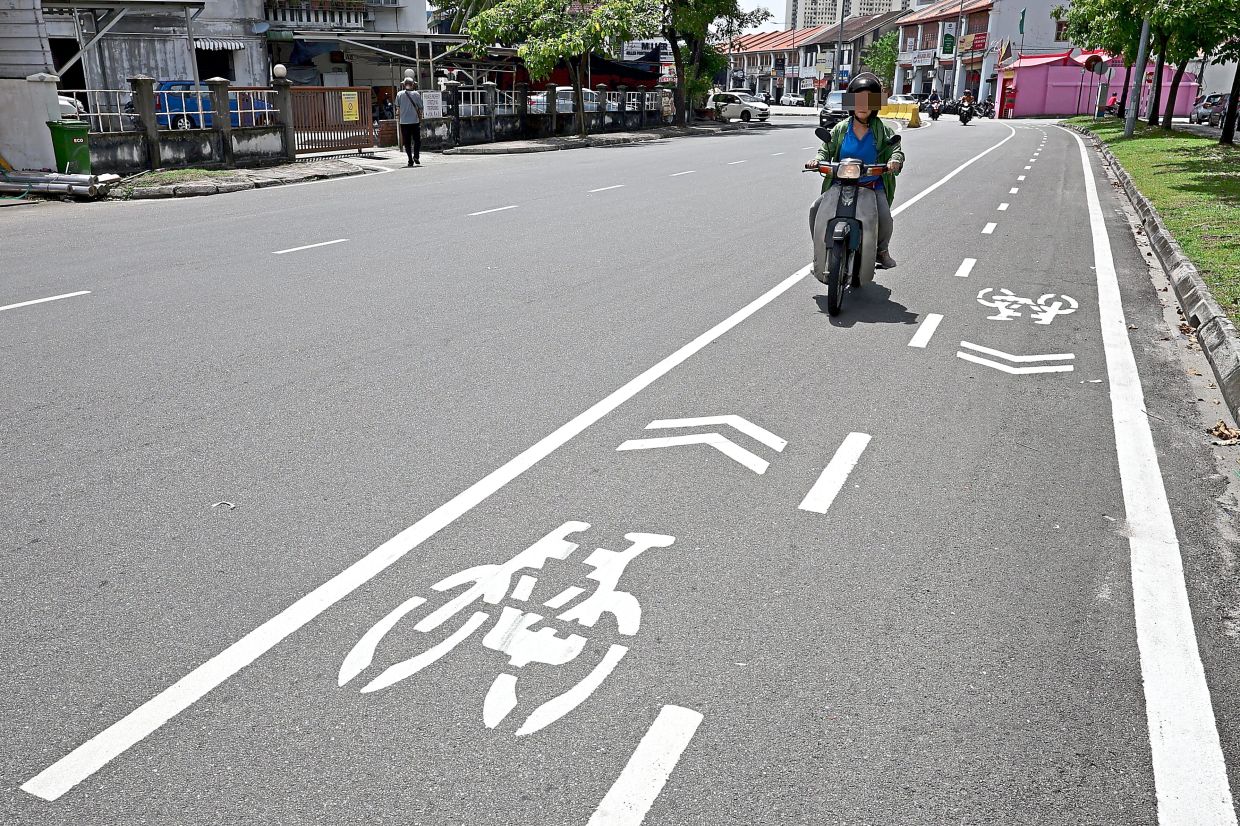
“However, dedicated lanes in George Town are often blocked by vehicles and delivery vans, while motorists tend to ignore bicycle boxes at traffic lights.”
He welcomed efforts to integrate cycling with public transport and turn George Town’s back lanes into pedestrian and cycling corridors.
Dr Lim, however, said cycling infrastructure required more proactive maintenance to ensure it remained safe and accessible.
“Painted lines alone are not enough,” he said.
“Cyclists want physical barriers or bollards to keep vehicles out of cycling lanes.”
With cycling events evolving into broader family- and community-oriented programmes, Dr Lim said cyclists want permanent or semi-permanent car-free
zones instead of occasional road closures.
He also called for safer segregated lanes, end-of-trip facilities such as showers and lockers, and incentives for electric bicycles.
“With Penang’s hilly terrain and hot weather, e-bikes could be a game changer,” said Dr Lim who helped organise the Tristate 160km Fellowship Ride, Penang Fellowship Ride, Bike on Friday, Ride for Sight charity rides, and Penang International Triathlon and Duathlon.
Beyond organised rides
Retired businessman Sim Nai Lee, 68, said many cyclists preferred riding with friends or informal groups rather than participating in organised events.
He said advances in technology had reduced the need to join events, as navigation apps and better bicycles allowed riders to take on routes independently.
“In the past, people joined events to get jerseys and discover trails which were difficult to access,” he said.
“Today, they can plan rides with the help of technology.”
He said lucky draws were once a major attraction for participants, but registration fees, sometimes reaching RM200, made some think twice about joining.
A cyclist for nearly 40 years, Sim said he preferred leisurely rides on his folding bicycle.
“It’s all about enjoying the fellowship, staying active and spending time with family.”
Adam Loh, 38, said cycling was a practical way to get around Penang, especially for short journeys.
Loh, who used to cycle 20km to and from work each day, said it had helped him stay fit while avoiding traffic congestion and parking issues.
He said better infrastructure was needed so more people would to take up cycling.
“Recent developments have removed key links, including the Sungai Pinang footbridge connecting Macallum and Karpal Singh Drive, while construction has disrupted existing routes.
“The authorities should provide alternatives before closing or demolishing existing links,” said Loh.
He said the lack of secure bicycle parking, and concerns over theft and vandalism, were factors discouraging people from commuting by bicycle.
Loh, who rides a motorcycle now, said cycling remained a viable commuting option, provided safer infrastructure and better support were in place.
Cyclist Gordon Khor, 50, said Penang island’s northern coastal stretch was ideal for cyclists.
He said the Tanjung Tokong to Pantai Malindo route was Penang’s most attractive cycling corridor.
“Hundreds of bikers ride the route every weekend,” he said adding that there was a need for more dedicated cycling infrastructure.
“Traffic conditions are manageable during weekend mornings, but worsen later in the day.
“There are still not enough bicycle lanes,” he said.
Khor hoped future developments such as Silicon Island would include wider and more comprehensive cycling facilities.
“There are plans for bicycle lanes at Silicon Island.
“A full loop with wider paths is ideal as it will help promote a healthy lifestyle and create a safer, more cyclist-friendly environment,” he said.
205km cycling network
Penang Island City Council (MBPP) has built 205km of cycling routes across the island, exceeding the 200km envisaged under its 2010 Bicycle Lane Master Plan.
Penang Island mayor Datuk A. Rajendran said the network had been expanded over the past 15 years to promote sustainable mobility, recreation and healthier lifestyles.
“The island has 205km of cycling routes – 49.1km (24%) are dedicated bicycle lanes and 155.9km (76%) shared lanes,” he said.
The master plan comprises coastal, riverfront, island-ring, radial and connector routes, as well as heritage, recreational
and Bayan Lepas industrial zone corridors.
Among MBPP’s landmark projects is the RM8.9mil Jambatan Harapan (Spiral Bridge), opened in Bayan Lepas in 2018 to provide cyclists and pedestrians with safe crossing over the Tun Dr Lim Chong Eu Expressway.
Since 2011, MBPP has required new developments to incorporate cycling infrastructure, including bicycle lanes, parking and supporting facilities, he said.
Commercial, educational and transport developments must also provide bicycle parking while larger projects are required to include showers, changing rooms and storage facilities.
Rajendran said RM34.8mil had been invested in a 30.2km coastal cycling route including bridges across Sungai Pinang, Sungai Nibong Kecil, Sungai Ara, Sungai Keluang, Sungai Tiram and Parit Mox.
The city council’s annual maintenance allocation has also increased, reaching RM200,000 in both 2025 and 2026 for the maintenance of cycling lanes, signage, barriers and lighting, he added.
Penang’s LinkBike bike-sharing programme now operates 29 stations with 250 bicycles.
It is operated by Fast Rent Bike (PG) Sdn Bhd, an MBPP initiative.
As of April 2026, LinkBike recorded 291,581 members and 387,515 rides, covering 1.88 million kilometres while reducing fuel consumption, carbon emissions and car trips.
To improve safety, MBPP has introduced Bike Box waiting zones at signalised intersections, installed 195 solar lamps and expanded CCTV coverage along cycling routes.
About 200 Rapid Penang buses were also equipped to carry foldable bicycles, said Rajendran.
Other facilities include bicycle parking, dedicated traffic signals, safety barriers, ramps and cyclist rest areas, with more planned at popular cycling locations.
MBPP infrastructure and traffic committee member Foo Yu Keong said cycling would play a bigger role once the Penang Mutiara Line LRT was completed.
“MBPP will study how cycling infrastructure can be better integrated with the public transport network to strengthen first- and last-mile connectivity.
“Technically, Penang’s infrastructure has improved but we need greater public awareness and stronger promotion to attract new cyclists for both commuting and recreation.
“We also welcome feedback from cyclists to help guide future improvements,” said Foo.
Routes across Penang
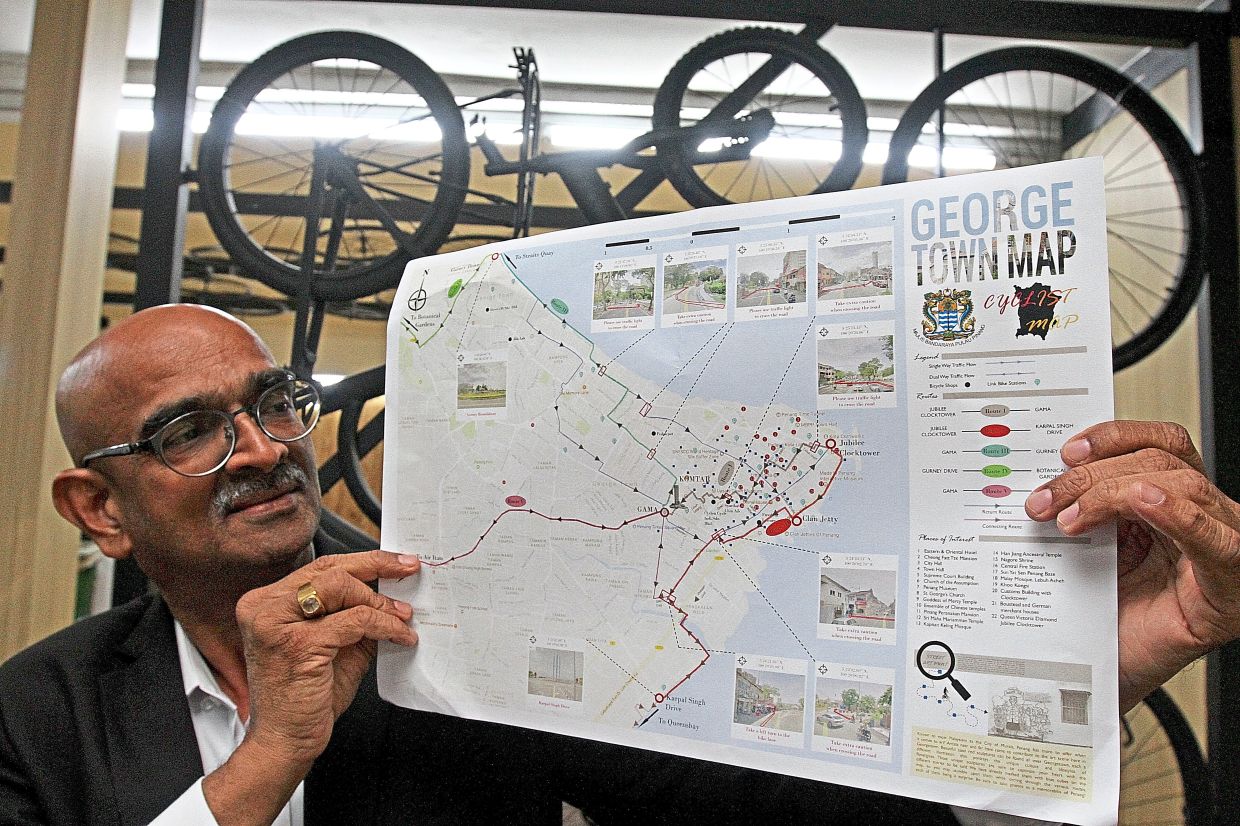
MBPP’s cycling maps feature island-wide and urban routes linking heritage, nature and recreational attractions.
The five island routes include the Round Island Route (R1), George Town-Tanjung Tokong (R2), George Town-Air Itam (R3), Bayan Baru-Bayan Lepas (R4)
and the Balik Pulau Eco Trail (R5), covering destinations such as
Batu Ferringhi, Penang National Park, Penang Hill, Kek Lok Si, Queensbay, Balik Pulau and the Penang War Museum.
A separate George Town cycling map connects landmarks including Komtar, Fort Cornwallis, Clan Jetties, Armenian Street, Khoo Kongsi, Little India and Unesco World Heritage Site.
MBPP said the routes were designed to encourage residents and tourists to experience Penang’s heritage, coastline and natural landscapes while promoting cycling as an environmentally friendly mode of transport.
Mainland expansion
Seberang Perai City Council (MBSP) on the mainland is reviewing its 2012 Bicycle Lane Master Plan which proposes 210km of cycling routes.
Seberang Perai mayor Datuk Baderul Amin Abdul Hamid said the revised plan, to strengthen sustainable mobility, would include connector routes across north, central and south Seberang Perai.
He said the plan also included proposed connector cycling routes in all three districts – 33.36km in north Seberang Perai, 36.21km in central Seberang Perai and 20.54km in south Seberang Perai.
A further 127.8km cycling and pedestrian network was also being planned in Bandar Cassia and Batu Kawan Industrial Park through 2040, he added.
The project will be implemented in four phases, beginning with upgrades to 58km of existing cycling lanes by 2028.
Baderul Amin said MBSP also allocated RM250,000 this year to maintain cycling paths, pedestrian walkways, bollards, fencing and related facilities.
Mainland Penang also offers recreational rides to Pantai Merdeka, Permatang Pauh’s padi fields, the Kedah-Penang boundary stone near Kepala Batas and the popular Cherok Tokun hill climb.
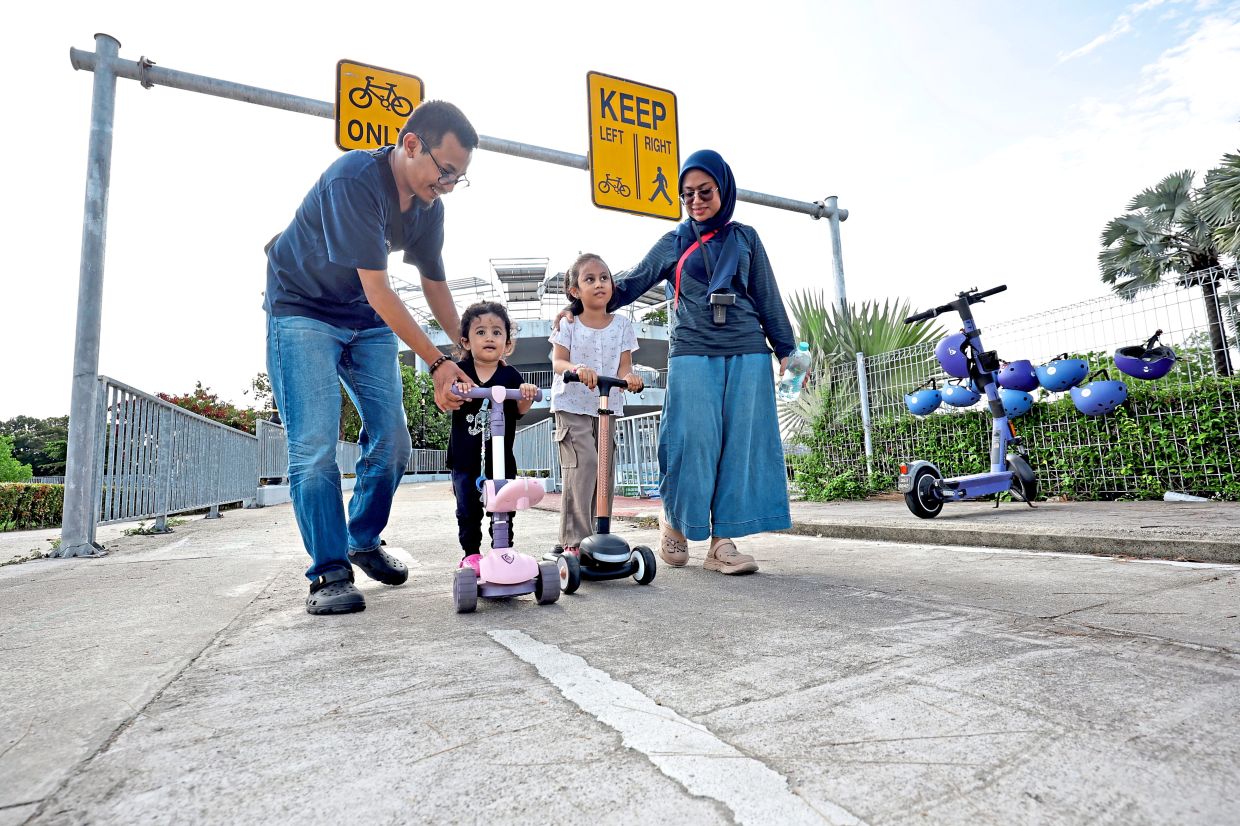


A couple spending quality time with their young daughters riding kick scooters along the dedicated pedestrian and bicycle path at Jambatan Harapan in Queensbay, Penang.
Dr Lim says cycling has shifted from an everyday means of transport to a weekend pastime.
Baderul Amin says Seberang Perai council is reviewing its 2012 Bicycle Lane Master Plan which maps out 210km cycling routes.
Foo says MBPP will study integrating cycling infrastructure with public transport to improve first- and last-mile connectivity.
Rajendran says 205km of cycling routes have been developed across the island, exceeding the 200km envisaged under Penang Island council’s 2010 Bicycle Lane Master Plan.
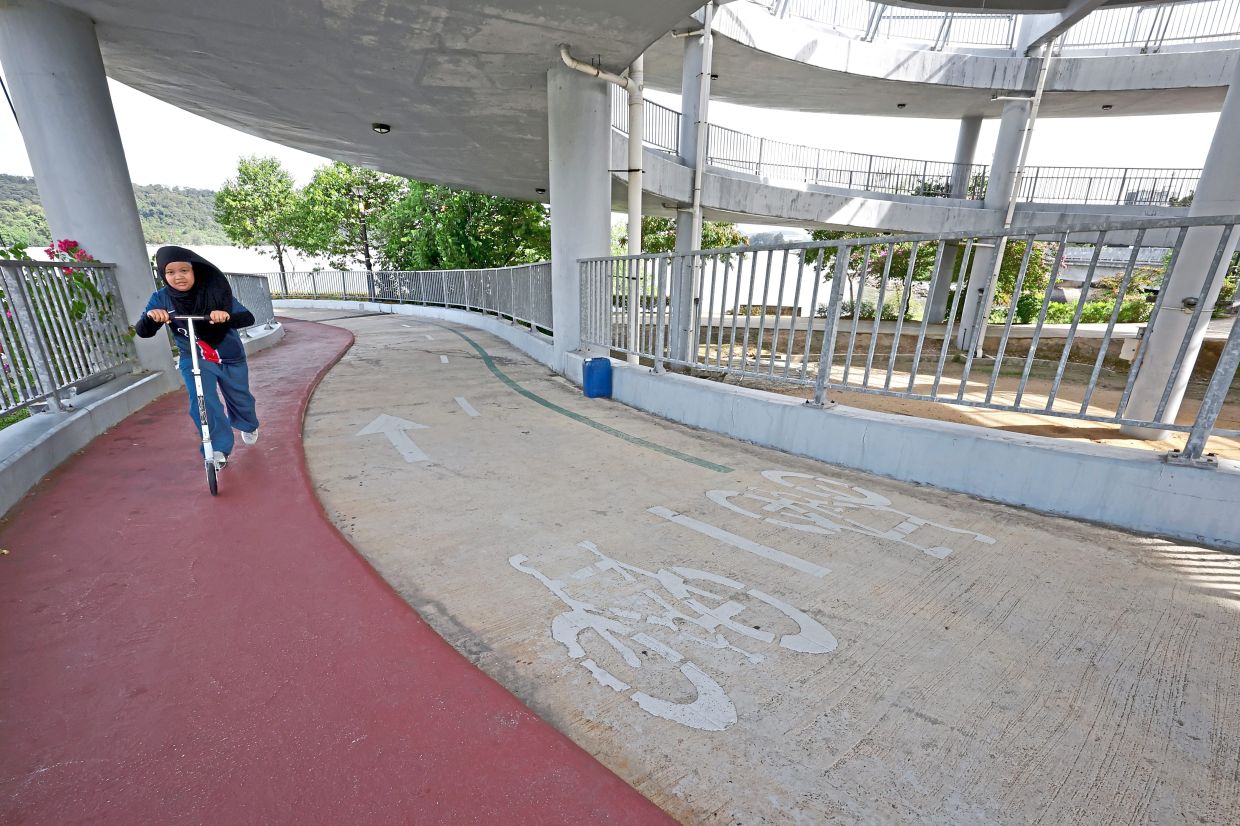
A young girl enjoying her kick scooter ride on the spiral ramp of the dedicated recreational path at Jambatan Harapan in Queensbay.
A motorcyclist riding along the bicycle lane on Jalan CY Choy in George Town, ignorant of the two-way road markings to guide cyclists safely.
Khor believes more cycling infrastructure is needed to encourage safe and healthy cycling. — Handout