




THE idea by parkrun Malaysia president Dr Aizat Mohd Taib of joining a parkrun on your balik kampung trip is happening on a larger scale across the globe.
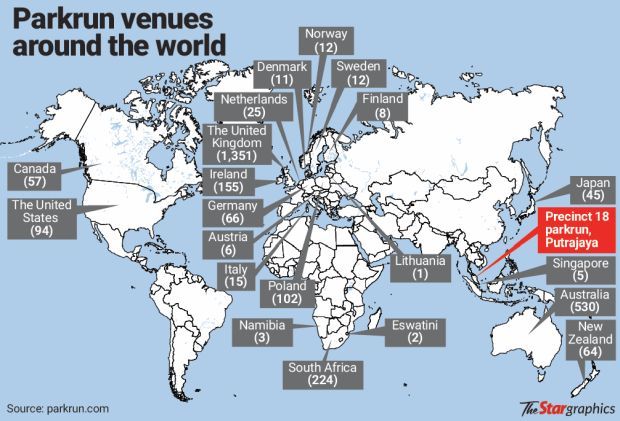
With over 2,500 parkruns in 22 countries (see map), and more sprouting up, parkrun tourism – planning holidays around the free event – has gained a large following.
The attractions are plentiful – seeing new places or recording new runs and milestones, especially as all the data is uploaded automatically to one place via only one registration.
In Putrajaya’s Precinct 18, Richard Ward, 38, and Eleanor Smith, 37, from Sheffield, England, completed their first parkrun in Asia after adding a four-day detour to Malaysia.

“We’re going to South Korea via Malaysia because we knew there was a parkrun here,” said Smith, who has recorded over 300 parkruns, 40 of those as a run tourist.
Mentioning a few of their most recent trips, with parkruns in Germany and Italy, she said: “Our holidays now tend to be, where is there a parkrun? Let’s go there.”
For Tom Read, 43, from Melbourne, Australia, his travel plan with his partner was crafted to take in a parkrun in Singapore, with the following Saturday morning in Putrajaya for his first Malaysian event.
“We are travelling through Malaysia and we basically planned our trip around coming to the parkrun,” he said of their four days in Melaka before stopping off in Putrajaya, with a stay in Kuala Lumpur to follow.
Read, who has joined parkruns in Japan, Germany, the UK, the US, Austria and South Africa, loves travelling and going to new places and meeting people.

In the pantheon of places to see as a parkrun tourist, there are some popular targets.
One is Bushy Park in the UK, home of the first parkrun, although Aizat warned that things could get a bit hectic with up to 10,000 runners during special events.
There are runs near iconic sights, such as Pirrama parkrun with Sydney Harbour Bridge in the background, while other parameters include the first event of each country or area.
The adventurous can also head for the farthest points of the compass across the globe – Pokkinen parkrun in Finland (North), Gisborne parkrun in New Zealand (East), Cape Pembroke Lighthouse parkrun in Falkland Islands (South) and Courtenay Airpark parkrun in Canada (West) – or record runs in all five continents.
For those keen on personal bests, the fastest course – where parkrun records have been set at 13:44 for men and 15:13 for women – is the three-lap Belfast Victoria parkrun in Northern Ireland.
Then there are the challenging ones such as Thousand Hills parkrun in Durban, South Africa, with the slowest average time over the single-lap course through bushland and forest with 200m of elevation.
Two other courses known for their difficulty over soft sand and dunes are UK’s Great Yarmouth North Beach and Woolacombe Dunes parkruns.
Closer to home are the five parkruns of Singapore, while some five to 11 hours’ flight away are events in Japan (45), Australia (530) and New Zealand (64).
One of the things to consider in parkrun tourism planning is the weather.
Aizat recalled that Precinct 18 parkrun had seen a visiting runner collapse due to heatstroke, while Read said he had underestimated the hot and humid conditions in Singapore and was partly forced to slow down to a walk.
In Japan, most parkruns go on hiatus in the summer because of extreme heat and the occasional typhoon.
Meanwhile, cold climates bring about their own set of questions including “how many layers should I wear?” and more importantly, “how soon am I going to be too hot in this many layers?”
Finally, although there is an effort to keep parkruns running each and every week, some events have been cancelled due to factors including winter rains, flooding, heavy snow and insufficient volunteers.
The advice for parkrunners is to gather information on target events via www.parkrun.com, which leads to the “countries” tab and the individual parkruns, while each event should also have a Facebook page where notifications are posted. — By EZANOR MK


