



IT HAS been a year since Kuala Lumpur City Hall (DBKL) implemented dedicated lanes for cyclists in the city by painting them blue at a cost of RM4mil.
The general feedback from regular cyclists then was that the bicycle lane was not implemented properly as it lacked safety features and was misused by motorists who drove on them.
The project was completed just before the World Urban Forum (WUF) in February last year, linking the WUF Village in Medan Pasar, Menara DBKL 1 to Menara DBKL 3, and KL Convention Centre.
DBKL also initiated the Kuala Lumpur Pedestrian and Bicycle Master Plan but details are unclear.
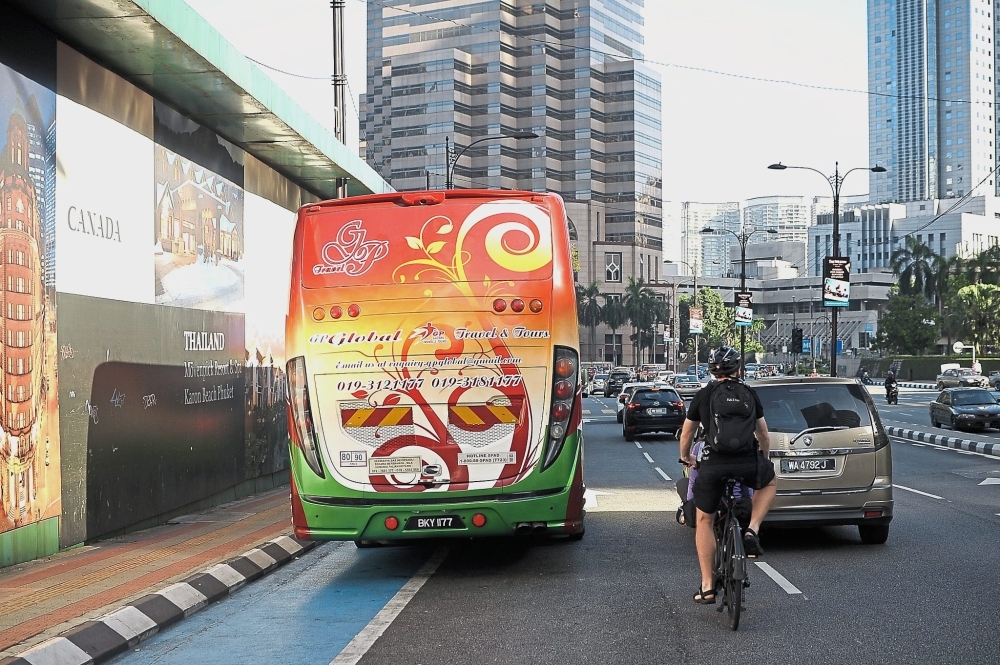
A frequent complaint among cyclists is that buses and other vehicles parked along the blue bicycle lane become obstructions and make it slightly more difficult for them to navigate.
StarMetro spoke to regular cyclists who said further improvements were needed. They are also unsure what the bicycle master plan would entail.
Jeffrey Lim — Cycling KL Bicycle Map project coordinatorLim said having the blue bicycle lane in the city centre was an achievement on its own by providing cyclists with a dedicated lane.
“The capacity of the road could not be taken away, so DBKL had to ensure there were three lanes for cars and space for pedestrians in addition to the bicycle lane.
“But the challenge was in areas where creating separate spaces was not feasible, so cyclists and pedestrians had to share.”
Lim worked with DBKL for over six months to map out the route for the bicycle lane.
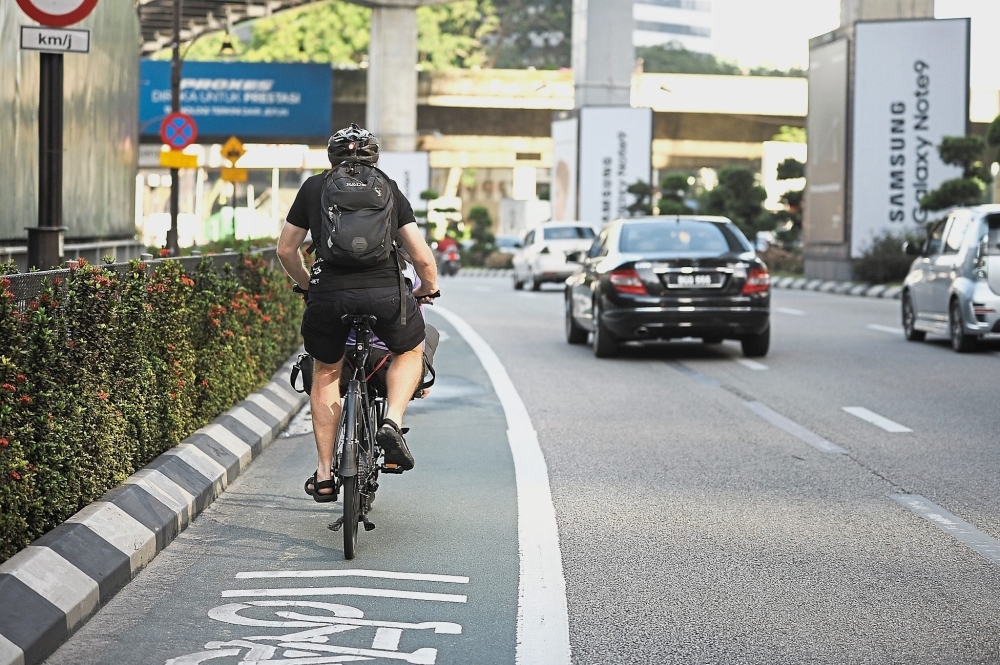
The paint on this stretch of the blue bicycle lane has faded.
“The proposed route of over 11km (one-way) was supposed to link KL Convention Centre, Bukit Bintang, Kampung Baru and Masjid Jamek. However, only about 7.2km was built,” said Lim.
“The bicycle lane project involved multiple government departments and agencies, a lot of red tape and challenges.
“But more importantly, the project was one of the most radical steps taken by DBKL as it was the first time they allowed a cycling lane on the street.”
Lim said the blue bicycle lane was designed to accommodate the novice.
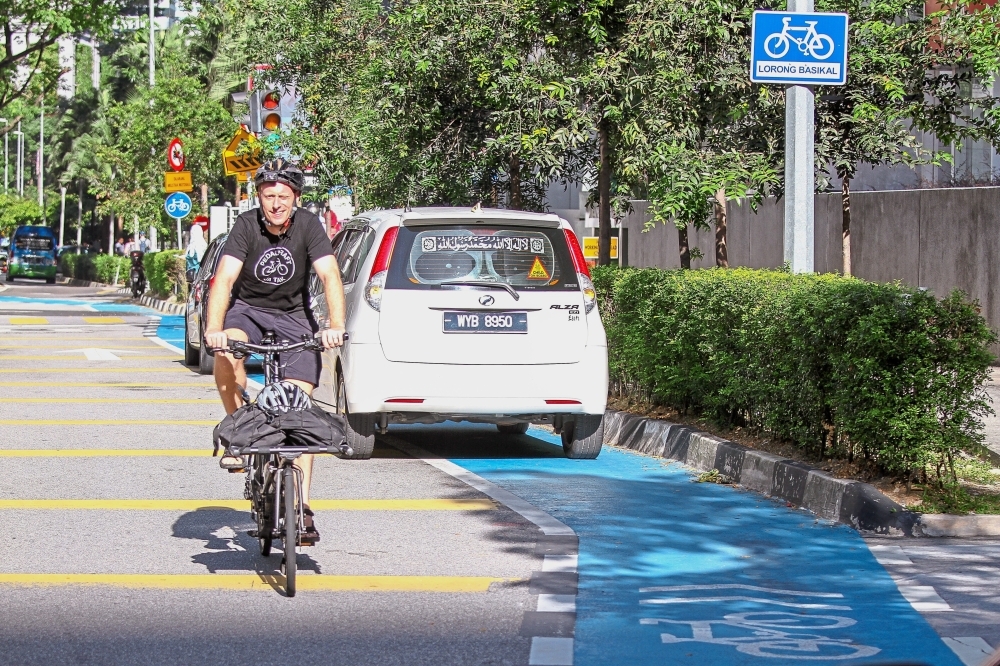
A frequent complaint among cyclists is that cars and other vehicles park along the lane, forcing them to ride on the road. — Photos: KAMARUL ARIFFIN, P. NATHAN, MUHAMAD SHAHRIL ROSLI and AFIQUE YUSOFF/The Star
“Everyone must be safe and courteous on the road, whether you are a driver, cyclist or pedestrian,” said the graphic designer who commutes using bicycles, trains and e-hailing services.
“It also involves a change in attitude, as it is somehow inbuilt among local motorists to disregard certain traffic laws such as double parking.”
Lim said opting to cycle on the daily commute requires a change in mindset and lifestyle, such as dropping the stigma that bicycles are only meant for poor people and packing an extra set of clothes when cycling to work.
On the bicycle master plan, Lim said although he was part of the focus group discussing it, he was unclear about the outcome as DBKL had yet to release details.
“I understand that the network is to connect suburbs to the city and is an initiative to provide first- and last-mile connection for people to travel from home to work.”
Noting that the master plan’s current stakeholders comprise academics and the public only, Lim added that there were no policymakers from the Federal Government.
“We need them to gazette bicycle lanes,” he said.
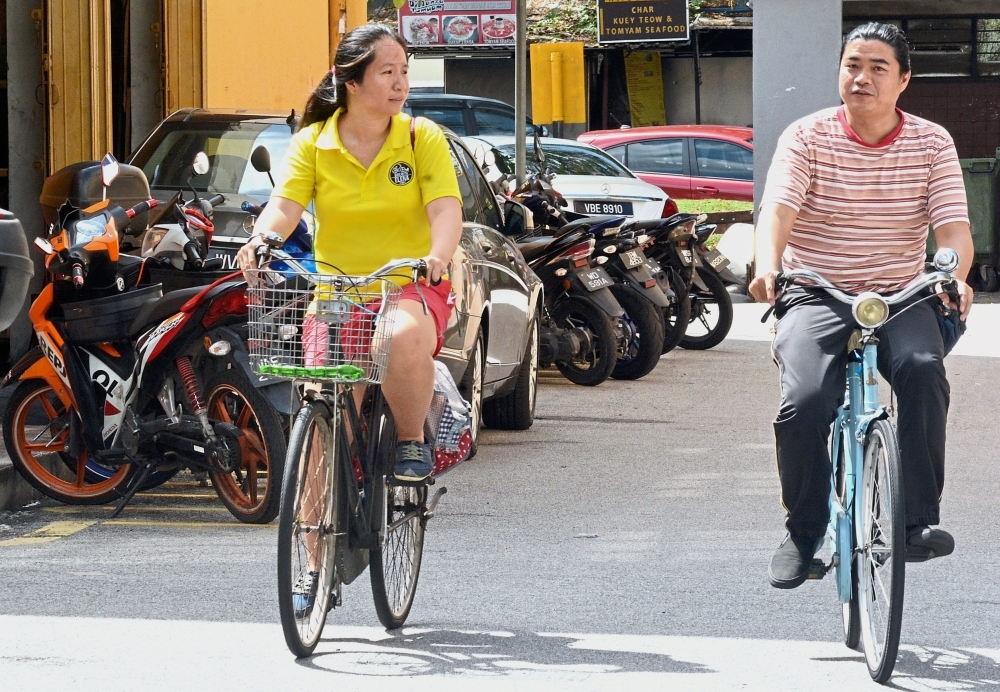
Shim (left) and Wong say they will take extra precautions when conducting cycling tours for customers and friends.
Gregers Reimann — green buildings consultant Reimann cycles almost daily to the office, meet clients, run errands and even take his wife out to dinner.
The 44-year-old alternates between a Brompton foldable bicycle and an Omnium electric cargo bicycle with 250 watt pedal-assist motor.
“The Omnium is great when I need to carry cargo, as it can take up to 100kg,” he said of the bicycle imported from his hometown of Copenhagen in Denmark.
Having lived in Kuala Lumpur for 14 years and been a commuter cyclist for eight, Reimann has been able to observe the changes in the cycling culture in Malaysia over time.
“The bicycle culture is not strong in Malaysia – more cycle for recreational purposes rather than daily commuting.
“In comparison, some 50% of Copenhagen residents commute by bicycle, including politicians who cycle to Parliament,” he said.
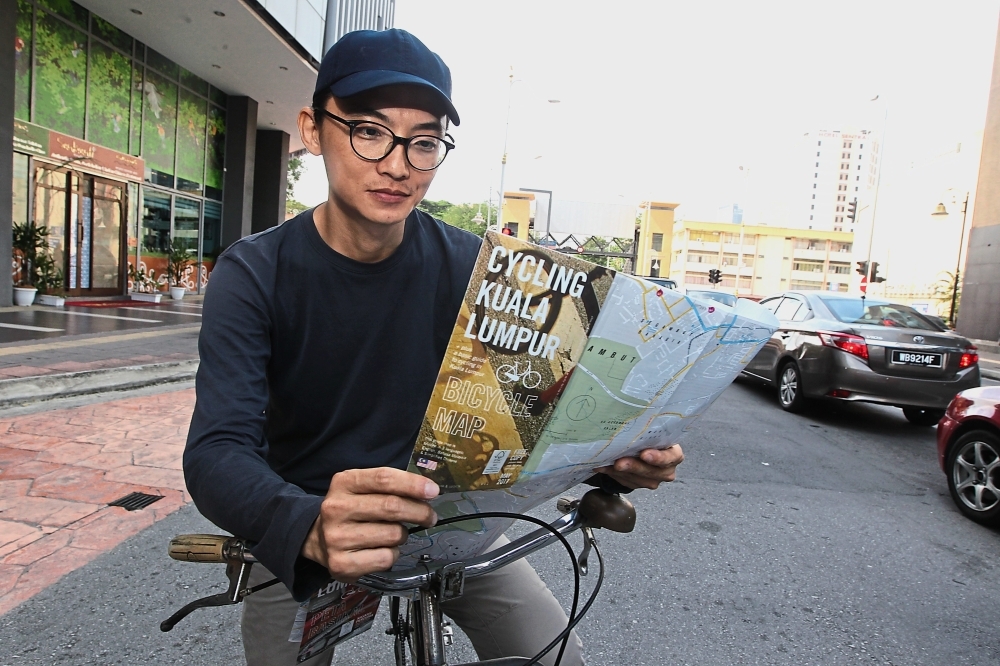
Lim worked with DBKL for more than six months to map out the dedicated bicycle lane route.
“The bicycle lane is a good start to see what works and what doesn’t in the city. I hope the mistakes will serve as lessons when DBKL rolls out the bicycle network to the rest of KL.
“There are stretches where the bicycle lane is painted on sidewalks. I believe in always giving way to pedestrians,” he said.
“While the Jalan Sultan Ismail stretch is the best example of how the dedicated lane has improved cycling conditions, the overall network is not safe because a bicycle lane should be separate from vehicles and pedestrian walkways and painted on both sides of the road.”
Besides improving the bicycle network, such as connecting suburbs to city centres, Reimann said the cycling infrastructure should be improved as it brings health and socioeconomic benefits “Malaysia has an obesity epidemic. This can be curbed by incorporating exercise in our daily routine or as part of our commute to work.
“People also lose lots of time and money being stuck in traffic jams,” said Reimann, citing the World Bank’s 2015 Malaysia’s Economic Monitor report stating that lost hours and fuel for each person in Greater KL came to at least RM3,100 each year.
Kevin Mark Low — urban planner“On a scale of one to 10, I would rate the bicycle lanes in KL as one, extremely bad. They violate almost every aspect of safe lane planning,” said Low, an urban planner, architect and teacher.
“Almost all accidents involving cyclists in cities globally happen at road junctions, intersections and crossovers. KL’s bicycle lanes left out this aspect.
“The lanes were painted over drainage gratings, across pedestrian crossings and cover disabled access ramps and whole sidewalks, leaving little room for other road and sidewalk users.”
Low said suggestions were only implemented after problems were highlighted.
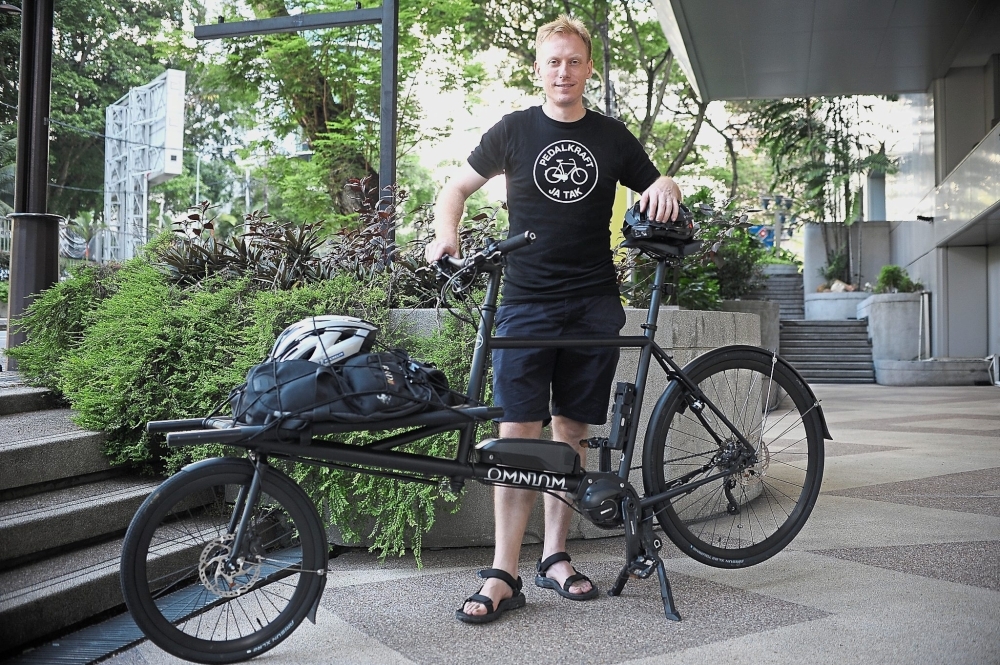
Reimann with his Omnium electric cargo bicycle with 250 watt pedal-assist motor says the bicycle imported from Copenhagen is great for when he needs to carry cargo, as it can carry up to 100kg.
“There was an attempt to perpetuate the falsehood that Malaysian motorists need to get used to the idea of cycling, when the proponents of the project themselves rarely cycle into the city.
“The project was ill-fated from the start, because it was not directed by those who cycle daily,” said the 54-year-old.
Previously, Low said an experienced cyclist would have been able to negotiate KL’s traffic like any other road user – communicating whenever required, in a friendly manner with other motorists.
“The blue bicycle lanes have eliminated this relationship. As primary road users, motorists are now further restricted and less giving.”
Low felt the lack of proper infrastructure and cycling culture may have been key to the project’s failure.
“There was also a lack of professional planning from those who first mooted the idea, then pushed their agenda through with DBKL, ignoring every warning the lanes would fail,” he said.
“If bicycle lanes are to be implemented in KL, then a close study of Singapore’s method of separating traffic from cyclists should be undertaken.”
Elena Shim — cycling tour guideShim has to be extra careful when taking tourists on a cycling tour around the city.
“We use a mix of dedicated blue lanes and back lanes for the tour.
“I remind tourists not to expect cars and motorbikes to give way to cyclists, and to be alert for their safety and obstacles along the route,” said the founder of Bike with Elena.
These obstacles include vehicles parked along the blue bicycle lane, particularly buses parked at Dataran Merdeka that reduce
visibility of smaller vehicles and oncoming traffic, vehicles making unexpected turns, and drain covers with large holes that may result in bicycle wheels getting stuck.
Shim cited the slip road from Jalan Sultan Ismail to Ampang –Kuala Lumpur Elevated Highway (Akleh) as a dangerous stretch as cars tend to turn in without looking out for cyclists.
“Another dangerous stretch is along Jalan Ampang, in front of the Malaysia Tourism Centre (Matic). As the blue bicycle lane is painted along the walkway, cyclists have to be careful and look out for pedestrians or cars turning left to avoid hitting them,” she said.
“As one of the stakeholders involved in contributing input to the master plan, I am eager to know the outcome of our engagement with the consultants and to view the final document.”
Wong Hau Young — cycling enthusiastWong. 42, is so familiar with cycling within the city, including via back alleys and shortcuts, that he prefers sticking to his usual routes rather than using the blue bicycle lane.
“Cycling is convenient and saves me a lot of time. It is easy, fast, and I do not get stuck in traffic or face parking problems,” he said.
“My house in Desa Pandan is just a five-minute ride from my shop. It only takes me about 15 minutes to drop off a customer’s order at Suria KLCC.”
Wong said he initially joined cycling groups to learn how to ride safely in the city, and is now confident in his ability to navigate KL on his own.
“The blue bicycle lane is a good effort by DBKL, although it has its pros and cons. It makes cycling safer for cyclists, but is often abused as a parking space for cars and other vehicles,” he said.
“I avoid riding on pavements where the blue bicycle lane overlaps with pedestrian walkways, as I want to give pedestrians right of way.
“Since the blue bicycle lane is not extensive and certain stretches such as Jalan Pinang and Jalan Perak are unsafe, I tend to use my own routes.”
He added that he planned to install a child seat on his bicycle and ferry his daughter around when she is old enough.
Already a subscriber? Log in
Get 20% OFF The Star Digital Access
Cancel anytime. Ad-free. Unlimited access with perks.
