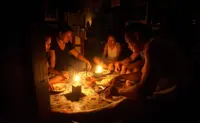
There’s more to the bakwa business than most people realise


Photos By StoryPhotos Grace Chen
Lighting the way: Lee purchased some 10,000 lanterns to decorate streets and the company’s 260 outlets this year.

It IS estimated the bakwa business in Malaysia is worth some RM50mil to RM55mil a year.

Among the bigger companies in the business, Loong Kee Dried Meat Sdn Bhd normally utilises about 30,000 tonnes of pork belly slices just during the Chinese New Year season alone. In terms of marketshare, Syarikat Kiew Brothers (the company behind the Oloiya brand) says it controls about 43% of the local market.

And it isn’t just marketshare the companies compete over. The two companies have a big influence in the current “lantern war” breaking out along Jalan Petaling and Jalan Alor in Kuala Lumpur.

As of press time, Oloiya said it had purchased some 8,000 lanterns from China, while Loong Kee revealed it had topped the number by an additional 2,000 units.

New twist to the traditional: Meat floss compacted into bite-sized biscuits. In addition to bakwa, Loong Kee has developed new lines to keep up with changing tastes and times.

In terms of prices, it’s often said that the prices of dried meat generally rises during the Chinese New Year period. However, Loong Kee maintains it has not hiked prices since 2012.

Loong Kee’s general manager Lee Jon Sem, 33, and the second generation to enter the family business, says policies might change once the GST is implemented.

“There is a possibility we may not be able to hold our ‘Buy 1 Free 1’ promotion because we had planned to absorb the 6% tax. But it is still too early to confirm anything yet,” says Lee of the company’s famous promotion that has been known to generate hour-long queues in some of its shops. The company has 20 outlets and the number balloons with the addition of some 260 mall and road side stalls during the Chinese New Year season.

GST, Lee surmises, will not be too much of a hindrance to the company’s business.

In fact, Lee says Loong Kee overcame a bigger challenge two years ago when pork belly prices suddenly shot up by 30% just a month before Chinese New Year.

Snack-size bakwa: A hundred grammes is equivalent to 11 pieces. Just for the Chinese New Year season alone some 70,000 tonnes of ham and minced meat will have moved off Loong Kee’s shelves.

According to Lee, the cause was partly due to the competition for supplies from the roast pork industry and a limitation in the number of approved permits for the import of pork.

Lee says he caught wind of the rumours of tight supplies and decided to stock up his freezer rooms ahead of time.

Still, it was an exercise that ate up close to 10% to 20% of his profits.

The bakwa business has suffered at least two serious downturns in the past 12 years.

One would be in 1999 during the Japanese Encephalitis outbreak where over 50 people died and hundreds of thousands of pigs were culled in Negri Sembilan and Perak.

Sales of dried pork, according to Lee, dropped by 50%. Fortunately the company managed to compensate with chicken-based products.

Not so simple: Lee says the business faced two major crises several years ago.

Another crisis took place June 2011 when Kiew Brothers was ordered by the Ministry of Health to take its dried meat slices off the shelves after tests showed dangerous levels of sodium nitrate.

The losses, reported by its executive director Raymond Khue, amounted to millions, equivalent to a “few Ferraris”.

The ensuing ripple effect also put a 10% to 20% dent on bakwa sales overall.

Khue’s most vivid recollection was the sight of his father, Jau Horng, now in his 70s, rolling his diabetes-weakened body into the office in his wheelchair.

“Despite his condition, my father declared that we had nothing to fear as it was not as if we had never tasted poverty before. My father said, ‘If the worst comes to the worst, we’ll start all over again.’ That spurred us on,” Khue recalls.

Family run: The Khue family standing beneath two plaques that read ‘The bakwa king, known to all near and far’. Clockwise from centre is Raymond, aunt Yen Lin, grandmother Chin Siew Yoong and younger brother, Peter.

A post mortem by industry insiders revealed the root cause may have either been carried over from the feed or illegal abattoirs, known for indiscriminate use of the substance to kill bacteria.

What followed was the company’s “It’s More Blessed To Give Than To Receive” public relations campaign to revive the stricken company’s reputation. The drive entailed the giving away of 8,000 packets of 300g of dried pork slices without conditions.

Beyond the numbers, the Kiew Brothers’ story also involves a tale of human spirit.

The story involves a prodigal son in the Kiew Brothers family. Khue readily admits to being the family’s black sheep until a crisis made him turn over a new leaf.

“I led a very wild life during my teens. I got into fights, didn’t work properly...” says Khue, now 27.

The roller coaster ride came to an abrupt halt one Chinese New Year eve when Khue received a distress call from his uncle and factory production head, Khue Jaw Sem, now 45.

Jaw Sem’s left hand man had suddenly upped and left — after stealing RM100,000 worth of products from their cold rooms.

“As our cold rooms were so big, we had always done the stock taking by calculating the volume of the room to estimate the number of cartons.

Evolving: Now you can enjoy bakwa in your stir-fried veges. This bakwa sauce is one of the 80 products developed over the years to add variety to the product range.

“When production told us they didn’t have enough stock, my uncle thought this strange. So, he drove a forklift into the cold room and raised himself up for a better view. To his shock, the middle part was all empty,” Khue says.

Uncle and nephew, who had never seen eye to eye mostly because of the younger man’s lifestyle for once sat down together, even if it was to brood.

“Suddenly, I could feel an energy pushing through my body. That was when I told my uncle that I’d help him. His first words were, ‘You sure, or not?’”

Once written off as a lazy good-for-nothing, Khue emerged a new man, the very next day.

“At that point, I told myself if there was a time I could redeem my credibility, it was then. And so for the next 45 days, I clocked into work at 8am and did not finish till 2am. I was paid RM1,500 at the end but what I had really earned was my uncle’s trust.

“From that time, his attitude towards me changed completely. In 2010, when I proposed to my family to open an outlet in the Pavilion mall in Kuala Lumpur, he was the only one who supported my idea,” says Khue.

The company now reports annual revenue of RM2mil for each of their 36 outlets.

As for the future of bakwa, Loong Kee is now looking at markets in China, Vietnam and South Korea.

“Do you know that the Malaysian style of bakwa is totally new to the Vietnamese and South Koreans? For now we are targeting joint ventures with local ham curing, sausages and salami factories to support the retail model.

“I am sure we can easily open up a few hundred outlets in South-East Asia, but it is also equally important to look at the marketing and management aspect for long-term sustainability,” says Lee.

Over at Kiew Brothers, Khue is looking at the viability of offering halal dried meat slices using chicken and beef.

“The inspiration came from an episode of Sex In The City where they had a scene in Istanbul, which saw the characters eating beef jerky.

“Of course, we also knew of a halal outlet known as DDQ that used to operate in The Gardens Mall, so the idea wasn’t completely unheard of.

However, we are still in the planning stage,” says Khue.

Get 20% OFF The Star Digital Access

Monthly Plan

RM 13.90/month

RM 11.12/month

Billed as RM 11.12 for the 1st month, RM 13.90 thereafter.

Best Value

Annual Plan

RM 12.33/month

RM 9.87/month

Billed as RM 118.40 for the 1st year, RM 148 thereafter.

Follow us on our official WhatsApp channel for breaking news alerts and key updates!

Others Also Read