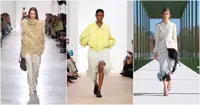
Nigerian models donned outfits of seemingly impossible amounts of fabric folded and moulded into massive silhouettes, or overlapping in shingled, feather-like patterns.
The colourful, detailed textiles evoked Carnival –- both Nigeria's own, in the southeastern city of Calabar, or that of Rio De Janeiro fame –- but were in fact splashing down a runway in Abuja, better known for being the sleepy seat of government than for avant-garde couture.
Nigeria Fashion Week, which wrapped up Sunday (Oct 4), decamped from Lagos this year, trading the mega-city of more than 20 million – the nation's economic and artistic mecca – for the centrally planned administrative centre, which nonetheless has developed its own, smaller creative scene.
"Abuja is slow, slow in every way. People are very laid back," Lexy Mojo-Eyes, the dapper organiser of the fashion week, who cut his teeth in Lagos.
"We want to change the dynamics, we want to build Abuja as a fashion city."
Read more: Global runways: How emerging fashion weeks are helping to redefine style
A slowly changing city
Nigeria officially moved its capital from thronging, crowded Lagos in 1991.
But even in 2026, Abuja can still look half-built, its pockmarked downtown home to modern office buildings alongside empty lots and even farms that pre-date its founding.
It doesn't have Lagos's famous, and infamous, raucousness -- but neither does it have a riposte to the Lagos film industry, known as Nollywood, or its major corporate headquarters and roster of Afrobeats stars.
As Abuja has slowly filled in over the years, it has shed some of its sterile feel, hosting a photography festival, an international film festival and a burgeoning literary scene.
Part of the reason the show moved to Abuja was to increase dialogue between industry and government, organisers said.
"Government has to be that enabling environment," including by reforming tourism and intellectual property law, culture minister Hannatu Musa Musawa said, wearing a metallic silver, pink and blue dress as she sat in the front row at a Friday (Oct 2) runway show.
Libyan designer Rabia Ben Barka, whose models showed off similarly shimmering dresses, said that she found Abuja – on her first trip to Nigeria – "so clean" and organised.
"Anyone who comes by, they greet you with 'Good morning,'" said Ben Barka, considered the doyen of Libyan fashion and who once counted Muammar Gaddafi's wife among her clients.
Some of her boxy silhouettes evoked retro women's shoulder pads – and then, down the runway, strutted a man in a metallic silver-and-black pinstripe suit, complete with heeled leather shoes: souped-up businesswear for a capital city shedding its stuffy image.
Read more: Seoul wants to be a fashion capital? Its fashion week may need a new plan
Cost of living
Abuja is also drawing longtime Lagos players, including Chinwe Ezenwa, a handbag designer who opened a second factory in the capital in 2021.
"It's a bit of a sleepy town," Ezenwa, the CEO of Le Look, said. "But it's picking up."
Lagos, for its part, still retains its own, separate fashion week.
And whether Abuja can support the workers needed to run a creative sector – designers, fashion students and entrepreneurs – remains to be seen.
Many residents are already forced beyond the suburbs by brutal housing costs, and the government has come under fire for razing green areas, farms and "gardens" – cheap, open-air restaurants situated in parks – in favour of luxury development.
Despite the change in venue, some things are universal in Nigeria, whose creaking grid is as infamous as Lagos traffic: as the models prepped backstage Friday (Oct 2), the power briefly cut out.
As the lights flickered back on, baptism in blackout over, one attendee quipped that the show was now, officially, "very authentic". – AFP