When you close your eyes and picture Taylor Swift, you may envision her bright red lipsticked mouth before any other detail comes into focus. Swift wore that red lipstick throughout her Eras Tour.
Swift, who has refrained from endorsing products in recent years, did not reveal which brand of lipstick she was wearing. But swarms of online commenters decided it had to be Pat McGrath Labs LiquiLust in Elson 4.
After all, Swift had signalled her approval of the brand when Pat McGrath appeared in the video for her song Bejeweled, playing a queen who applies makeup to the star’s face.
If a company tried to engineer this kind of promotion, the fee would reach several million dollars.
But when the social media chatter tying McGrath to Swift was at its peak, the lipstick was out of stock – and it stayed that way for much of the nearly two-year run of the Eras Tour.
In the impulse-driven, roller coaster cycle of makeup trends, the steady flow of products is crucial.
The fact that one of the most promising cosmetics brands of the past decade was unable to fill eager fans’ handbags with LiquiLust suggested that something at the company was wrong.
Valued at more than US$1bil (approximately RM3.9bil) in 2018, Pat McGrath Cosmetics announced that it had filed for Chapter 11 bankruptcy protection on Jan 22 to “simplify its capital structure, reduce its debt load and unlock the potential of this brand”.
Last month, after having agreed to an interview for this article, McGrath decided against it.
The plunge from billion-dollar valuation to bankruptcy has baffled many people outside the company.
Here was a brand founded by the most creative makeup artist since Max Factor, one who has touched the faces of Oprah Winfrey, Kim Kardashian, Madonna, Rihanna and – well, how much time do you have?
Read more: Meet the tailor who turns red carpet outfits into flawless fashion moments
Born in Northampton, England, McGrath spent her childhood with her single Jamaican mother, Jean, a dressmaker.
After school, McGrath would plant herself in her neighborhood newsstand, poring over the latest issue of Italian Vogue.
“I was always obsessed,” she said in an interview for The Cut in 2016.
She eventually figured out a way into that arena.
Step one was an introduction to Caron Wheeler, the lead singer of Soul II Soul, whom she joined in the early 1990s as her makeup artist while she was on tour in Japan.
Step two was, naturally, Paris. With a counterfeit Vogue ID, she slipped her way into the standing section of a few fashion shows, shouting the names of the models as they hit the runway.
It didn’t take long for her to get her hands on those models. Her friend Edward Enninful, fashion director of i-D magazine at the time, asked her to paint a model’s eyebrows banana yellow for an editorial photo shoot.
Her break came in 1994, on set with photographer Steven Meisel, a star-maker with the power to elevate models, stylists, makeup artists and Madonna.
Soon, McGrath was doing shows for Prada, Givenchy, Louis Vuitton, Versace and Lanvin. In those days, she was known to bring more than 80 trunks filled with cosmetics, reference books and sequins, just in case.
She also functioned as a sort of brand whisperer, collaborating with designers on their nascent cosmetic collections, starting with Giorgio Armani for L’Oreal, which was introduced in 2000.
“She’s a true, true, true creative visionary,” said John Demsey, a beauty industry consultant and former Estee Lauder executive.
She wasn’t above Walmart or CVS, where she developed mass-market products as the global creative director of CoverGirl and Max Factor. The logical next step was to start her own brand.
She called her brand Pat McGrath Labs, billing it as “a place of innovation, experimentation”.
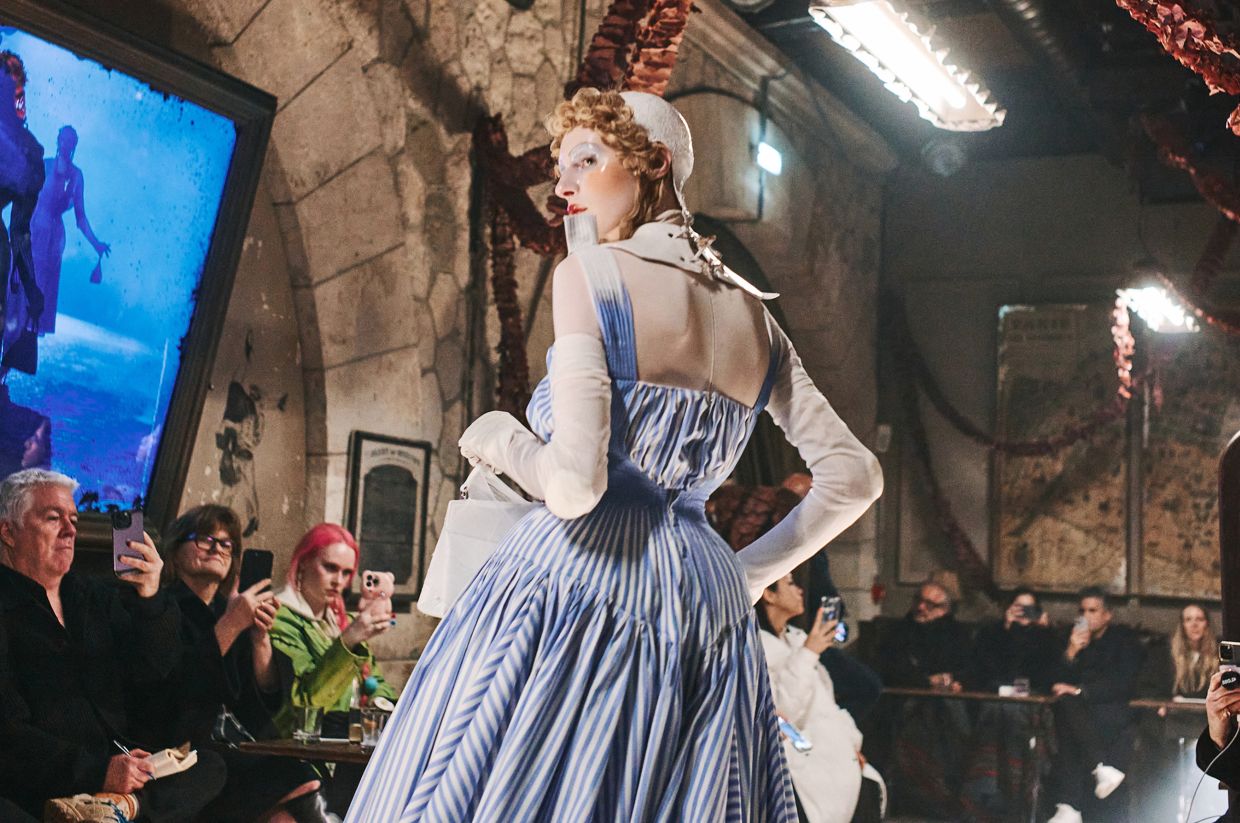
In the makeup labs of manufacturers in Italy, she found a highly reflective, prismatic gold eye shadow with a gel base that gave the pearlised finish a pure intensity. When McGrath dripped an activator on the disk, it became fluid without losing its vibrancy.
In keeping with the laboratory theme, she named it Gold 001, left it in its plastic lab-sample compact and sold it with a liquid activator.
On a sunny afternoon in September 2015, McGrath and her fleet of assistants gathered at Tuileries Gardens in Paris to paint gold on the eyelids and lips of Bella Hadid, Imaan Hammam and other models who wandered over between fashion shows.
The organic, unchoreographed energy of the event mirrored McGrath’s approach to makeup, that chaotic backstage moment when inspiration strikes.
She packaged 1,000 kits of eye shadows and activators in sacks filled with a cushioning of gold sequins.
The US$40 (RM156) kit, offered on her website, sold out in minutes. There was no business plan, no aspiration for shelves at Sephora, no product pipeline on a seasonal cadence.
At a 2016 event celebrating her line’s Sephora debut, fans waited outside the company’s Union Square location for hours to see McGrath.
Grace Coddington, the longtime Vogue fashion editor; Kim Chi, a runner-up on RuPaul’s Drag Race; and a number of models leaned in to congratulate her. Shoppers hugged her, held her hand.
Until then, McGrath had funded her company herself.
In 2018, investors came courting. Eurazeo Brands, a private equity firm in Paris, invested US$60mil (RM235mil), valuing the brand at more than US$1bil (RM3.9bil), even though its sales were estimated at only US$40mil (RM156mil).
In interviews since December, five former Pat McGrath Cosmetics employees described having been brought into the company with no formal titles and no specific job descriptions.
They emphasised that McGrath made every decision, despite her lack of financial and operational experience. She approved every social post, creative campaign and piece of email marketing, even when she was out of the office at fashion shows and photo shoots.
Meetings took place at all hours to accommodate her schedule. And yet, former employees said they were dazzled by McGrath’s talent.
They endured the stress and sleeplessness for the privilege of working with a star.
In 2016, Pat McGrath Labs entered an exclusive relationship with Sephora. The retailer is partial to independent, founder-led brands – and if that brand pledges its loyalty, Sephora rewards it with its institutional knowledge, almost as if it were incubating a startup.
The game works like this: Sephora steers the new brand with frequent check-ins. It bestows prime shelf space while giving the brand time to ramp up. It offers promotional emails and prominent placement on Sephora.com.
And it all goes swimmingly until it doesn’t.
“It’s relatively easy to get to the US$20mil (RM78mil) threshold,” said Davin Staats, the global head of beauty and personal care at Lazard, a financial advisory and asset management firm.
“And then you’re off to the races. It’s like printing money.”
Reaching US$50mil (RM195mil) in sales, however, is another matter entirely.
At Sephora, Staats added, “If a brand doesn’t get significant scale quickly, it will actually get lost in the organization. You wither.”
Pat McGrath Labs started missing deadlines and cancelling some product introductions altogether.
And then Pat McGrath Labs did something that bewildered industry experts: It broke its exclusive with Sephora by striking a deal with Ulta. And, poof, there went the favoured status at Sephora.
Ulta, a cosmetics retailer with headquarters in the Midwest, is an unusual choice for fashion-driven makeup. The chain attracts a price-conscious consumer, offering frequent discounts – not necessarily the best fit for a foundation called Skin Fetish.
The move brought added complexity to McGrath’s company. And managing distribution and deadlines was never its strong suit.
Read more: The Sui family factor behind designer Anna Sui’s enduring fashion label
In fashion, practicality is the ultimate sin. If you want to insult a designer, call a collection “wearable” or, worse, “commercial”.
But to be successful in the beauty business, you have to sell a lot of lipsticks to a lot of people; it’s a volume play. And in that way, Pat McGrath Labs seemed ill equipped.
McGrath’s Instagram and TikTok videos seem inspired by Fellini, not Nancy Meyers.
Then there was the matter of the missing red lipstick during Swift’s Eras Tour.
Several executives who were then working at the company suggested that late payments to vendors made it more difficult to get the makeup on the shelves.
Eurazeo, the early investor in Pat McGrath Cosmetics, exited the brand in 2021, and Sienna Investment Managers put in US$204mil (RM797mil). From there, the company’s performance declined.
In August, there was some good news for McGrath herself, if not for her company.
Louis Vuitton announced that she was the new creative director for its lipsticks and eye shadows. But the move was puzzling.
Was McGrath distancing herself from her company, shifting her allegiances back to luxury fashion?
Some industry watchers believed that LVMH, the luxury giant that owns Louis Vuitton, might bring Pat McGrath Labs under its umbrella. That hasn’t happened.
Perhaps she had grown weary of running a business and welcomed the chance to return to what she does best: creating impeccable makeup colours and textures.
With all she has achieved – the Most Excellent Order of the British Empire (you may address her as Dame Pat) – McGrath had certainly earned the right to relax.
But as Pat McGrath Labs entered its first month under bankruptcy protection, McGrath signalled that she was committed to her brand, saying in a statement: “This Chapter 11 will enable me to remain in the driver’s seat and keep the company’s vision focused.”
“It’s very sad,” said Demsey, the beauty consultant. He added that McGrath is “without question, the most important, talented makeup artist of modern times”.
“There is no one that has had a greater influence on the fusion of fashion, beauty and rethinking makeup looks in truly creative and unconventional ways.”
And maybe that wasn’t enough. Maybe that was the problem. – ©2026 The New York Times Company
This article originally appeared in The New York Times.