
At the start of his Super Bowl performance, Puerto Rican musician Bad Bunny materialised in a field of sugarcane wearing an outfit of angelic slightly off-white.
His shoes, his pleated pants, his linebacker-padded football jersey were all nearly the colour of the sidelines on the football field.
His jersey was cropped to a few fingers above the waistline (what can be called the preferred Bad Bunny proportions) and on the back it read “Ocasio”, part of his full name: Benito Antonio Martínez Ocasio.
The jersey was splayed with the number “64”, sparking viewers to scour the internet for what the digits meant.
Read more: How American football is finding new fans through high-fashion flair
After the performance ended, Complex Magazine reported that the number was a reference to the singer’s late uncle, who had worn the number as a football player.
If that was the riddle for the masses, a smaller mystery emerged: Who was behind the outfit?
There is perhaps no current male pop star who is as intimate with the high-fashion world. Bad Bunny has appeared in campaigns for the French fashion house Jacquemus, sat front row at Calvin Klein and performed at the couture circus that is Vogue World.
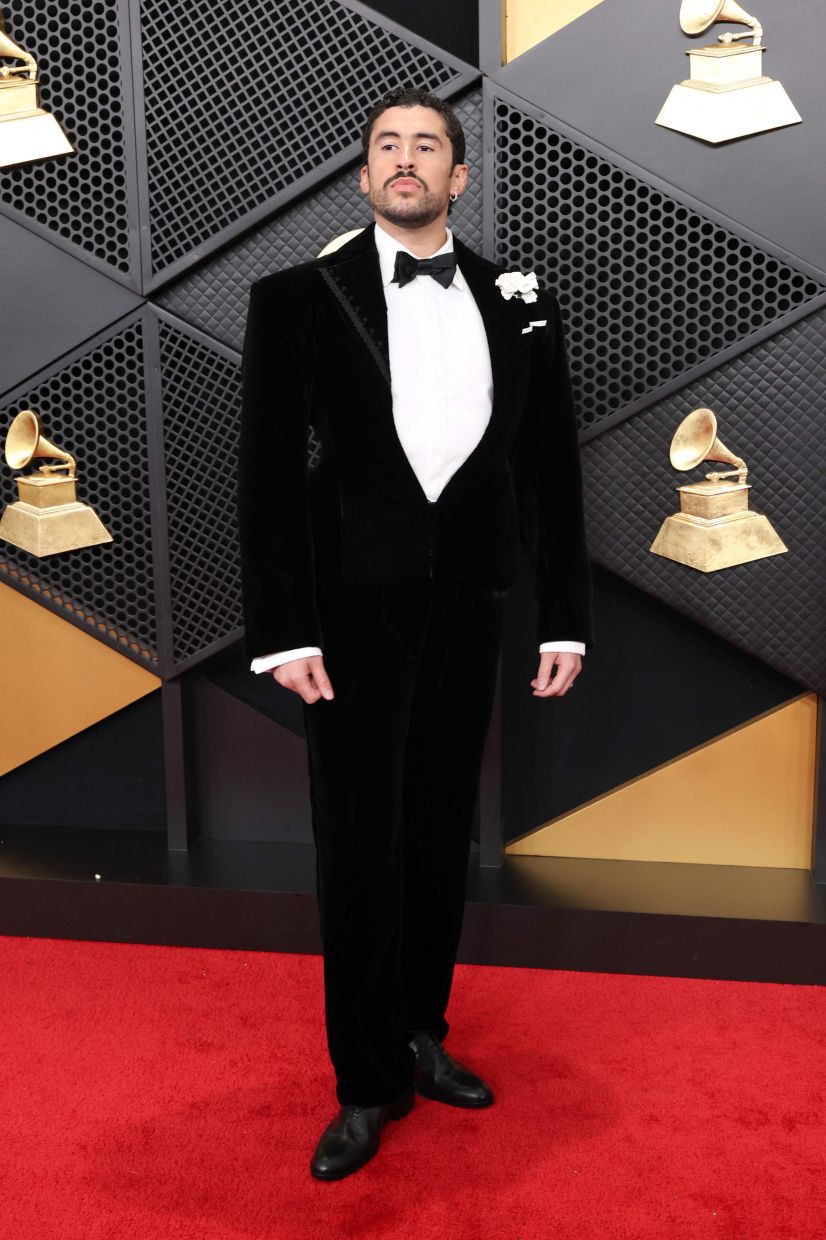
Just a week ago, Bad Bunny was sweeping up Grammys in a va va voom suit, with corset-lacing crawling up the spine, from the French fashion house Schiaparelli.
But, turns out it was as far from high fashion as you can go before you hit Kohl’s: made by fast-fashion retailer Zara, where similar suits, albeit not in cream, can sell for US$250 (approximately RM977).
His sneakers were Adidas, a company the singer has long had a partnership with.
As dancers enveloped him in kaleidoscopic street clothes also from Zara, Bad Bunny looked like a celestial bandleader orchestrating a steamy, late-summer block party for the ages.
Read more: Celebrities at the Grammys embrace bold risks as they rewrite fashion rules
The white suit makes most mortals look like Colonel Sanders or a bleached-out member of a barbershop quartet, but on Bad Bunny, it bestowed a sheen of above-it-all poise, an image orchestrated to counter critics.
After all, in the lead-up to the Super Bowl, some had framed the performance by Bad Bunny, who sings almost entirely in Spanish, as something un-American.
That criticism grew firmer after the singer had spoken up, briefly but pointedly, against the US Immigration and Customs Enforcement, the federal agency known as ICE, at the Grammys last week.
Rather, during the finale, the singer, dressed in a so-white-it-practically-gleamed outfit, marched off, propelled by his kaleidoscope of dancers.
Behind him, a screen read: “The only thing more powerful than hate is love.” – ©2026 The New York Times Company
This article originally appeared in The New York Times.