
Back in late 2018, a lifetime ago in fashion, a radical shift happened in footwear. Square-toed clunkers – sandals defined by exaggerated, spatula-like soles that jutted out from under the foot and pumps with bulbous stubbed toes – were shown in Daniel Lee’s first collection for Bottega Veneta.
At first sight, the shoes were hideous. Within months, they were on the feet of nearly every celebrity, editor, influencer and luxury VIC in the land.
Retailers like Vince Camuto and Shein promptly issued dupes of the popular Lido sandal, a simple slide in a blown-up interpretation of Bottega’s signature intrecciato woven leather.
Lyst declared them the “hottest shoes in the world” in 2019.
“It’s funny what you can make people wear in fashion if it’s done the right way,” said Nina Christen, the Swiss shoe designer responsible for the Lido.
Christen’s distinctive touch has quite literally been all over some of the most influential shoe design trickling down from luxury houses for the better part of the past decade.
She has worked for Phoebe Philo at Celine, Jonathan Anderson at Loewe, Mary Kate and Ashley Olsen at the Row and Lee at Bottega Veneta.
Last month, Anderson hired Christen as the design director of shoes at Christian Dior. It’s one of the biggest jobs in fashion right now, and she is balancing it with a moonlighting gig, too.
Read more: Era of the Frankenshoes: Why are hybrid footwear becoming so fashionable?
Last year, Christen introduced her eponymous independent shoe brand. The first pure expression of her design identity came partly out of frustration.
The shoes she designed for other brands were her taste, her take, she said, but they were never 100% herself.
Opportunity arose when she met Paul Dupuy, an entrepreneur and a founder of Zoi, a health-tech company in the longevity space.
Christen designed uniforms for Zoi’s staff and clients, and Dupuy was so impressed that he offered to help her start her own brand. His mother was a fashion designer, and he has friends in the industry. He got it.
“When she told me she designed shoes for Loewe and Bottega, I was like: ‘OK. This is solid,’” Dupuy said.
Christen already had a complete vision for a brand beyond shoes: the perfect pair of Japanese denim jeans, the perfect leather jacket, even fine jewellery, the first piece of which is a diamond toe ring.
All are prototyped and planned. She had the packaging, branding, logo and positioning in mind.
Dupuy raised US$5mil (approximately RM63.6mil) in capital and helps with business logistics, including with the planning of a store in Paris slated for 2026.
Christen shoes are produced in Italy by the same factories and specialists that work with big luxury brands. The prices – US$1,100 to US$3,650 (RM4,668 to RM15,485) – reflect Christen’s uncompromising production standards and ambition to compete at the highest level.
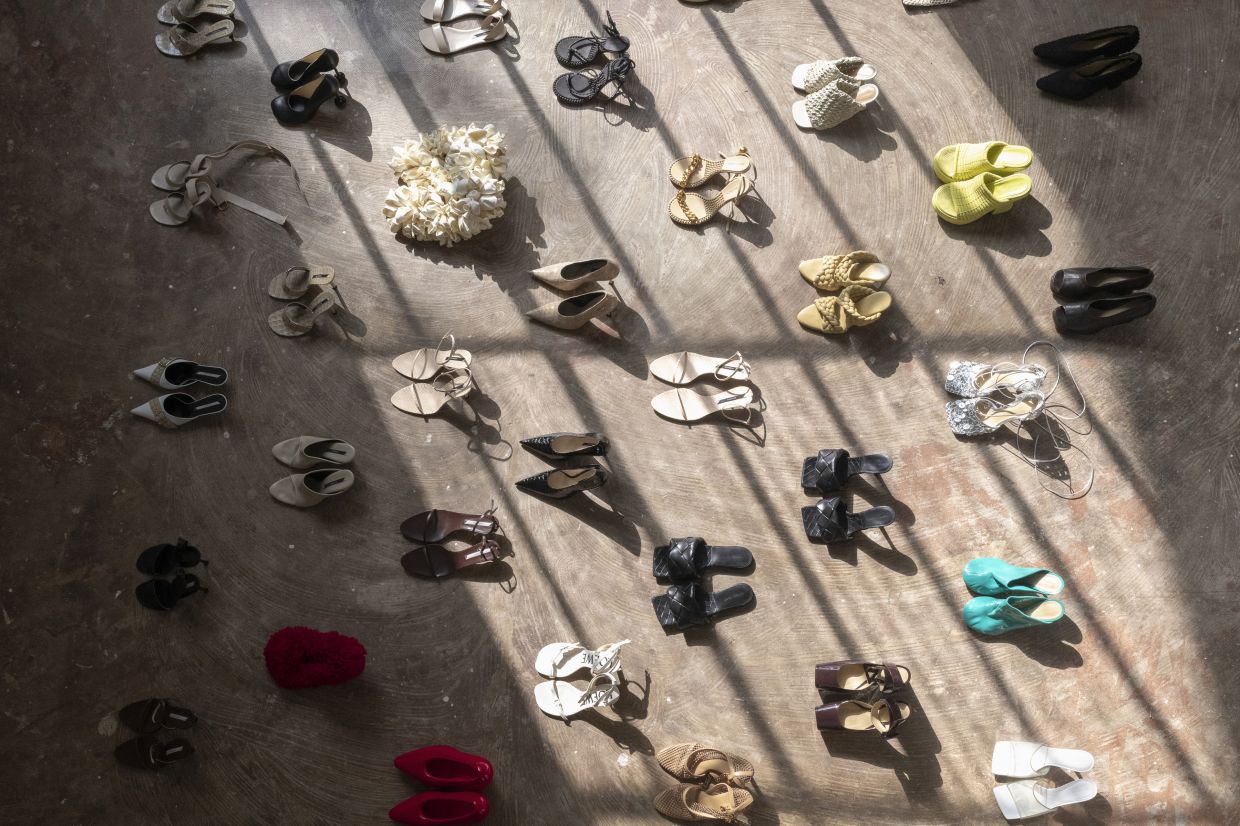
On a morning in late June, the raw cement floor of the studio below Christen’s apartment in Paris was set with more than 30 examples of her designs arranged in a neatly art-directed grid.
Three styles from Loewe’s Spring/Summer 2023 runway collection stood out for their cartoonish, fantastical qualities.
There were pumps embroidered with an explosion of deflated white balloons and sandals abloom with a giant, hyper-realistic anthurium. Red rubber pumps that looked fit for Minnie Mouse were particularly complicated.
“You can’t wear this for more than two hours,” Christen said of the pumps. “But Jonathan Anderson was very open to ideas that really crossed the line between art and fashion.”
By comparison, the styles on display by Christen's brand appeared compact, sexy and razor-sharp.
“I love the space of geometric shapes,” Christen said, surveying the body of work at her feet. “When I think of toe shapes, for example, it’s all about that. Is it a square? Is it rectangle? Is it a circle? Is it oval? What is the degree?”
She wore a pair of white sandals by her brand that left the foot nearly naked, bisecting it with a single strip of leather like a strand of floss through the big and second toes.
The sole was thin and slightly elongated under the toes, like an insole that was a size too big.
The proportions of the shoes varied wildly, but a common thread was a certain offness. Christen thinks a lot about redefining standards.
“It’s about creating things we are not used to yet,” she said. “When I make something and I don’t know if I like it, that’s always a good sign.”
Christen, 40, grew up in Bern, Switzerland, in her own words, “obsessed with fashion without an explanation”.
“It was just in me,” she added.
There she studied technical tailoring and pattern-making and practiced on the “normal” garments she prefers to wear in her personal life. She never dreamed of being a shoe designer.
Finding Switzerland to be a fashion void, she moved to Paris. While completing a master’s degree at Institut Francais De La Mode, a shoe design workshop liberated her.
“I realised I could do all kinds of crazy things,” she said.
Christen met Lee in 2017 when they were working for Phoebe Philo at Celine. Before that, Christen did the rounds consulting for less elite players, including Marimekko and H&M.
Consulting for the traditional French rubber boot brand Aigle proved to be one of her most formative gigs.
Read more: Jane Birkin’s original Hermes bag sold for over RM42mil in an intense auction
The platform rubber boots she designed for Philo’s last collections at Celine, and subsequently the viral Bottega Veneta Puddle Boot introduced in 2020, were directly descended from what Christen learned at Aigle.
“I thought, ‘Why not make it fashion?’” she said.
“Working with Nina was a special collaboration,” said Lee, who has been the creative director of Burberry since 2022. “She’s a designer that understands precision and refinement.”
Rather than reference the work of a specific artist or architect, Christen draws from the worlds of science and spirituality.
She cited CERN, the European Organisation for Nuclear Research, as a source of inspiration, the tangible effect of which is difficult to explain.
“It’s more that I like to think about things that are impossible,” she said. “From drawing shoes to the reality, there is this huge gap of things that you can do, things that you cannot do. I enjoy finding a way to do new things.”
The power of the mundane, even the ugly, courses through Christen’s work.
“Every day I see normal people wearing extremely interesting things that have nothing really to do with fashion,” she said. Orthopedic shoes for the elderly have been good source material.
After Christen’s first year in business, its most popular shoe is a grandpa-style slip-on bootee lined in goat shearling.
As Christen said, “Once you wear them, you cannot wear anything else.” – ©2025 The New York Times Company
This article originally appeared in The New York Times.