



New records for heat are being set in cities and towns around the world, and forecasters say we should brace for further heatwaves in many places.
"It’s even hotter in the city,” people often say, though weather services do not always feature readings from city centres.
However, it is in fact hotter in urban areas than in surrounding greener areas, particularly at night, researchers say.
We asked meteorologists about heat and how best to handle it.
Are record-breaking locations actually always the hottest on that day?
No. "There’s always a hotter place,” says Ferdinand Briegel from Germany's Karlsruhe Institute of Technology (KIT). After all, you can’t take measurements at every single point in the country.
Generally, weather services place monitoring stations at locations chosen to be as representative as possible of their respective surroundings, say on short grass and at a distance from trees, buildings and other sources of interference. International guidelines require this in order to prevent distortions caused, for example, by the urban heat island effect.
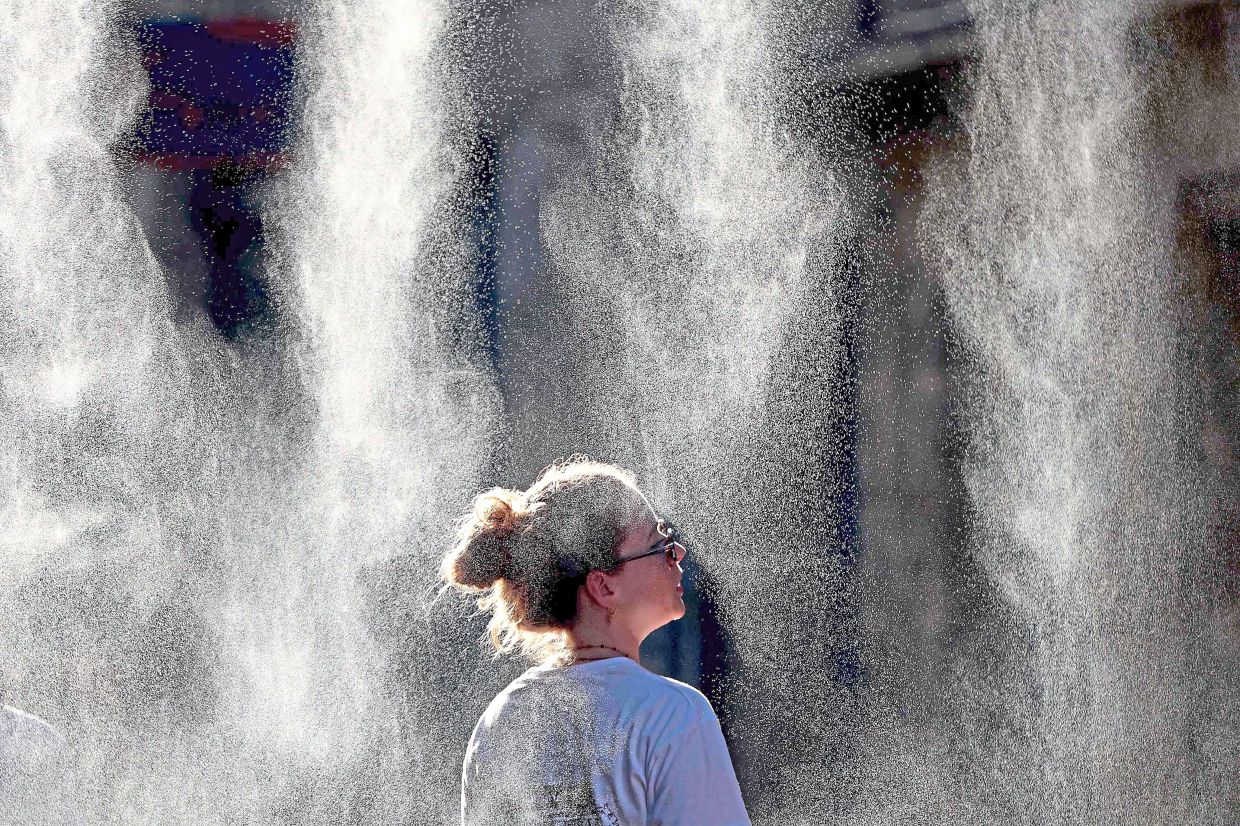
The urban heat island effect, what is that?
The urban heat island (UHI) effect is when cities experience significantly higher temperatures than surrounding rural areas.
On average, cities are noticeably warmer than their surrounding areas. During the day, the difference is usually no more than 1-2°C, but at night it can be as much as 10°C, says Meinolf Kossmann from the German Weather Service.
He says meteorologists in Germany for example are seeing this effect from Munich to Freiburg, with city centres warmer than outside the city.
He points to Freiburg, where the university recorded 13 consecutive nights defined as "tropical" last month, when the temperature did not drop below 20°C. "During the same period, just 5km outside the city there were only two or three tropical nights,” says Briegel, who models heat stress in cities using AI.
Why and how does that happen?
Cities are three-dimensional structures made up of vast quantities of concrete, stone and asphalt. Masses of closely packed buildings combined with large areas of sealed surfaces such as roads and squares all store the energy of the sun’s rays as heat.
At night, this heat is released into the air, which cools down much more slowly than in the countryside, Kossmann says.
Another factor is that the layer of air near the ground generally extends much higher during the day than at night – 1-2km high instead of just a few dozen to a few hundred metres.
"The heat re-radiated by the ground and buildings is consequently distributed over a much larger area during the day." Plus, winds that drive heat out of the city usually reach their peak during the day and largely die down at night.
All that means the differences between the countryside and the city remain relatively small during the day.
But at night, what does that mean for our health?
Heat at night is particularly harmful to our health because our bodies cannot recover sufficiently from the day’s strain, says environmental meteorologist Briegel.
Our bodies are under constant stress. Our sleep becomes more restless, our heart and circulatory system are under greater strain, and the risk of exhaustion, dehydration or circulatory problems increases.
The longer a period of tropical nights lasts, the greater the risk of long-term health damage and deaths.
Epidemiologist Alexandra Schneider from the Helmholtz centre in Munich, says heat is already one of the most significant environment-related health risks in Germany, for example.
Can we fix the heat island effect?
No, even though people are talking more and more about climate adaptation these days. "That’s why many people think that urban redevelopment is enough to avert the effect,” says Briegel.
But the options are limited, and even with committed measures, it would only be possible to mitigate the effect, not stop it altogether. "Cities will keep getting hotter; that is definitely the case,” he says. You cannot change that, even with perfect measures.
A key factor in the heat island effect is the size of a city – which is hard to reduce.
Air corridors extending from the outskirts into the city centre and as low-density development as possible are helpful, Briegel says. But generally, we cannot demolish buildings, and in some areas with housing crises, cities are becoming even more densely built up.
Don’t humans simply adapt?
Only to a limited extent. While our bodies acclimatise over the course of the year, we always feel the first hot days as harder than those later in the summer, says Briegel.
For people in hotter regions such as southern Europe, however, it is less a matter of physical adaptation than the way they change their behaviour. People take a siesta at midday, followed by more extended activity stretching into the night – and ultimately, escaping the city in summer.
Moving to the countryside during the summer months will become the norm in many cities in future – for those who can afford it, he says.
Generally speaking, socio-economic status plays a very significant role in determining how badly a person is affected: Do I work in an air-conditioned office or outside in the heat? Do I live in a small flat in an old building or in a house in a cool, green setting? Can I switch on the air conditioning in my car, or do I have to travel on an overheated train?
What about air conditioning?
This is not something one should wish for, not least because of the immense electricity consumption that would be required. "Air-conditioning systems are, ultimately, heat exchangers: it gets cooler inside, but even warmer outside due to the exhaust air,” Briegel says.
A study addressed this question in Paris, in 2020, and said the outside temperature could rise by around 2°C if air-conditioning were widely used during an intense heatwave. Other models showed similar figures.
Of course, care homes, hospitals and nurseries must be fitted with air conditioning. However, it is open to debate whether every single office and every private home really needs to be cooled to 19°C, he says.
As for public transport and public facilities, it is reasonable to assume that, in future, air temperatures will regularly reach levels at which cooling will be necessary to avoid endangering the health of the people using them.
Would it help to turn parks with more trees into forests?
No. While trees do absorb a great deal of solar radiation during the day and also provide cooling through water evaporation, at night, according to Briegel, the tree canopies act like a cloud – and a forest, accordingly, like a closed cloud cover: they trap the heat emitted by the ground close to the surface, making it harder for the air to cool down.
"That’s why a mosaic of trees and open spaces is always important,” says Kossmann. Not only in parks – in narrow streets, it can make sense to plant trees on just one side so that the air can circulate more freely.
If you are lucky enough to living on the edge of a large green space, you are likely to experience more comfortable temperatures, particularly at night, adds Briegel. But this effect applies only a few hundred metres into the streets nearby.
The longer term risk is that many trees and green spaces will die off as plants suffer not only from increasing heat but also from a lack of water. Generally, watering them will become increasingly difficult due to wider water shortages.
"A brown meadow has similar thermal properties to an asphalt surface,” says Briegel. In other words, it no longer has any cooling effect. – dpa
Pullout quote: A mosaic of trees and open spaces is always important. Meinolf Kossmann.

