
Being something of an outsider has been part of Padma Lakshmi’s identity for as long as she can remember.
Born in Chennai, India, in 1970, she is the only child of a courageous mother who left an arranged marriage and moved to New York City, supporting them both as an oncology nurse at Memorial Sloan Kettering Cancer Center.
In the 1980s and ’90s, Lakshmi stuck out in Roman Catholic school in Queens, in high school in suburban Los Angeles and as one of the first supermodels of South Asian descent.
Long before she hosted Top Chef, she found belonging in the kitchen. During summers in India, she followed her grandmother and aunties around and learned to make dosas and idli.
As a (bored) working model, she cooked for colleagues on sets and shoots around the world, and published her first cookbook, Easy Exotic, at age 27.
She has lived in the United States for 50 of her 55 years, and is a naturalised citizen. But during the first Trump administration, she suddenly felt like an outsider again.
In 2017, she began working with the American Civil Liberties Union as an advocate for immigrants’ rights. She resigned from Top Chef in 2023.
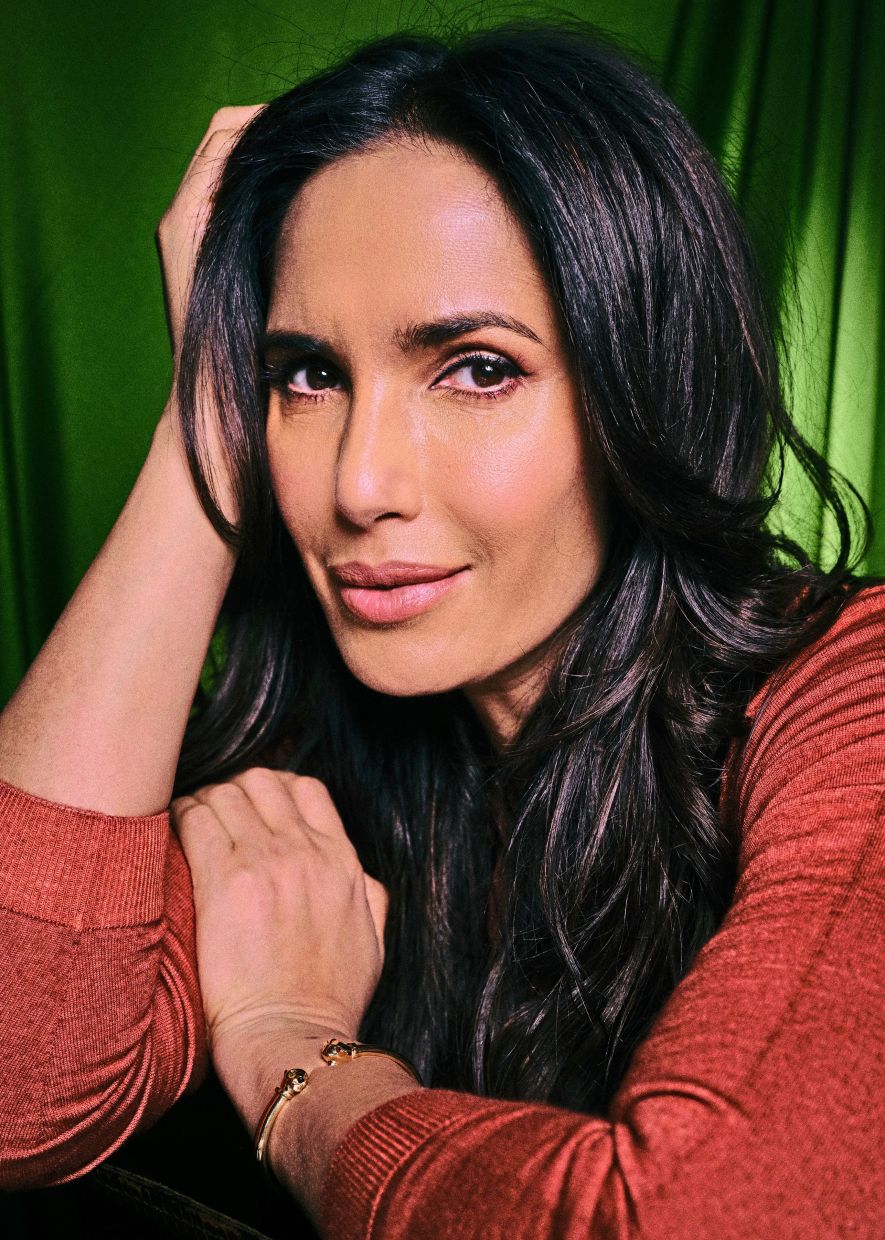
Her new book, Padma’s All American: Tales, Travels, And Recipes From Taste The Nation And Beyond, was published last week.
It began life as a cookbook proposal and became the scaffolding for the Hulu show Taste The Nation, for which she received an Emmy nomination in 2023.
Through food, each episode tells the story of a specific American immigrant community, like the Thai war brides who moved to Las Vegas in the 1970s and the Cambodian refugees who have revitalised the abandoned downtown of Lowell, Massachusetts.
Those stories and dishes are remixed with recipes from Lakshmi’s home kitchen, so that green papaya salad sits near plum chaat, and Nigerian goat shares a page with Cantonese fried dumplings.
In an interview, which has been edited for length, she spoke about how food and advocacy have combined in her recent work:
A: I was looking for something to do in my creative life that would incorporate the crash education I had gotten from immigrants in different parts of our country.
I didn’t want to do a lifestyle show, which is what all the networks wanted. I wasn’t interested in trying to make something that’s fuzzy at the edges.
I want it to be real, I want to dress like I really dress and talk like I really talk. Why is it that male chefs get to be swashbuckling on TV, and I have to be at home in the kitchen?
If we just ate what was native to the United States, we’d be living on desert packrat and ramps. I’ve eaten those things, and they’re delicious, but we wouldn’t last 15 minutes if that was our only option. Even apple pie isn’t American: not the crust, not the filling, not the spices. American food has always stretched to make room for new foods, and we have to hold onto that.
I hope that people will be curious enough about the book to open it and cook from it. And maybe if the food entices them, they may have more empathy and curiosity for the people making it.
Fusion food got a bad name from things like California Pizza Kitchen. Their tandoori chicken pizza is atrocious. But I’ve also had bulgogi pizza that was delicious.
All these dishes I’m presenting are third-culture food, the result of the meeting of Indian and American, or Chinese and Nigerian, in a new place.
Some of them are pretty similar to what you would get in those countries of origin. And some of them are different, like the Nigerian jollof rice made by my friend Precious — they grew up in Ohio, and puts dashi and sun-dried tomatoes in. It increases the umami! It’s delicious! But that’s not my culture, so I would try that in my own kitchen, but I wouldn’t put it in print.
You know, my publishers didn’t want me to be so political, but that ship has sailed. It goes with having the title of “Padma’s All American”.
Because I am American. I can’t believe that’s become a political statement, but I am. I love this country for what it gave me and my mum.
But if you take away the immigrants, the country — the food system, the tech arena, Wall Street and medicine — will all come to a standstill. I’m floored, and I’m frightened for the first time. Will ICE come for naturalised citizens next? It no longer seems impossible.
Because I got to be in charge, and I had a crew of 350 people, and I made it about the principles of good cooking, not about challenges.
All the chefs are professionals, and they are teaching real restaurant skills, in a serious kitchen that looks like a three-Michelin-star kitchen.
And we are giving away a million dollars. People come out of the woodwork to get a chance at that! – © 2025 The New York Times Company