
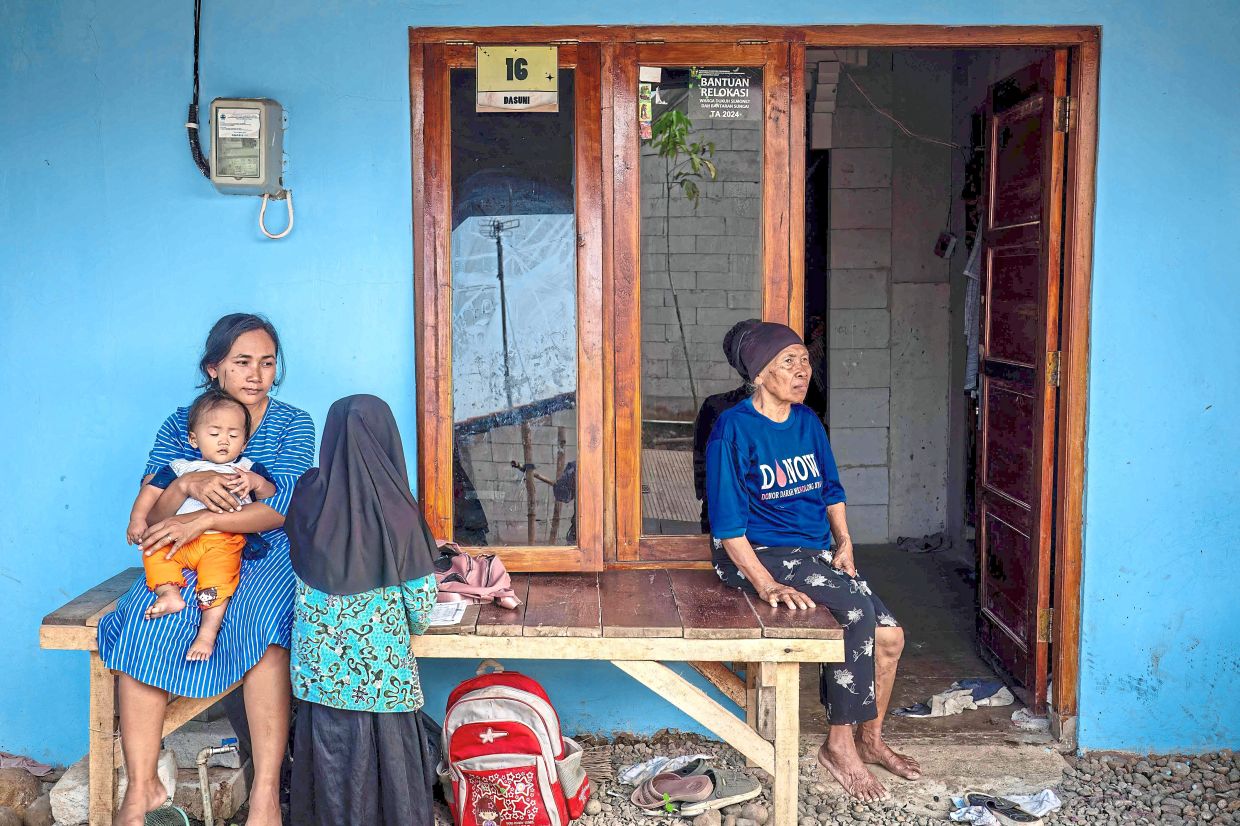
The encroaching ocean laps against a road in Karminah’s village, threatening her home on Indonesia’s Java island, where the government says it has a plan to hold back the tide.
It wants to build an US$80bil (RM338.45bil), 700km seawall along Java’s coast to tackle land loss as climate change lifts sea levels and groundwater extraction prompts land to sink.
For residents who have seen the tide come more than a kilometre inland in parts of Java, the plan sounds like salvation.
But with a timeline of decades and uncertain financing, it looks unlikely to arrive quickly enough, and climate experts warn it could make matters worse by pushing erosion elsewhere and disrupting ecosystems.
For Karminah, 50, those concerns feel distant.
“What’s important is that it doesn’t flood here. So that it’s comfortable,” she said, speaking with journalists in Bedono village, referring to a coastal road that disappears almost daily.
“School can’t happen, the children can’t play, they can only sit on the pavement staring at the water.”
The government calls the colossal wall one of its “most vital” initiatives to help coastal communities in Java, which houses more than half of Indonesia’s 280 million citizens, as well as fast-sinking capital Jakarta.
Bedono residents like village chief Muhammad Syarif currently elevate their homes with clay soil but say a seawall is “very much needed” to avert disaster.
“It is the right solution because the coastline needs wave management,” he said.
Funding remains uncertain, though President Prabowo Subianto has urged Asian and Middle Eastern investment.
Recently, he inaugurated a new agency to oversee the project.
“I don’t know which president will finish it, but we will start it,” Prabowo said in June.
Abandoned villages
Seawalls and other coastal fortifications have been used globally to keep damaging tides at bay.
In Japan, fortress-like barriers were installed in some places after the 2011 earthquakes and tsunami, while the Netherlands relies on a system of hill-like dikes to stay dry.
Such fortifications absorb and deflect wave energy, protecting coastal infrastructure and populations.
But Indonesia’s needs are urgent, with one to 20cm of land disappearing along Java’s northern coast annually.
Large areas will vanish by 2100 on the current climate change trajectory, according to environmental non-profit Climate Central.
The fortifications can also have negative consequences, destroying beaches, pushing erosion seaward, and disrupting ecosystems and fishing communities.
In places like Puerto Rico and New Caledonia, seawalls have collapsed under the constant beat of waves, which also erode sand below.
“They come at considerable environmental and social cost,” said Melanie Bishop, professor at Australia’s Macquarie University.
“Their construction leads to loss of shoreline habitat and they impede movement of both animals and people between land and sea,” the coastal ecologist said.
A 2022 United Nations report warned seawalls only offer a temporary fix and can even worsen climate change effects.
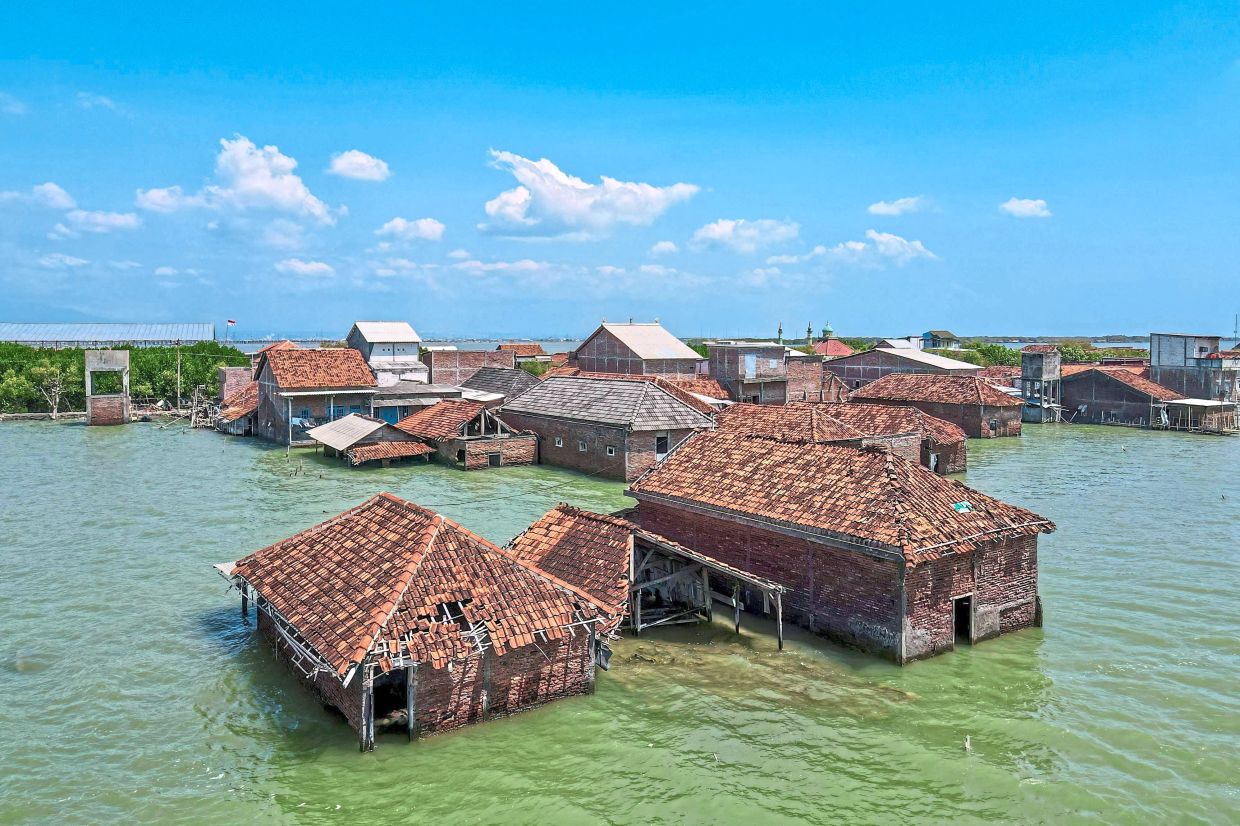
For Indonesian crab farmer Rasjoyo, coastal erosion is not a theoretical problem.
He and hundreds more once lived in now-abandoned Semonet village, where seawater laps into evacuated homes. It now lies a 20-minute boat ride from land.
“The floods were getting worse. The house was sinking. Every month, the change was drastic,” said Rasjoyo, 38.
He says the seawall – first proposed in 1995 –will come too late.
“If it happens, when will it arrive here? In what year?” he asked.
“It might not be very effective either, because the land has already subsided.”
Find a solution
Some climate experts believe nature-based solutions like mangroves and reefs would be better alternatives.
“Unlike seawalls that would need to be upgraded as sea levels rise, these habitats accrete vertically,” said Bishop.
“In some instances this vertical accretion can keep pace with sea level rise.”
Another alternative could be a mixture of relocations and more targeted, limited seawalls, said Heri Andreas, a land subsidence expert at the Bandung Institute of Technology.
“The win-win solution is a partial or segmented seawall,” he said, describing the current proposal as like “killing a duck with a bazooka”.
“It is more effective if we do relocation. And then in some parts, maybe only a coastal dike or elevating the coastal infrastructure would be enough.”
He hopes to persuade Prabowo’s administration to switch course before the mega-project begins.
“We need more listening,” he said. “It’s a bit better than before, but it’s not enough yet.”
In Bedono, where a cemetery was recently relocated to save it from the waves, residents simply want a fast fix.
“The solution is to build something, I don’t know, just build a road, a dike or a coastal belt so it doesn’t keep happening,” said Karminah.
“What can we do?” she added. “Please help me find a solution so the water doesn’t rise.” – AFP