
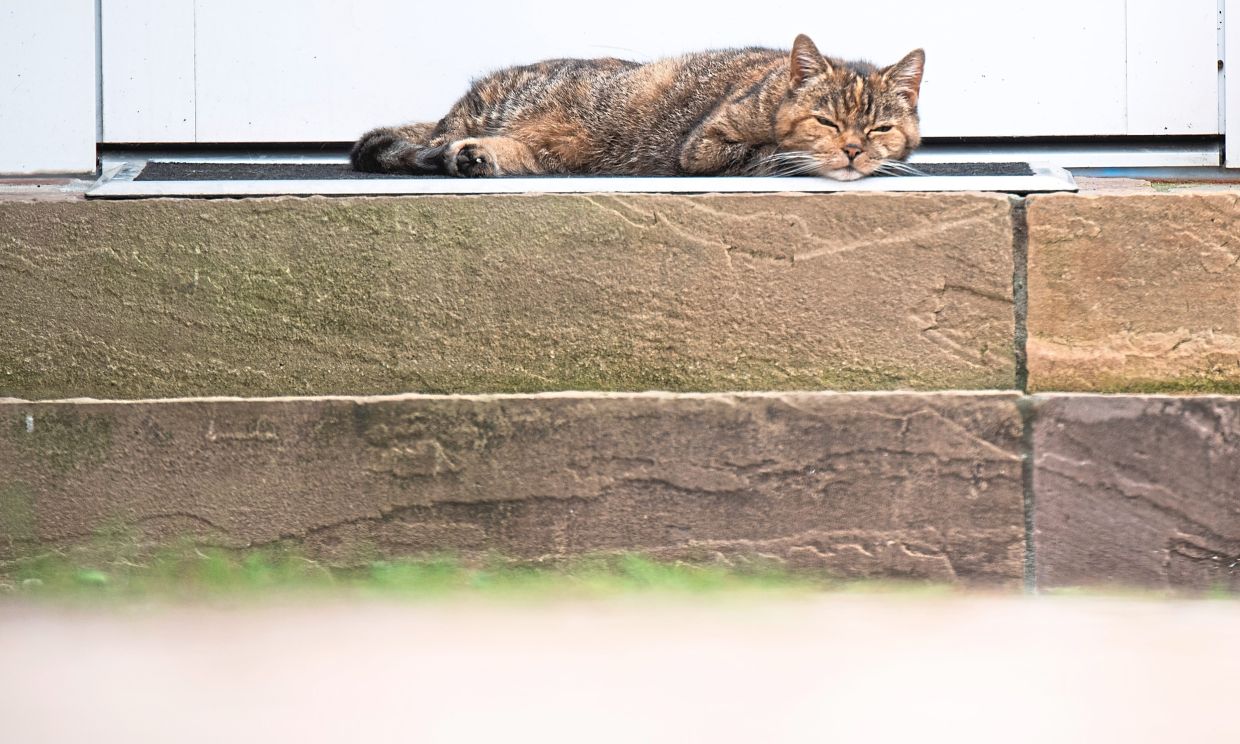
While watching hours of cat videos on social media, scientists in Germany have noticed something strange: Most cats appear to prefer sleeping on their left side.
Now, a study published in the journal Current Biology has confirmed this peculiar preference and shed light on what is likely an evolutionary survival strategy.
The cat nap scientists say the brain structure of cats means they may be able to react more quickly to predators or prey upon waking on their left side.
Animals are of course particularly vulnerable while sleeping, and cats spend 12 to 16 hours a day doing so, often in slightly elevated positions such as on steps or sofas.
A team led by Onur Gunturkun from Germany's Ruhr University Bochum analysed 408 YouTube videos of sleeping cats. Around two-thirds of the animals were said to prefer a left-sided sleeping position.
The reason they believe that cats are faster to detect threats on one side is that the two hemispheres of the brain are specialised for different tasks.
Ready for threat
According to Gunturkun's team, the right hemisphere dominates spatial attention, the processing of dangers and the coordination of rapid escape movements.
Cats sleeping on their left side perceive their surroundings upon waking with the left half of their visual field, which is processed in the right hemisphere. If a cat sleeps on its right side, its left visual field is restricted by its own body.
"We are inclined to believe that the significant leftward bias in sleeping position in cats may have been evolutionarily driven by hemispheric asymmetries of threat processing," the researchers conclude.
In fact, it's not just cats – the researchers believe that in most species, animals react more quickly when a predator approaches from the left.
But there is still much mystery to the habits of a house cat, the authors admit. "Additional factors cannot be excluded," the scientists say, calling for further research into the development of such asymmetries. – dpa