Indigenous people of the Amazon under threat as gold miners grow bold


By Agency
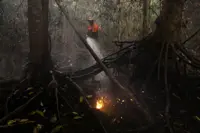
Illegal gold miners work in the territory of the Yanomani indigenous people in Brazil. Photo: Christian Braga/Greenpeace Brazil

Maria Leusa Munduruku put out a call for help on WhatsApp: "They have come to my house, a large group, they will burn everything here. Call everyone, I'm very worried," she wrote.

Her house and that of another indigenous leader were set on fire. Both are outspoken opponents of gold mining in their territory.

The fight for land in northern Brazil has been going on for a long time.

"By the 1980s at the latest, the Rio Tapajos basin, rich in mineral resources, sparked the interest of gold miners," anthropologist Luisa Molina from University Brasilia tells dpa.

A pristine way of life collided with the industrial world; indigenous people and so-called garimpeiros, or gold diggers, began to clash.

In this image provided by Amazonia Real, indigenous leader Maria (left), participates in an event to preserve the Tapajos, one of the largest Amazon tributaries. Photo: Ana Mendes/Amazonia Real/dpa

The Tapajos is one of the largest Amazon tributaries. The area is home to about 14, 000 Munduruku, 8, 000 of whom live in two territories near Jacareacanga. The south-western corner of Para, where villages don’t have a bank but dozens of shops selling and buying gold, is the main digging hub in the Brazilian Amazon region, with some 200 mines.

Garimpeiros cut swaths through the rainforest, dig several metres deep into the earth and pollute the river with mercury.

But now the destruction has taken on new dimensions – as have the threats. Just like with the Munduruku, gold diggers have also attacked members of the Yanomami and even fired at police officers.

Experts assume criminal organisations like the Primeiro Comando da Capital (PCC), one of the most powerful in Brazil, or syndicates from neighbouring Venezuela have become involved due to increased prices.

According to media reports, at least 15 people were injured in total, while indigenous people said that several people have died.

"This – together with the pandemic – is the worst moment we are experiencing since World War II," says Sonia Guajajara, head coordinator at the indigenous umbrella association ABIP.

Maria's house in Brazil's Amazon region on fire. Photo: Ministério Público Federal no Pará/dpa

Today's heavily armed attackers don't really fit the romantic idea of the quest for gold embedded in the country's collective memory.

Financially powerful entrepreneurs invest in the exploitation of indigenous territory – and the equipment is correspondingly professional. These entrepreneurs are also behind the illegal gold digging in the Munduruku’s territory – and they are sure to also include indigenous people to ensure they have access to the mines.

The entrepreneurs distribute shares to families, deliver food packages or give away motorbikes, dividing the indigenous population.

"Whenever there is an increase in gold digging, the pressure on the Munduruku also increases. This was clearly visible in past years," says Molina.

Destruction caused by illegal gold mining in the Munduruku's territory has increased by more than 360% over the last two years, while the Yanomami lost about 200ha of forest during the first quarter of 2021.

Aerial shots taken recently by Greenpeace show the immense devastation of Brazil's largest protected area for indigenous communities. Photo: Christian Braga/Greenpeace Brazil

Aerial shots recently taken by Greenpeace show the devastation of Brazil’s largest protected area for indigenous communities, measuring almost 10 million hectares in the states of Roraima and Amazon: It is now permeated by metre-deep sinkholes and gold mining camps.

The entire area is home to about 27, 000 Yanomami, but an estimated 20, 000 illegal gold diggers are also currently in their territory.

Indigenous people who show resistance, like Maria and the Munduruku Wakoborun Women's Association, live a dangerous life.

Brazil’s north is considered the country’s Wild West, a land without laws where the survival of the fittest governs. And their opponents are powerful – they have President Jair Bolsonaro on their side.

Brazil’s president supports the economic use of the Amazon region and wants to legalise gold mining in indigenous areas.

"The gold diggers now feel encouraged to confront and attack. They know they have the government on their side," says Guajajara.

And they also know they probably won't be persecuted.

Environmental agencies and supervisory bodies have been deliberately weakened, while the coronavirus pandemic further restricts the work of officials – contrary to the gold miners, who don’t work remotely.

Faced with questions about a possible solution for indigenous communities, Guajajara admits: "Honestly, I don’t know. Safety has to be guaranteed, but how?"

This is usually the task of the state, but it has withdrawn.

The Munduruku are considered one of the most martial people of the region. However, in the fight against the gold diggers, Maria and other indigenous leaders have left Fazenda Tapajos village with their families to take cover in hidden locations.

"We are not afraid," Maria tells the investigative news agency Agencia Publica. "We can't back down. It's just a matter of getting out of the way of these conflicts, because we still have a lot to do."

Ousting the gold diggers, for example. – dpa

Get 20% OFF The Star Digital Access

Monthly Plan

RM 13.90/month

RM 11.12/month

Billed as RM 11.12 for the 1st month, RM 13.90 thereafter.

Best Value

Annual Plan

RM 12.33/month

RM 9.87/month

Billed as RM 118.40 for the 1st year, RM 148 thereafter.

Follow us on our official WhatsApp channel for breaking news alerts and key updates!
indigenous groups , Amazon , gold miners ,

Next In Living

Contradictheory: When science goes to the cats and dogs
Sucker fish are hiding in manta rays' rear ends, new study reveals
Those World Cup tourists loving American food? They’re not all what they seem
Vast areas of coral reef could resist climate change: study
Heart And Soul: The measure of a man
'Jumping genes' in sloths may help scientists better understand human ageing
Martini time in Penang: 8 twists of the classic cocktail to try on the island
Scientists develop AI�to create the perfect burger
Heart And Soul: Food is the language of care
Did the milk expire? California bans 'sell by' food labels to cut food waste

Others Also Read