There are moments in life that divide everything into before and after.
For our family, that moment came in February 2023.
Just six months earlier, we had celebrated our younger son Mirza Noah Muizz’s first birthday, never imagining how quickly life could change.
Noah, as we called him, was only 19 months old when what we thought was a persistent fever changed our lives forever.
At first, we assumed it was a common viral infection.
But he became unusually pale, bruises appeared across his body, and tiny red spots spread over his skin.
As a mother, I knew something was terribly wrong.
After a series of investigations, the doctor gently told us what no parent is ever prepared to hear: “Your son has severe aplastic anaemia.”
Until that day, we had never even heard of the disease.
We soon learnt that severe aplastic anaemia is a rare bone marrow disorder in which the bone marrow stops producing the blood cells needed to survive.
Noah’s pale complexion was caused by severe anaemia, his bruising by dangerously low platelets, and even a simple fever had become life-threatening because he had almost no white blood cells to fight the infection.
ALSO READ: Aplastic anaemia causes your blood cell production to go down
Overnight, our lives changed.
The hospital became our second home.
Blood transfusions replaced birthday parties and family outings.
Every blood test brought either hope or heartbreak.
Searching for a treatment
As many parents would, I searched endlessly for answers.
I learnt that without effective treatment, up to 90% of children with severe aplastic anaemia do not survive beyond a year after diagnosis.
The first-line treatments are drugs that aim to switch off the immune system to stop it from attacking the bone marrow.
For some children, this works. For Noah, it did not.
Our next hope was a bone marrow transplant.
Unfortunately, neither Noah’s father nor his older brother were a full match.
We searched donor registries in Malaysia and overseas, hoping that somewhere, a stranger could save our son, but none were found.
In December 2023, we were referred to Universiti Malaya Medical Centre (UMMC) under the care of senior consultant paediatric oncologist Prof Dr Hany Ariffin and the paediatric bone marrow transplant team.
Looking back, that referral changed everything.
The team introduced us to a treatment we had never heard of before: a half-matched (haploidentical) stem cell transplant.
Unlike conventional transplantation, which requires a fully-matched donor, a haploidentical transplant allows a parent or sibling who is only half a match to donate.
For families like ours, who had exhausted every conventional option, it offered something we thought we had lost: hope.
Rejection before acceptance
In early 2024, Noah underwent his first haploidentical transplant, with his eight-year-old brother, Mika Naufal, as the donor.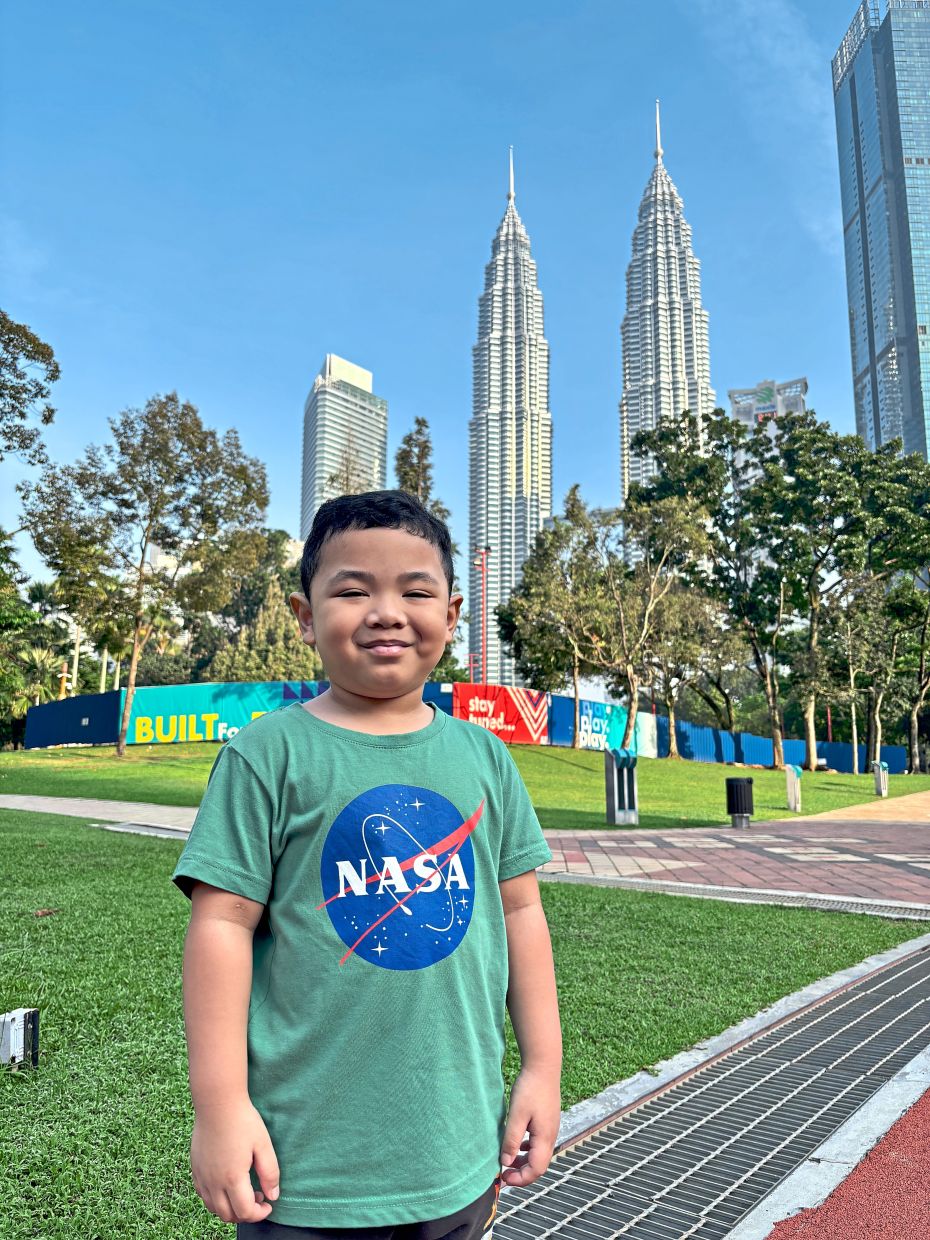
Explaining the procedure to Mika was one of the hardest conversations we have ever had.
Like any child, he was frightened.
We told him it was okay to be scared.
I will never forget his quiet reply: “I’m scared, but I’m more scared of losing Noah if I don’t help him.”
Watching one child undergo a medicalprocedure in the hope of saving another is something no parent can prepare for.
We believed this transplant would finally be our turning point.
Four weeks later, we received another devastating blow.
Noah’s body had rejected Mika’s stem cells.
Instead of giving up, the UMMC team gave us another chance.
They recommended a salvage haploidentical transplant – a highly complex procedure performed only in specialised centres.
Without hesitation, Noah’s father, Muizz Aiman, stepped forward as his second donor.
There were no guarantees, but we knew it was Noah’s best chance.
This time, the transplant was successful.
After almost three months in hospital, Noah was finally well enough to go home.
But we soon realised that a successful transplant was not the end of the journey.
Post-transplant challenges
Noah developed acute graft-versus-host disease (GVHD).
His father’s immune cells were attacking his skin, and later, his intestines, causing severe bloody diarrhoea.
At the same time, he developed cytomegalovirus (CMV) infection as his new immune system slowly rebuilt itself.
ALSO READ: What is a virus? 13 common viruses and the diseases they cause
The months that followed were filled with repeated hospital admissions, weekly visits to UMMC, blood tests, medications and constant monitoring.
His recovery became a delicate balance between controlling GVHD and treating infection.
There were moments of progress, followed by setbacks that tested our resilience.
It took almost two years before we finally felt we could breathe again.
During that time, the doctors reminded us that recovery after a bone marrow transplant is measured not in days or weeks, but in months and years.
Looking back, I now understand exactly what they meant.
A transplant is not a single procedure; it is a journey.
Today, Noah is a happy, energetic five-year-old who spends his days chasing his older brother and filling our home with laughter.
He remembers parts of his time in the hospital, reminding us of his resilience.
As parents, we remember everything, especially the times when we wondered what tomorrow would bring.
Those memories will never leave us.
Supported by so many
Looking back, I realise Noah’s journey was never ours to carry alone.
The UMMC team stood beside us through every setback and never stopped believing Noah could recover, even when we struggled to believe it ourselves.
Their expertise, dedication and compassion gave our son a second chance at life.
We are equally grateful to the countless blood donors whose generosity sustained Noah throughout his treatment.
Every donation from someone we had never met gave him something priceless: more time to fight, more time to heal, and ultimately, more time to live.
Our extended family became our anchor during the hardest days, and I was fortunate to have a workplace that showed extraordinary understanding and flexibility, allowing me to be where I was needed most – by Noah’s side.
Throughout our journey, we also came to appreciate that not every family has the same support.
Although UMMC works tirelessly to make treatment as accessible as possible, the cost of a haploidentical bone marrow transplant remains beyond the reach of many families.
We saw firsthand how charities, community organisations, corporate partners and individual donors helped make life-saving treatment possible for children who might otherwise have gone without.
My hope in sharing Noah’s story is to raise awareness of severe aplastic anaemia, highlight the life-changing impact of haploidentical bone marrow transplantation, and encourage more people to support children facing similar battles.
Whether through blood donation, helping families access treatment, or simply raising awareness, every act of kindness can help give another child the tomorrow we once prayed for.
Where we once used to pray for another tomorrow, now, every day is a tomorrow we once feared we might never have.
When I look at Noah today, I don’t just see my son; I see a miracle made possible by science, compassion and countless people who never gave up on him.
Nattasha Azami is the mother of two children. For more information, email starhealth@thestar.com.my. The information provided is for educational and communication purposes only, and should not be considered as medical advice. The Star does not give any warranty on accuracy, completeness, functionality, usefulness or other assurances as to the content appearing in this article. The Star disclaims all responsibility for any losses, damage to property or personal injury suffered directly or indirectly from reliance on such information.