
There is a simple number that can tell you at a glance, the state of a country’s healthcare system.
This statistic reflects the number of women who die due to pregnancy-related causes, and is known as the maternal mortality ratio (MMR).
Its exact definition, according to the World Health Organization (WHO), is “the number of maternal deaths during a given time period per 100,000 live births during the same time period”.
Maternal death includes all deaths from any cause related to or aggravated by pregnancy and its management, as well as during childbirth and within 42 days of the termination (whether natural or induced) of pregnancy, regardless of how long or short the pregnancy was.
The deaths of pregnant women that are the result of accidents or other non-pregnancy related causes are not included.
Some may wonder, how does the number of pregnant women dying reflect on an entire healthcare system?
After all, women are only about half the population, and not all women get pregnant.
United Nations Population Fund (UNFPA) Malaysia assistant representative Tengku Aira Tengku Razif notes that: “In general, from a developmental and progressive perspective, the more deaths that we can prevent, the better the healthcare system is.”
And the reason why the MMR is used as such an indicator is because the majority of maternal deaths are preventable, she says.
Good access to healthcare
In the modern age, pregnant women are expected to receive antenatal care as a matter of course.
Such care is expected to be provided by a qualified healthcare professional, whether a midwife, nurse or doctor, on a regular basis, and includes basic health assessments and screenings for common pregnancy-related conditions.
The availability and uptake of such care is a reflection of a population’s access to basic healthcare and their level of health knowledge, or literacy.
Malaysia has striven, quite successfully, for universal health coverage since before its formation, when its earliest independent component, the Federation of Malaya, gained Independence in 1957.
And this has been reflected in its decreasing MMR since then.
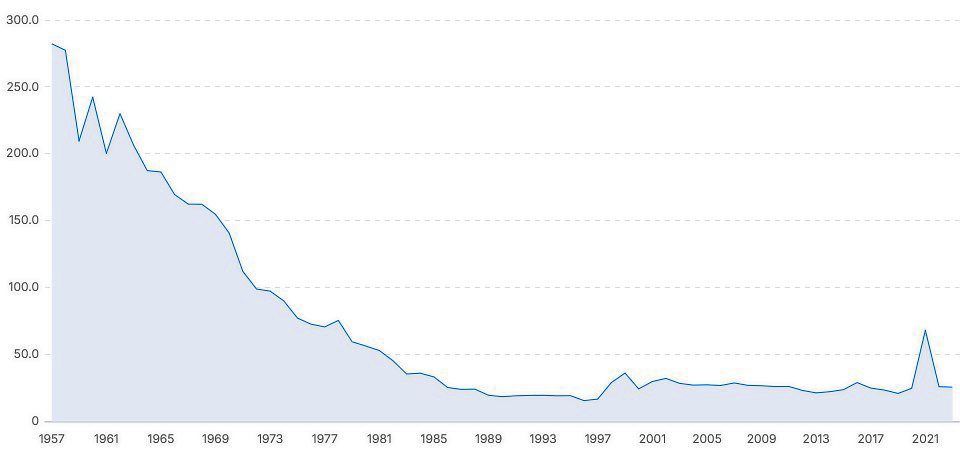
“We are quite good actually; from three digits – 282.2 – in 1957, to now, we are 25.7,” Tengku Aira points out.
She notes that we have also surpassed the UN Sustainable Development Goal (SDG) for the MMR, which is less than 70 maternal deaths per 100,000 live births by 2030.
“But, of course, if Malaysia wants to be a high-income nation, then we also have to follow the other high-income countries where it is approximately 12 maternal deaths per 100,000 live births.”
In general, she shares that Malaysian women experience at least four antenatal care appointments or visits during their pregnancy, and 99.5% of births are attended by a skilled birth attendant.
“So, access [to healthcare], based on the data, should not be an issue,” she says.
Improving healthcare quality
However, ever since our lowest MMR – 15.6 in 1996 – we have been hovering between an MMR of 20 to 30.
The exception to that was in 2021, when the MMR shot up to 68.2 due to the complications of the Covid-19 pandemic.
It came back down to 26 in 2022.
Referring to the Enhancing Human Capital Through Sexual & Reproductive Health Investments And Family Support Policies In Malaysia study, Tengku Aira notes that with the issue of access mostly having been taken care of, attention now needs to turn to potential quality issues that could be hindering the further improvement of the MMR.
“We should be able to further improve it to 25 and below, so that provides us an indication that there’s potentially quality issues.
“In the study, we actually highlighted that we should conduct further studies to specifically identify these quality issues that we need to address.”
Published in December 2022, the research was conducted by Harvard University’s TH Chan School of Public Health, reviewed by the Economic Planning Unit, and commissioned by UNFPA Malaysia.
According to the study, some of the maternal care quality issues included misdiagnoses, long waiting times, inefficient care during antenatal checks, as well as disrespectful care and lack of clear communication from healthcare providers during delivery.
The researchers also suggested using “near-miss” statistics, such as the near-miss mortality ratio, which is recommended by the WHO to gain a clearer picture of maternal healthcare quality.
A maternal near-miss is when a woman almost dies from a pregnancy-related complication.
In fact, the study notes that Malaysia was one of the first countries in the world to introduce the near-miss audit as a pilot project in 2007.
However, the findings are not yet publicly available.
The reason why compiling such statistics in Malaysia is possible, is because we are one of the few countries in the world to conduct the confidential enquiry into maternal deaths (CEMD).
This enquiry is considered the most comprehensive form of maternal audits, and only three other countries in the world do it, i.e. Egypt, Jamaica and South Africa.
Says Tengku Aira: “This is a good audit in terms of managing maternal mortality that Malaysia has taken on board since 1991.
“So, just to highlight that we have a good system in place.”
More than just pregnancy
Women are, of course, not just the vessels of our future generations.
They are active and critical participants in our society and economy, often bearing outsized burdens of caregiving, household management and work responsibilities.
Tengku Aira points out that maternal death has a multiplier effect as it impacts not just the woman, but her entire family and community.
“The death of a mother will impact how the child grows and the number of population as well.
“And beyond mortality, if we don’t take care of maternal health and they experience complications during pregnancy, there are also long-term effects, like their ability to participate in the economy and contribute to the labour force,” she says.
Expanding on the UNFPA’s aim of improving reproductive and maternal health worldwide, she adds: “Because we promote rights and choices for all, the ability to choose the life options that you want, based on the available options and technology today, means you should be informed so that you can make the best decision for yourself.
“And this includes taking care of your maternal health as well.”
She says: “At the end of the day, sexual and reproductive health, which includes maternal health, is an essential element of inclusive human capital development and human rights, and deserves national investment.
“Lifecourse sexual and reproductive health investments that result in inclusive socioeconomic well-being at the individual and collective levels start with age-appropriate comprehensive sexual education, and move to support for deliberate pregnancy and family formation, contraceptive choices, high-quality maternal health services, protection against gender-based violence, and access to screening, diagnostics and treatment for other sexual and reproductive health conditions.
“Access to sexual and reproductive health including comprehensive sexual education, family planning and access to quality maternal care, are crucial in preventing maternal deaths by addressing preventable causes like unsafe abortions, complications during pregnancy and childbirth, and inadequate healthcare access.”
Already a subscriber? Log in
Get 20% OFF The Star Digital Access
Cancel anytime. Ad-free. Unlimited access with perks.