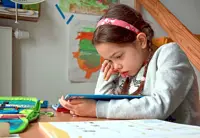
The Covid-19 pandemic has forced almost all of us to rearrange our lives.
This is especially difficult for people with autism spectrum disorder (ASD), who have a strong need for structure, predictability, and specific routines and rituals.
How are they managing?
Karoline Teufel, director of the Autism Therapy and Research Centre (ATFZ) at Frankfurt University Hospital in Germany, says the change brought about by lockdowns and physical distancing can reverse the progress made in therapy.
A condition related to brain development, autism is marked by a wide range of symptoms and severity that have therefore been grouped in a ”spectrum”.
ASD begins in early childhood and includes Asperger’s syndrome, which is generally thought to be at the mild end of the spectrum.
Common to all forms of ASD is difficulty in social interaction and communication, and a tendency towards limited, repetitive patterns of behaviour, interests or activities.
An estimated 1% to 2% of the population have ASD.
The ATFZ has an outpatient clinic for children and adolescents.
No family members of patients there were willing to share their struggles with a journalist though, not even in a brief phone interview.
Since the start of the pandemic more than a year ago, ATFZ staff have seen stress on the families grow.
“The longer the lockdown lasts, the more we realise that the loss of accustomed structures is presenting a problem,” Teufel says.
“This has led to uncertainty. Challenging modes of behaviour are increasing.”
Challenging modes of behaviour include anxiety and tension, compulsiveness, aggression, and self-harm.
Patients revert to old patterns they had already overcome with the help of therapy, or seek escape in excessive computer gaming, for instance.
“This holds potential for conflict in families,” remarks Teufel. “Previously existing challenges are intensified.”
Face masks are a problem too.
Since autistic children have trouble getting used to new things, they may find wearing one intolerable.
As a result, their parents are reproached in public more often than usual for their supposedly ill-bred children, which discourages them from leaving the house together and intensifies the children’s withdrawal.
Masks are also a hindrance in autism therapy.
The ATFZ’s 12-member staff is currently treating about 80 children and adolescents.
One of the aims of therapy is the ability to correctly interpret a person’s facial expressions, which is hardly possible when masks are worn.
In these trying times, the therapists advise family members of children or adolescents with ADS to preserve as many familiar things for them as they can, or where that’s not possible, to establish new routines, such as for meals, sleep, homework or computer games.
“Routines that regulate family interactions or daily activities have a significant stabilising and tension-reducing effect,” says an ATFZ flyer for parents.
Pandemic-related stress on ASD sufferers varies.
“People with autism are just as diverse as people without autism,” notes Teufel, but adds that some parents worry their autistic children won’t be able to make up for lost ground when the lockdown is over.
“On the other hand, many (of the children) are now surpassing themselves.”
ASD sufferers have an advantage over others in a few respects during the pandemic, she points out.
Since many find social contact taxing, the restrictions on them are often less of a problem.
And people with Asperger’s syndrome obey rules easily, she says, “which is definitely a strength now”. – By Sandra Trauner/dpa
Already a subscriber? Log in
Get 20% OFF The Star Digital Access
Cancel anytime. Ad-free. Unlimited access with perks.