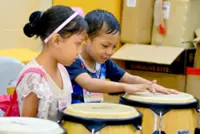
I walked into a class of four-year-olds doing papier-mache work. Some were cutting and tearing up newspaper while others were pasting strips of it on the bowl using homemade glue. A little girl walked by with a brush and pan, sweeping stray pieces of paper off the floor.
Children aged between two and six years are active but notorious for having a short attention span. They are always looking for something to do.
Have a little discussion with your preschooler before starting any activity with him. Children have lots of ideas. Try listening to them. It becomes more meaningful when both adult and child share ideas. Rather than sitting them down to a “lesson”, teach them – in clear, simple terms – the concepts of colour, size and shape.
Here are some pointers:
Cutting with scissors
Some children may place their thumb and index finger – instead of their thumb and middle finger – in the rings. This incorrect way of holding the scissors often goes unnoticed and the child will have difficulty balancing the pair of scissors in his hand.
Many so-called children’s scissors are poorly constructed with blades that don’t fit together. So, parents, try using them first. Always look for children’s scissors that have blunt tips but that can cut properly.
Easy ways of cutting
Give your child small squares of paper and teach him to snip all around the edges to make a fringe effect. When he is still learning to cut, try holding the paper for him. Allow him to hold the paper and cut by himself when he has better control of the tool.
As your child becomes more comfortable with the action, teach him to make confetti. After he has mastered cutting fringes and making confetti, he can start to cut larger but simple shapes.
Use paper with different textures and weights. Your child needs the experience of all kinds of paper to master the skill of cutting.
Learning to colour
Children will take crayons or markers to scribble all over the paper. It is excellent for imagination and creativity. When they are in their preschool years, they love to colour and not worry about keeping the colours within the lines. Show them the difference between applying more or less pressure on the paper.
Also, demonstrate the way to make large and small strokes by using both the crayon tip and its side.
After much practice with the scribbling, take a colouring book of large, simple shapes and cut out one item at a time for him to colour. Getting a beginner to work on a whole page can be intimidating. Try selecting pictures with bold thick lines so that when mistakes are made, they aren’t so obvious.
Avoid commenting on your child’s work but rather, pay attention to his enjoyment. Let him tell you what he thinks of his work.
Learning to paste
Children aged two to six years are developing fine motor skills, like putting small objects together. They are fascinated by small objects. Use a glue stick for the first pasting project.
Show your child how to place the glue on the paper before placing a cutting on it. The first few attempts with the glue stick can be quite messy. So have a wet cloth handy.
Do not push him to complete if he decides to stop. Also, avoid doing it for your child to make the picture look good. It is the process that children find interesting.
Other things children may enjoy creating are mosaics and collages.
There are so many possibilities when your child can cut, colour and paste.
Ruth Liew is a child developmentalist, Montessori teacher trainer, children’s rights advocate and a mother of two teenagers.
Already a subscriber? Log in
The Star Festive Promo: Get 35% OFF Digital Access
Cancel anytime. Ad-free. Unlimited access with perks.